



 33 / 70

A D V A N C E D
M A T E R I A L S
&
P R O C E S S E S | J U L Y / A U G U S T
2 0 1 5
3 3
MINIMILL CONSOLIDATION
After 2000, a few corporations be-
gan to grow by acquisitions. Many pri-
vately held mills could not compete for
recycled steel and for markets where
they were still producing only small
bars and shapes. This trend was led by
Nucor when they purchased Birming-
ham Steel in 2002, acquiring minimills
in Alabama, Mississippi, Illinois, and
Washington. Nucor then purchased the
Kingman, Ariz., rod and wire mill from
North Star in 2004. Later, the compa-
ny acquired Harris Steel in Canada for
$1 billion and David J. Joseph, a major
recycler of feedstock for minimills, for
$1.4 billion. It was now vital for bigger
minimill companies to enter the recy-
cling industry to ensure scrap supply.
Nucor bought a cold rolling plant locat-
ed in Sparrow’s Point, Md., which was
part of the now bankrupt Bethlehem
Steel Co. The company’s latest acquisi-
tion is the Gallatin Steel minimill located
in Kentucky, bought for $770million. Nu-
cor’s production capacity now reached
28 million tons per year, slightly exceed-
ing that of U.S. Steel. They are not only
the biggest minimill at 50% of the mar-
ket, but the largest steel company with
25% of all steelmaking in the U.S.
In 1999, a new company came on
the scene and began buying minimills—
Gerdau, a name unfamiliar to the Amer-
ican public. Gerdau is from Brazil and
has holdings of both minimills and in-
tegrated mills in South America, Central
America, and Mexico. Its first purchase
was Florida Steel, a minimill making
concrete reinforcing rods with four
plants in Florida, Tennessee, and North
Carolina. Gerdau then bought four mills
from North Star in 2004. Over the next
decade, the company acquired 10 more
minimills for a total of 18 in 12 states
and Canada. Most of these were old-
er ones that produce bars and shapes.
Gerdau’s most important acquisition
was Chaparral Steel Co., the minimill
built by Gerald Heffernan. Chaparral en-
abled Gerdau to enter the wide-flanged
beam and rail markets. Without build-
ing a single facility, Gerdau became the
third largest minimill producer in the
U.S. In addition, with its global hold-
ings, Gerdau now approaches Nucor in
production capacity and sales.
Steel Dynamics bought Roanoke
Electric Steel Corp. in 2006, its first ac-
quisition, which included Steel of West
Virginia. The company also bought into
the manufactured beam market, acquir-
ing New Millennium Building Systems.
SDI’s strategy followed that of Nucor—
having an in-housemarket for long prod-
ucts. SDI made its biggest acquisition in
2014 when it purchased all the assets of
a large sheet product mill in Columbus,
Miss., for $1.63 billion. This minimill was
built in 2007 by Severstal, a Russian com-
pany, and featured the latest technology
and capacity of 3.3 tons per year. SDI’s
production capacity in sheet, structural
beams, rail, and long products is now
11 million ton per year, making it the
second largest minimill company in the
U.S. This was accomplished just 18 years
since the opening of its first minimill.
North Star, the original leader with
the first U.S. minimill, was still second
in production in 1997 with capacity of
5 million tons per year. The company
upgraded its mills, added new ones,
and entered the flat steel product mar-
kets. During the early 2000s, Cargill
(owner of North Star) decided to leave
the steel industry except for the flat
product mill in Ohio they owned jointly
with Bluestone (formerly BHP) of Aus-
tralia. North Star sold its newest mill in
Kingman, Ariz., to Nucor and four of its
other mills to Gerdau. North Star is now
a minor player in the minimill industry.
NEW PROCESSES FOR
MAKING IRON
Availability of recycled steel for the
minimills was a critical problem due to
rapid industry growth after 1995. The
price for high-grade scrap had increased
from$30 per ton in 1970 to $125 in 1995,
reaching $150 by 2005. Big producers,
especially Nucor and Steel Dynamics,
responded by buying national recycling
companies to ensure supply, but they
had no control over price, which was set
by the global market. Next, iron units
were sought for electric arc furnaces,
to use new processes that convert iron
ore by direct reduction, i.e., removing
oxygen without adding carbon. Other
elements in the ore are then eliminated
by using slags. Steel Dynamics installed
a plant to make iron as a feedstock in
its Butler, Ind., plant. The latest devel-
opment is a direct reduction plant in
Louisiana, built by Nucor. The compa-
ny plans to build a second plant in the
near future and eventually add a blast
furnace, coke ovens, and a basic oxygen
converter to make steel. If these plans
materialize, Nucor will move closer to
the integrated mills of its competitors.
REVOLUTION IN STEELMAKING
The introduction of flat products,
flanged beams, and railroad rails along
with consolidation of the industry into
large corporations completed a revolu-
tion in steelmaking in the U.S., albeit a
quiet one that occurred in small towns
and rural areas out of sight of the general
public. There isnoPittsburghofminimills,
and this revolution came at the expense
of the large integrated steel mills—as
most disappeared with their best assets
bought by U.S. Steel or ArcelorMittal.
For more information:
Charles R. Simcoe
can be reached at
crsimcoe1@gmail.com.
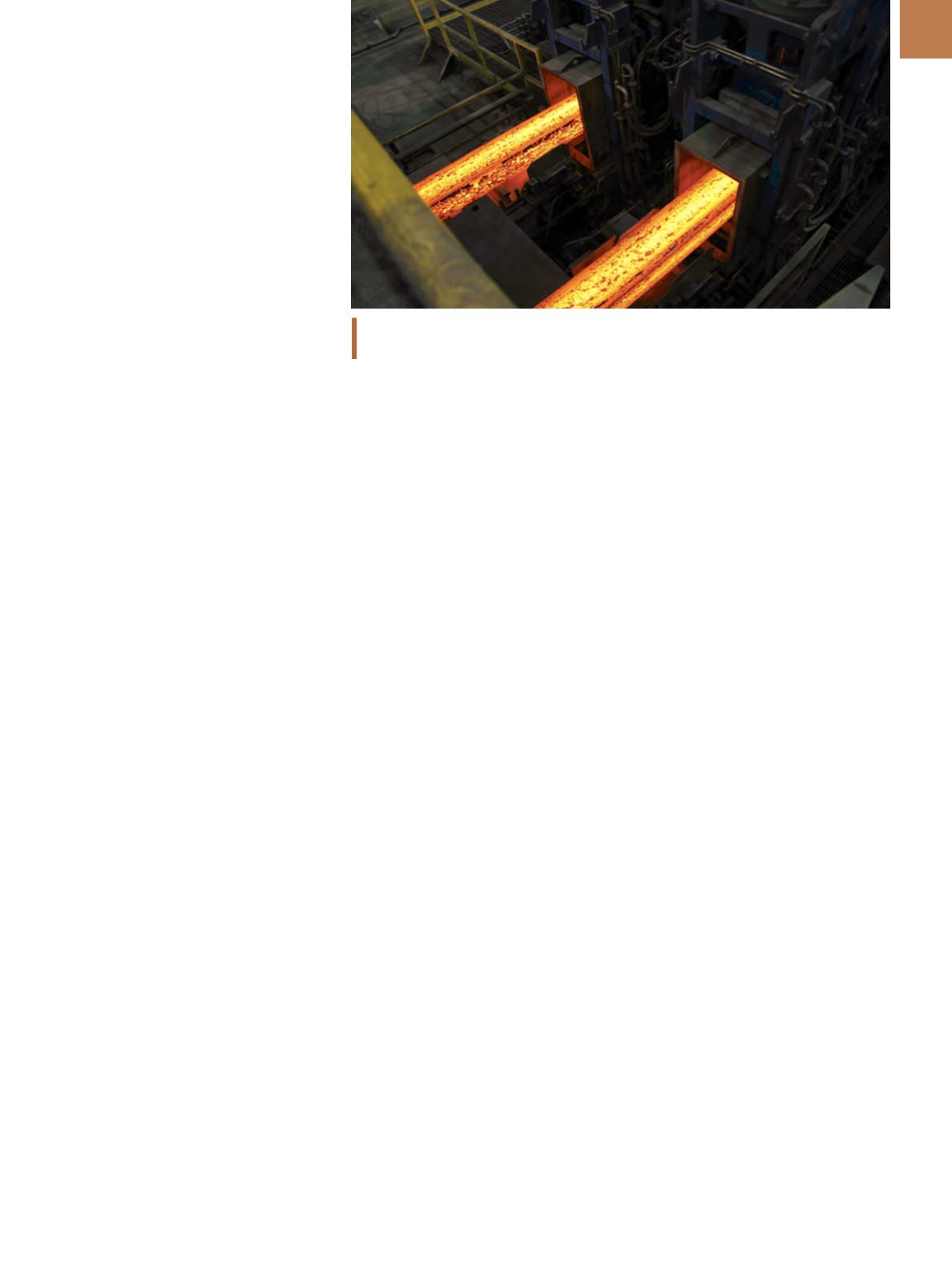
The ability to make large flanged beams was a newmarket for the minimills. Courtesy of
steeldynamics.com.