



 32 / 70

A D V A N C E D M A T E R I A L S & P R O C E S S E S | J U L Y / A U G U S T 2 0 1 5
3 2
METALLURGY LANE
Metallurgy Lane, authored by ASM life member Charles R. Simcoe, is a continuing series dedicated to the early history of the U.S.
metals and materials industries along with key milestones and developments.
STEEL MINIMILLS: PART II
FROM 1988 TO 2008, THE MINIMILL INDUSTRY ADDED 25 MILLION TONS
ANNUAL CAPACITY———25%OF THE TOTAL U.S. STEEL MARKET.
D
uring the 20 years between 1988
and 2008, the minimill industry
added 25 million tons annual ca-
pacity. Competition for raw materials
and markets eventually led to industry
consolidation that resulted in just three
major domestic minimill producers.
INDUSTRY GROWTH
Nucor named Daniel DiMicco as its
new CEO in 2000, a role he took on after
working in several company positions
since 1982. DiMicco continued the mo-
mentum that had been established by
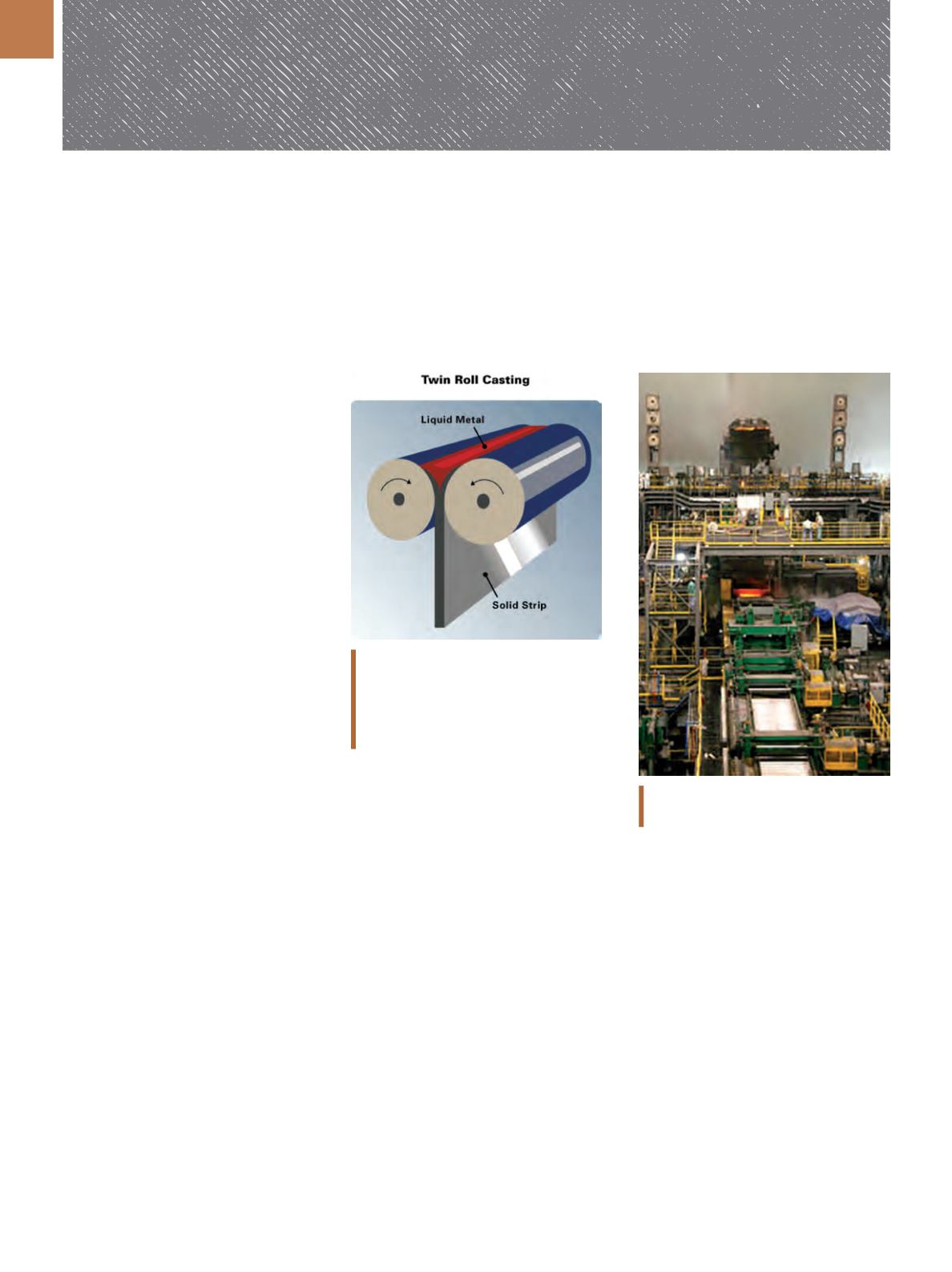
F. Kenneth Iverson. Nucor built a new
continuous casting machine at their
Crawfordsville, Ind., plant to produce
what they call
Castrip.
Molten metal
enters between two counter-rotating
rolls where it solidifies into a thin sheet.
This sheet can be hot rolled with fewer
passes than a long stand of rolls, saving
on energy, space, and time to produce
a finished product. The Castrip con-
cept was adopted at the Nucor plant to
manufacture wide-flanged structural
beams and railroad rails. The contin-
uous casting machines were rebuilt to
cast a beam or rail near finished size.
This new shape, called
near-net shape,
could then be rolled to finished size
without the long train of rolls. The en-
tire minimill industry had to follow Nu-
cor’s lead in this new technology to be
competitive, and the large integrated
steel mills were faced with yet another
problem in maintaining sales in their
best markets.
By 1977, North Star Steel Co. had
become the second largest minimill
producer in the U.S. The company
moved beyond St. Paul, Minn., buying a
mill inWilton, Iowa, that went onstream
in 1974 with a capacity of 150,000 tons
per year and building a minimill in
1977 in Duluth, Minn., to make parts
for grinding mills at iron mines. In 1980,
North Star built a minimill in Monroe,
Mich., to manufacture higher quality
steel bars for the automotive industry.
The company purchased a mill in Beau-
mont, Texas, in 1983 with a 500,000 ton
capacity to make rod and wire prod-
ucts, and bought a minimill from Hunt
Steel Co. in Youngstown, Ohio, in 1985.
North Star increased capacity of the
original St. Paul plant to 650,000 tons
in 1993. In 1996, the company built a
minimill in Kingman, Ariz., with 500,000
tons of capacity to make rod and wire
for the West Coast market. North Star
entered the flat products market in
1996 by partnering with BHP Steel, an
Australian company. This plant, located
Twin roll casting uses two copper
water-cooled, counter-rotating rolls. The
Castrip process produces a thin strip
that requires minimal rolling to achieve
finished size. Courtesy of
castrip.com.
Nucor’s Castrip line in Arkansas. Courtesy
of
castrip.com.
in Northwest Ohio, had capacity of
1.5 million tons per year. North Star
now had an annual steel capacity of
5 million tons per year.
In 1993, several executives at Nu-
cor left the company to start their own
minimill company, Steel Dynamics Inc.
(SDI). Headquartered in Fort Wayne,
Ind., the company built its first minimill
in Butler, Ind., to produce flat products,
coming onstream in 1996. SDI entered
the wide flange and railroad rail mar-
kets with a minimill in Columbia City,
Ind., at a cost of $315 million. Welding
facilities were installed at this plant to
join rail steel into lengths up to 1600
feet—a major advantage over the other
rail mills.