


 30 / 70

A D V A N C E D M A T E R I A L S & P R O C E S S E S | J U L Y / A U G U S T 2 0 1 5
3 0
AWESOME AUXETIC FOAM
BOOSTS COMFORT OF
ATHLETIC GEAR
Whether it’s in a football helmet,
hospital bed, knee pad, or body armor,
foam plays a critical role in making
products both comfortable and safe.
But can that foam be transformed into
something significantly better, safer,
and
more
comfortable? Changchun
“Chad” Zeng with Florida State Uni-
versity’s High Performance Materials
Institute, Tallahassee, says yes, and
his brand new, high-performing auxet-
ic foam is proving the point as it heads
to the marketplace through a license
agreement with Auxadyne LLC.
“We knowwhat is not workingwith
current products and technology, and
what it is going to take to make it bet-
ter,” says Zeng. “For example, the socks
that amputees currently use to attach
prosthetic devices do not adjust to limb
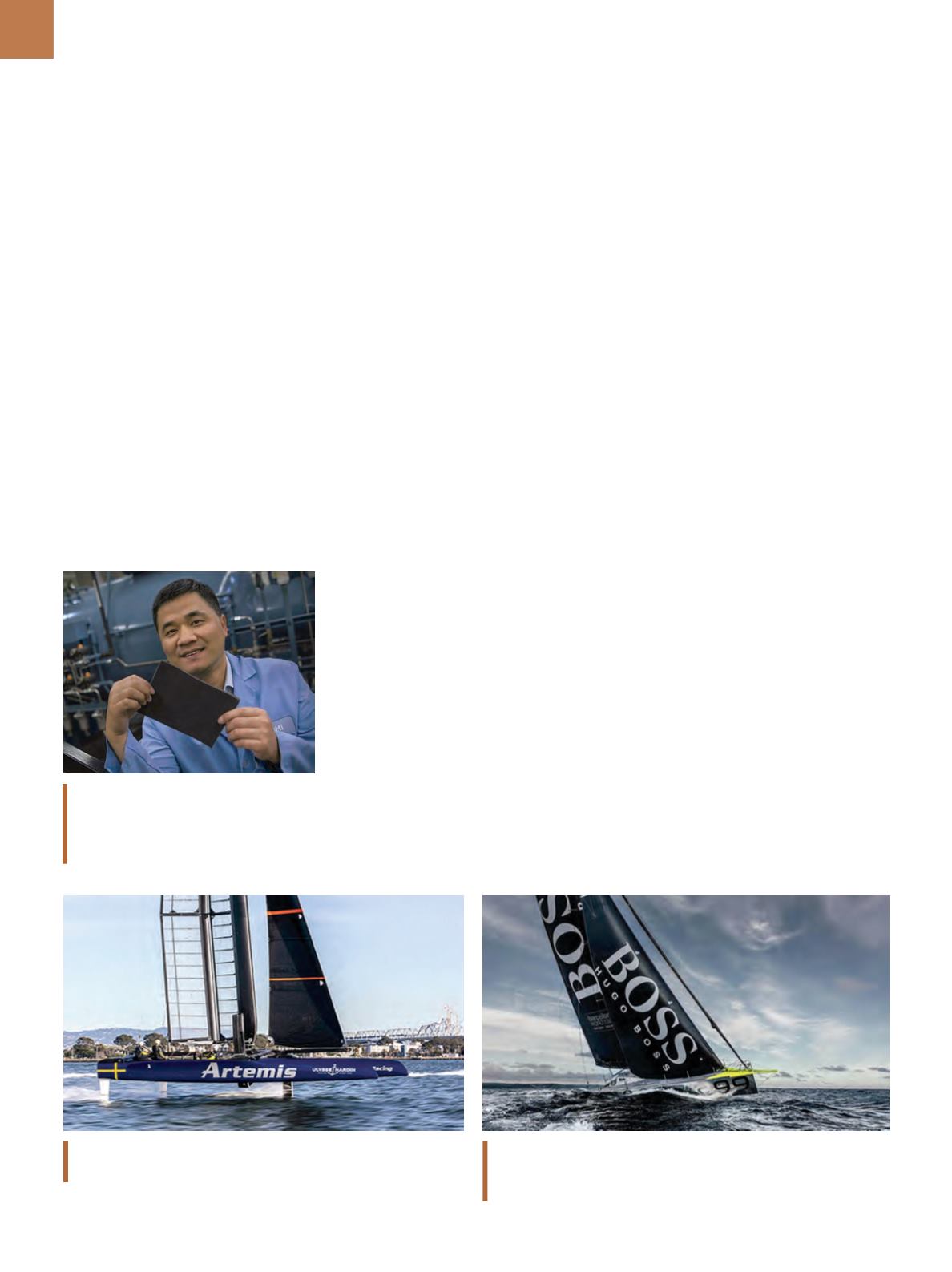
Chad Zeng developed a unique foam that
can be used to make better football hel-
mets andmore comfortable prosthetics.
Courtesy of Florida State University.
Accurate prediction of composite behavior is critical when designing
a sailboat for elite competition. Courtesy of Artemis Racing.
By incorporating new graphene-enhancedmaterials in future boat
designs, ATR is seeking to keep vessels light to ensure optimum
speed without compromising strength. Courtesy of ATR.
shape and volume, creating problems.
My invention solves those issues.”
Part of what makes Zeng’s aux-
etic foam truly unique is its ability to
get thicker, rather than thinner, when
stretched. In practical terms, this coun-
terintuitive behavior—totally opposite
that of conventional foam—leads to
many enhanced materials properties
including a better and more comfort-
able fit that adjusts on the fly. The
sports equipment industry in particular
could take advantage of the new foam
technology to improve impact absorp-
tion and overall comfort of various pro-
tective gear that athletes must wear,
says Zeng.
For more information: Chang-
chun Zeng, 850.410.6273,
zeng@eng.fsu. edu,
www.fsu.edu.COMPOSITES SOFTWARE
SUPPORTS SMOOTH SAILING
Artemis Racing, Alameda, Calif.,
chose Altair Engineering Inc., Troy,
Mich., to serve as a technical suppli-
er in its bid to win the 35th America’s
Cup in 2017. Areas of focus for this new
era of wingsail foiling catamaran de-
sign include composites development,
aerodynamics simulation, structural
optimization, and fluid-structure inter-
action. Altair OptiStruct composite op-
timization technology helps companies
efficiently design composite structures
and has been used for more than 20
years in multiple industries.
The foils and rigid wings greatly
improve the speed, stability, and ma-
neuverability of racing yachts. Rigid
wingsails provide more lift than tradi-
tional soft sails as well as a better lift-
to-drag ratio. Composite materials are
used extensively for yacht construction
due to their lightweight properties,
stiffness, and strength. America’s Cup
yachts are built primarily using lami-
nated honeycomb sandwich structures,
which are efficient load carriers.
Optimization of hulls, structures,
appendages, sail sets, and other ele-
ments is performed using specialized
design software. In parallel, the team
may interact with a virtual product pro-
totype to refine hull shape and overall
design proportions to improve perfor-
mance. This type of analysis can pro-
vide a significant competitive advan-
tage.
artemisracing.com,
altair.com.YACHT RACING TEAM SETS
SAIL WITH GRAPHENE
NANOPLATELETS
Haydale Ltd., UK, signed a collab-
orative agreement with Alex Thomson
Racing (ATR)—the Hugo Boss spon-
sored extreme sailing team. Alex Thom-
son is the youngest yachtsman to ever
win a round-the-world race. When he
won the Clipper Round the World Race
in 1998/99, he set a record he still holds
to this day.
Haydale developed a patent-pend-
ing, proprietary scalable plasma process
to modify the surface of graphene and
other nanomaterials. Surfaces are mod-
ified through a low-pressure plasma
process that treats both mined, organ-
ic fine powder, and other synthetically