


 29 / 70

A D V A N C E D
M A T E R I A L S
&
P R O C E S S E S | J U L Y / A U G U S T
2 0 1 5
2 9
Institute of Standards and Technology
(NIST) to launch Head Health Chal-
lenge III, an open innovation competi-
tion to advance materials that better
absorb or dissipate energy. Winners
will be announced in September. It
is hoped that these new materials
will improve performance of protec-
tive equipment for athletes, military
personnel, and those in dangerous
occupations.
The challenge, which will award
up to $2 million for innovative mate-
rials, is part of the $60 million Head
Health Initiative, a multiyear collabora-
tion between GE and the NFL. Launched
in March 2013, the initiative includes a
four-year, $40 million research and de-
velopment program from GE and the
NFL to develop next generation imag-
ing technologies to improve diagnosis
of mild traumatic brain injury. The ini-
tiative also includes $20 million open
innovation challenges to address better
ways to improve diagnosis, prognosis,
and protection from brain injury.
Head Health Challenge III aims to
support the discovery, design, and de-
ployment of advanced materials that
can protect people from brain injuries
by better absorbing and mitigating
force. Additionally, NIST will work to
refine measurement approaches, con-
vene the research and industry commu-
nities to assess the state of performance
testing for impact energy absorbing/
dispersing materials, and identify gaps
in these measurements. The ultimate
goal will be to develop standard testing
methods for these materials systems
over the next several years.
Entries will be judged by leading
experts in the field of materials science
who will select six winners to receive a
$250,000 award each to advance their
work in developing technologies that
can help prevent mild traumatic brain
injury. The judging panel includes three
longstanding ASM members, Alton
Romig, FASM, Tresa Pollock, FASM, and
Alan Taub. One overall winner will be
selected from the six and will receive
an additional $500,000 to further devel-
op their innovation. Previously, Head
Health Challenge I focused on discov-
ering imaging and algorithms that will
be able to better detect and analyze
subtle changes in the brain. Challenge II
focused on new materials and technol-
ogies that can protect the brain from
traumatic brain injury and new tools
for tracking head impacts in real time.
headhealthchallenge.com.SHE(FFIELD) SELLS SEASHELLS
BY THE SEASHORE, FOR
SPORTS SAFETY
The Australian Cricket Board inqui-
ry into the 2014 death of cricketer Phil-
lip Hughes, two days after he was struck
on the neck where his helmet offered
no protection, could result in newly-
designed safety helmets being made
mandatory. SheffieldHallamUniversity,
UK, is working to develop improvedma-
terials for impact protection in sports.
The materials have the fascinating and
unusual auxetic property that can be
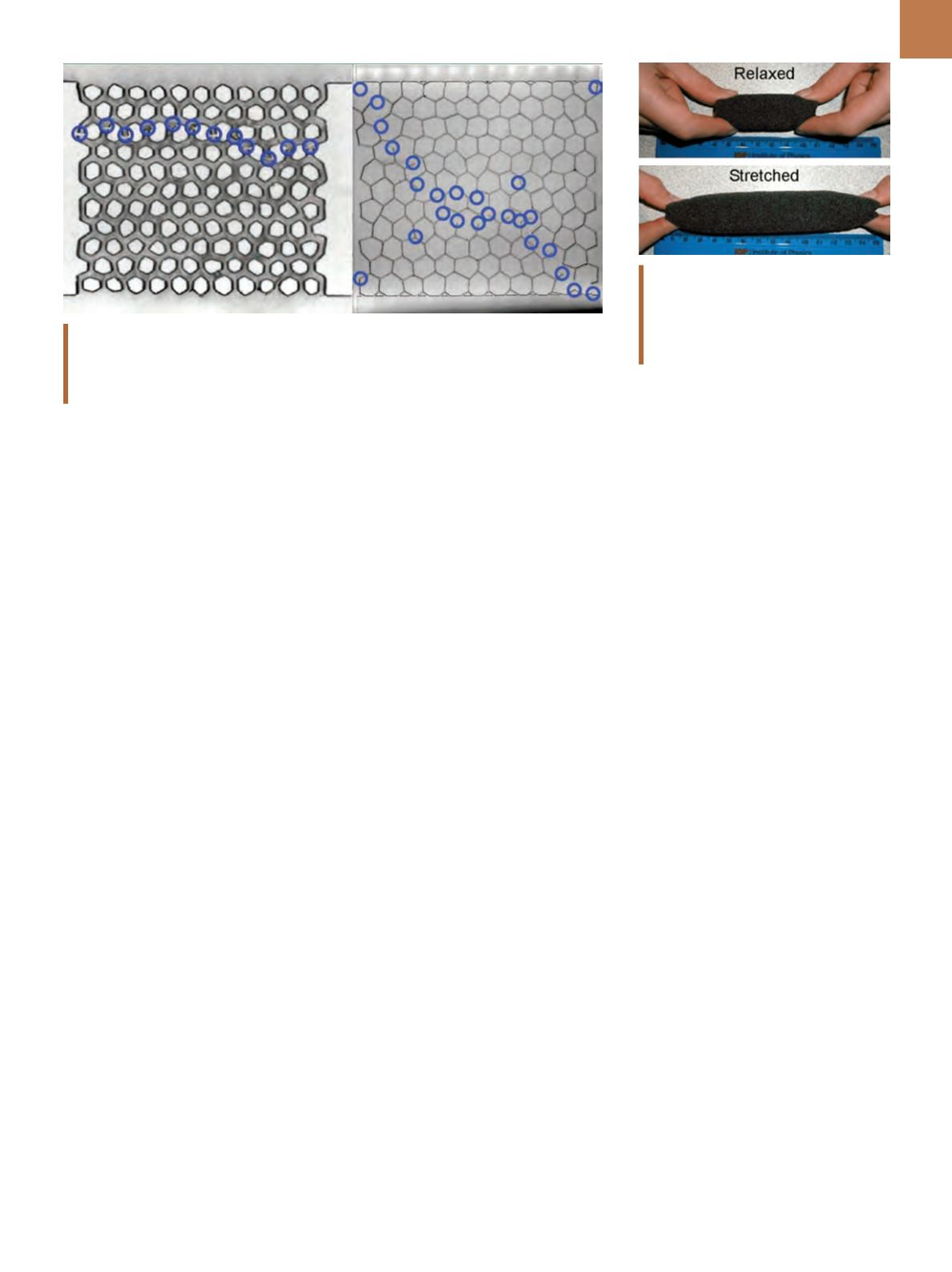
By fine-tuning the thickness of the connecting spokes in a sheet of acrylic, scientists change
how it transmits force when fractured. With thick spokes (left), fractures propagate in a
straight line and concentrate the impact. Thin spokes (right) divert the fracture across the
sheet, diffusing the impact. Courtesy of Center for Hierarchical Materials Design.
used in helmets, pads, guards, gloves,
mats, and barriers. Instead of becom-
ing thinner when stretched, an auxetic
material actually gets fatter. When com-
pressed, the material becomes thinner.
At first glance this fascinating property
of auxetic materials may appear highly
unusual, but is actually being discov-
ered to be a key feature of a growing
number of natural materials. Examples
include certain forms of skin and other
soft biomaterials, and inorganic sili-
cates such as quartz and cristobalite.
Inspiration for the current work
on auxetic materials comes from the
ultimate natural armor protection
system—seashells. The inner layer of
the two-tier armor protection system
found in seashells—nacre, also known
as mother of pearl—provides high stiff-
ness, strength, and toughness. This ex-
ceptional combination of properties en-
ables the seashell to avoid catastrophic
failure and maintains shell integrity in
the event that the hard and brittle outer
layer becomes cracked. Nacre is also an
auxetic material.
Unlike conventional materials that
adopt a saddle shape when bent out of
plane, an auxetic material naturally
adopts a convex dome curvature simi-
lar to the overall shape of the seashell.
This characteristic dome-like double
curvature for auxetic materials is ideal
for sports protective equipment such
as helmets and shoulder or elbow pads
to ensure a close fit of the equipment
to the body for maximum comfort and
performance.
www.shu.ac.uk.Auxetic foams covered by a rigid outer
shell display an average of six times the
reduction in peak acceleration under the
impact typical of many sporting applica-
tions. Courtesy of Andy Alderson.