



 20 / 54

• Successive layers follow the same principle and build
up the part layer-by-layer.
Table 2 provides a comparison of capabilities, benefits,
and limitations of various AM technologies used for pro-
ducing titanium parts
[3-6]
.
Titanium AM applications
Extensive exploration regarding use of AM titanium
parts in aerospace and medical applications is underway.
Other potential AM applications include the chemical and
defense industries. While powder bed fusion technologies
are suitable for smaller, complex geometries with hollow
unsupported passages/structures, directed energy deposi-
tion is better suited for larger parts with coarser features
requiring higher deposition rates.
Use of finer powder grains combined with smaller
laser/electron beam size achieves a superior surface fin-
ish on the as-built parts from the powder bed fusion
technologies compared to directed energy deposition
technologies. However, the majority of AM parts require
finish machining for most applications. Beyond building
new parts, the ability of directed energy technologies to
add metal onto existing parts makes it possible to apply
protective surface coatings, remanufacture and repair
damaged parts, and reconfigure or add features to exist-
ing parts.
Complex geometry
A small beam size and small layer thickness, along
with support of the powder bed, allow powder bed fu-
sion technologies (such as EBM, DMLS, or SLS) to
ADVANCED MATERIALS & PROCESSES •
FEBRUARY 2014
20
TABLE 2 — COMPARISON OF VARIOUS ADDITIVE MANUFACTURING TECHNOLOGIES
Item/Process
Laser-based PBF
Electron beam-based
Laser-based directed energy
(DMLS)
PBF (EBM)
deposition (DMD)
Build envelope
Limited
Limited
Large and flexible
Beam size
Small, 0.1-0.5 mm
Small, 0.2-1 mm
Large, can vary from 2-4 mm
Layer thickness
Small, 50-100
m
m
Small, 100
m
m
Large, 500-1000
m
m
Build rate
Low, cc/h
Low, 55-80 cc/h
High, 16-320 cc/h
Surface finish
Very good, Ra 9/12
m
m,
Good, Ra 25/35
m
m
Coarse, Ra 20-50
m
m,
Rz 35/40
m
m
Rz 150-300
m
m, depends on
beam size.
Residual stress
High
Minimal
High
Heat treatment
Stress relief required,
Stress relief not required,
Stress relief required,
HIP’ing preferred.
HIP’ing may or may not be
HIP’ing preferred.
performed.
Chemistry
ELI grade possible, negligible
ELI grade possible, loss of
ELI grade possible, negligible
loss of elements.
Al needs to be compensated loss of elements.
for in powder chemistry.
Build capability
Complex geometry possible
Complex geometry possible Relatively simple geometry
with very high resolution.
with good resolution.
with less resolution. Limited
Capable of building hollow
Capable of building hollow
capability for hollow
channels.
channels.
channels.
Repair/Remanufacture
Possible only in limited
Not possible
Possible; capable of adding
applications (requires
metal on 3D surfaces under
horizontal plane to begin
5+1-axis configuration, making
remanufacturing).
repair solutions attractive.
Feature/metal addition on Not possible
Not possible
Possible; depending on
existing parts
dimensions, ID cladding is
also possible.
Multi-material build or
Not possible
Not possible
Possible
hard coating
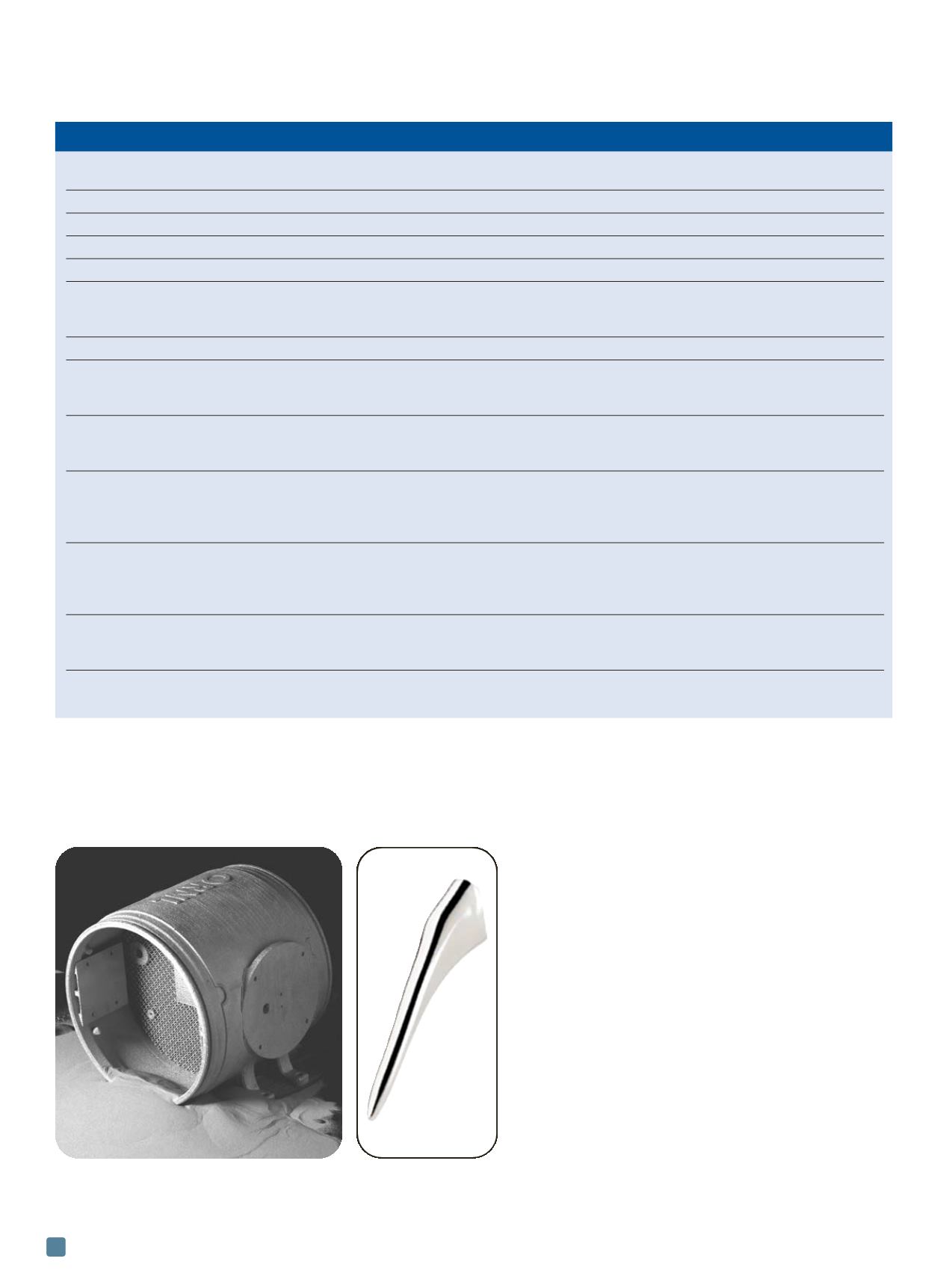
Fig. 3 —
Hydraulic manifold built using EBM
technology. The part was built at Oak Ridge
National Laboratory (ORNL). Courtesy of ORNL.
Fig. 4 —
Medical
implant application.
Courtesy of Jim Sears.