



 24 / 54

ADVANCED MATERIALS & PROCESSES •
FEBRUARY 2014
24
A
ll iron, except for
occasional mete-
orites, is tied up in
compound form. There-
fore, its discovery must
have been fortuitous as hu-
mans built fires and
placed stones within the
fire pits to maintain heat.
People learned that iron could
be reduced from iron-rich
stones at high temperatures in an
atmosphere of burning wood. This
type of iron was not melted, but
was formed in a solid state as
stone was slagged off, leaving a
mass of iron particles at the bot-
tom of the pit. The iron was essen-
tially carbon-free because
it never reached a tem-
perature in which carbon
could be dissolved. As is
widely known, carbon is
the element in iron that
produces steel, which can then be heat treated to
achieve higher strength levels. Iron particles can
also be consolidated by hammering hot or cold, as
is done with particles of gold, silver, and copper.
As time went on, special fire pits were built to
increase the amount of iron that could be pro-
duced. Bellows were used to raise the temperature
by blowing air into the fire. With further refine-
ment, this process was used for many centuries to
produce what we call “wrought iron.” During the
thousands of years that humans have used iron,
wrought iron has been the dominant form, as it
could be worked hot or cold to produce weapons,
armor, knives, and many items for everyday life.
Evolution of wrought iron
By the Middle Ages, blowing engines and
larger furnaces increased temperatures until the
iron melted. The molten iron dissolved the car-
bon from the fuel until it reached 3-4% of the iron.
When this iron cooled, it was brittle and could not
be worked either hot or cold and could only be
cast into molds that formed the shape of the fin-
ished article. This “cast iron” could be used for
cannons, cannon balls, utensils, and eventually
stoves, lamp posts, and other products, yet it
could not replace wrought iron.
Demand for wrought iron greatly increased
with the advent of the Industrial Revolution. At the
same time, a new process called “puddling” was de-
veloped in England during the late 18th century by
Henry Cort and others. The puddling process was
carried out in a reverberatory furnace, in which the
fire is separate from the “charge,” which was cast
iron from the blast furnace rather than iron ore.
Heat and gases from the fire passed over the cast
iron, both melting it and removing the carbon. Cast
iron melts at roughly 2100°F and is dissolved into
the slag. As carbon is removed, the melting point of
the carbon-free iron increases to 2800°F, higher
than the furnace temperature. The iron then pre-
cipitates as solid particles that fall through the slag
and onto the hearth as a mixture of iron and slag.
This mixture is then agitated with a paddle to form
a semisolid ball, which is handled as ordinary
wrought iron and made in batches of approxi-
mately 500-600 lb.
In the first half of the 19th century, iron produc-
tion increased rapidly, from about 50,000 tons at the
beginning to more than 500,000 tons by 1850 with
primary demand from the railroads. Railroading
started in the U.S. in 1830 with roughly 10 miles of
track outside of Charleston, S.C., and somewhat
more laid by the Baltimore and Ohio Company. By
1840, 3000 miles of track had been constructed. By
1850, 9000 miles were complete. During the 1850s,
Metallurgy Lane is a
new series authored by
ASM life member
Charles R. Simcoe,
developed to share the
early history of the U.S.
metals and materials
industries along with key
milestones and
developments. Simcoe,
a World War II veteran,
holds a degree in
metallurgical engineering
from Purdue University
and spent his career in
physical metallurgy R&D
at Westinghouse Atomic
Power Division, Battelle
Memorial Institute,
Armour Research
Foundation,
and Simonds Steel Co.
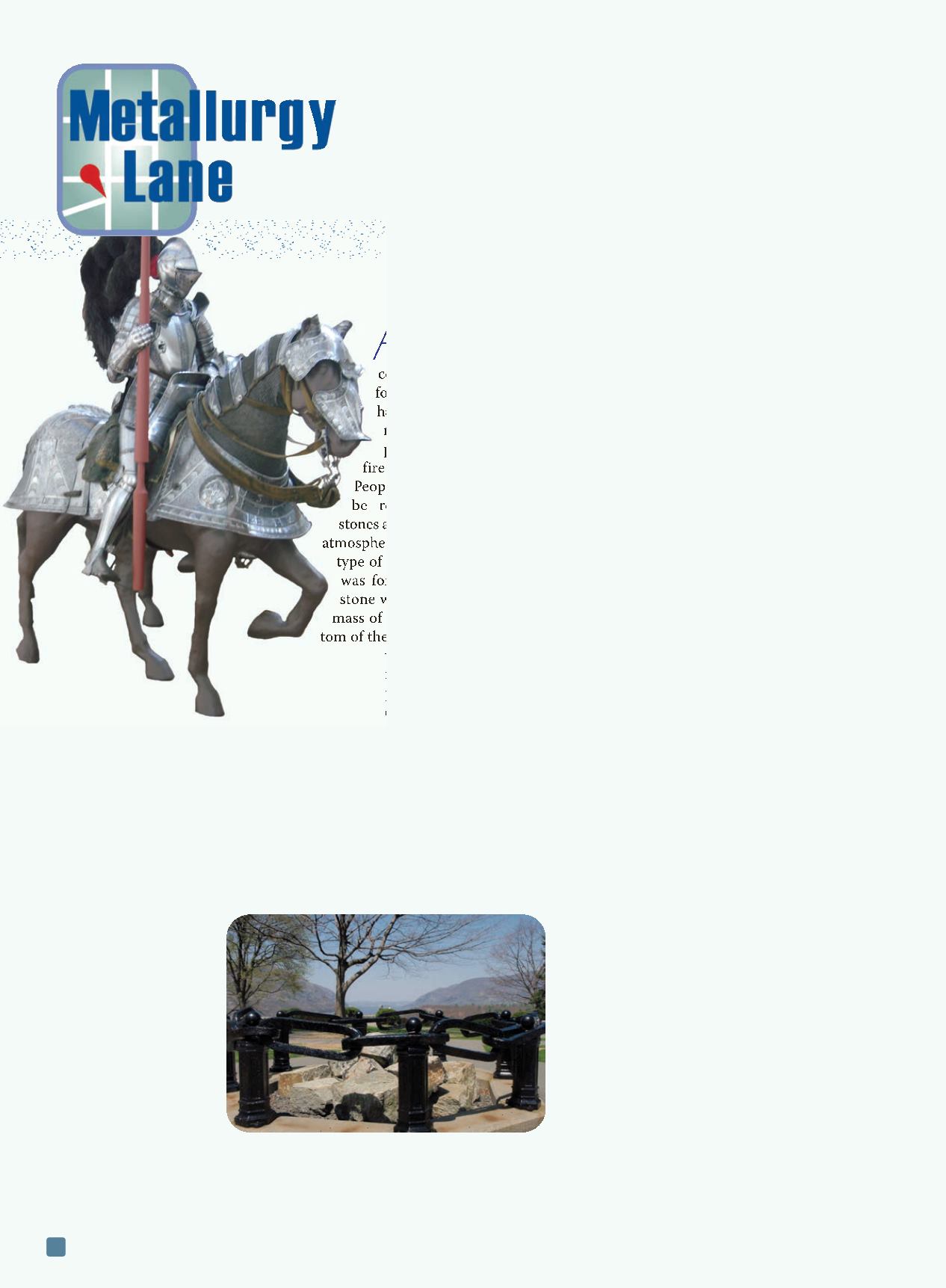
The Hudson River Chain was used during the Revolu-
tionary War to prevent British naval vessels from sailing
upriver. The Great Chain, shown here, was constructed
in 1778 with 750-lb links forged in Orange County, N.Y.
Courtesy of Wikimedia Commons.
Wrought Iron: A Metal for the Ages
Early humans had no knowledge of iron. Unlike gold, silver, and copper, iron does not
exist as a native metal. Here we explore the early days of wrought iron production.
Wrought iron was used
to make body armor, as
seen in this exhibit at
The Metropolitan
Museum of Art, New
York. Courtesy of
Mattes.