



 21 / 54

produce complex geometries with high precision and
unsupported structures. Figure 3 shows an example of
a hydraulic manifold mount for an underwater manip-
ulator built using EBM technology. Building the inte-
grated mount and manifold with internal passageways
in a single operation eliminates fabrication of multi-
ple parts and costs much less. A quality surface finish
eliminates the need to machine finish all surfaces ex-
cept seal surfaces and threading of screw holes. Gen-
erally, the PBF technique achieves a better surface
finish than the DED approach, although demanding
applications such as aerospace require finish machin-
ing. Figure 4 shows a biomedical implant built with a
Ti-6Al-4V alloy using DMLS technology. These tech-
nologies also make it possible to build patient-specific
custom implants.
Adding features to existing parts
Directed energy deposition technologies, such as
DMD and/or LENS, can add metal to 3D surfaces to
allow additional features to be added to existing parts
and/or blanks, which is not possible using the
PBF approach. Adding features to a forged or
cast preform, as opposed to machining such
features, can result in the most cost-effective
manufacturing process, where a significant re-
duction of preform size and weight can be
achieved by eliminating the need for a machin-
ing allowance. Examples include various cas-
ings and housings in jet engines where flanges
and bosses can be added on cast or forged
cylindrical preforms. To illustrate, Fig. 5 shows
a feature added to a titanium fan casing for an
aerospace engine.
Remanufacturing
One of the application areas best suited to
directed energy deposition techniques is reman-
ufacturing and repair of damaged, worn, or cor-
roded parts. Due to the ability to add metal to
select locations on 3D surfaces, these technolo-
gies can be used to rebuild lost material on various
components
[7-9]
. Closed loop technologies, such as
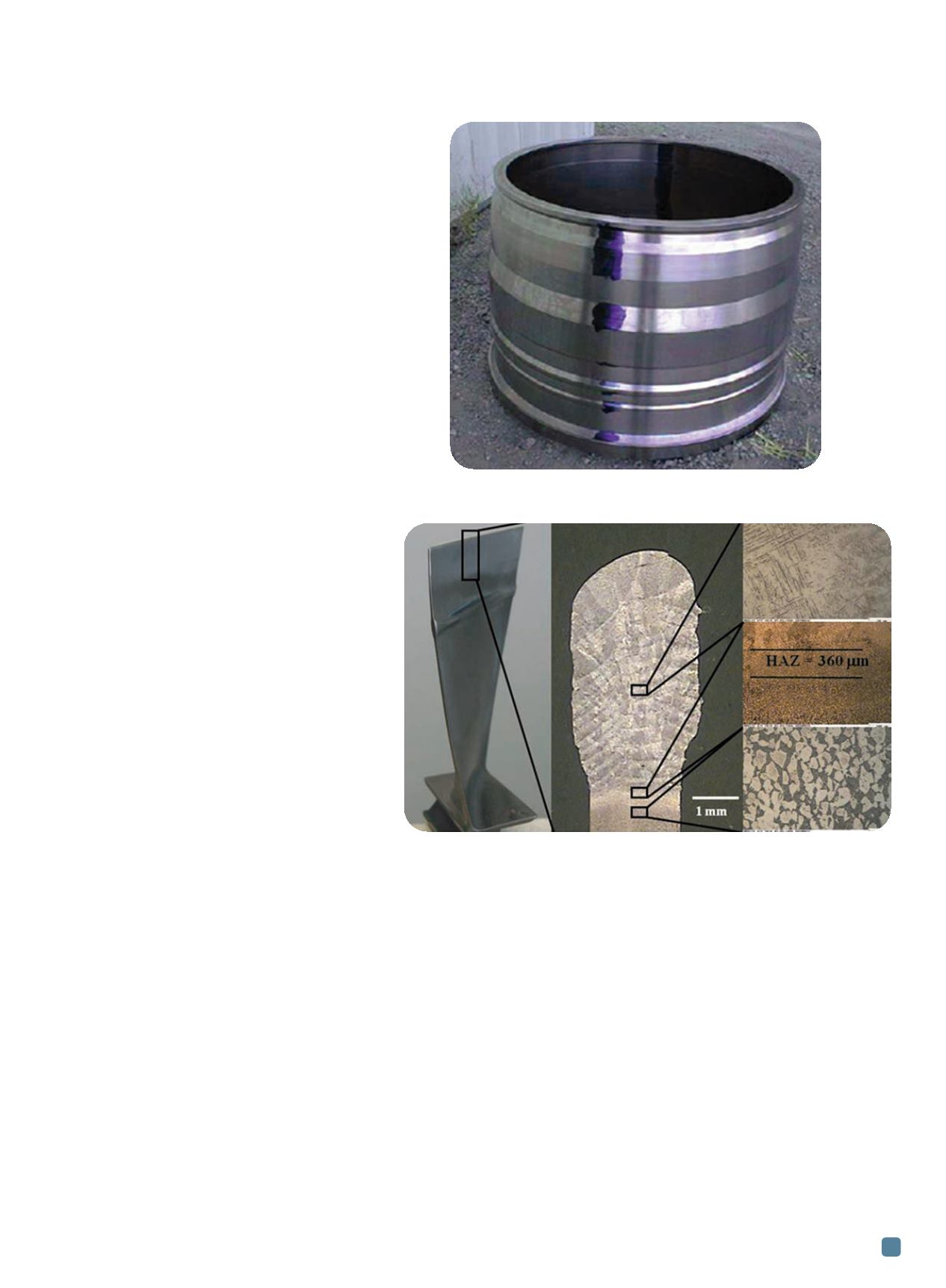
DMD, achieve a minimum heat affected zone (HAZ) in
the repaired part, which helps retain its integrity.
Figure 6 shows cross-section microstructures of the
DMD area of a remanufactured turbine blade. Excellent
process control during DMD leads to a fully dense mi-
crostructure as observed in the vertical cross-section. A
layer thickness of roughly 0.1-0.2 mm was applied and a
minimal HAZ occurs in the as-deposited blade. The DMD
vision system plays a significant role in this type of reman-
ufacturing application. An integrated, calibrated vision sys-
tem allows automatic identification of part location in the
machine coordinate system, resulting in precise process-
ing. Other titanium components that can be repaired using
DMD include housings, bearings, casing flanges, and land-
ing gears.
Microstructure and mechanical properties
The Aerospace Materials Specification SAE
AMS4999A covers Titanium Alloy Direct Products Ti-
6Al-4V Annealed. This calls for a post-build annealing
treatment of 1025°F (550°C). If a hot isostatic pressing
(HIP’ing) treatment is used, it should be at no less than
14.5 ksi (100 MPa ) within the 1650°-1750°F (899°-954°C)
temperature range for 2-4 hours followed by a slow cool
to below 800°F (427°C). Minimum tensile properties
should be UTS 124-129 ksi (855-889 MPa, depending on
direction), YS 110-116 ksi (758-800 MPa), and elonga-
tion of 6%.
[10]
Typical microstructures of as-built material using
the DMD process and after subsequent HIP’ing and
aging are shown in Fig. 7. The as-built microstructure
shows the typical martensitic structure expected for Ti-
6Al-4V cooled rapidly from the beta phase field, while
ADVANCED MATERIALS & PROCESSES •
FEBRUARY 2014
21
Fig. 5 —
Fan case produced by adding features with AM
(laser-aided directed energy deposition) to a forged perform.
Courtesy of Jim Sears.
Fig. 6 —
DMD repair of turbine components. Left, repaired vane; middle, macro
cross-section; and right, microstructures (top to bottom shows the clad, interface,
and base material). Courtesy of DM3D Technology.