



 22 / 54

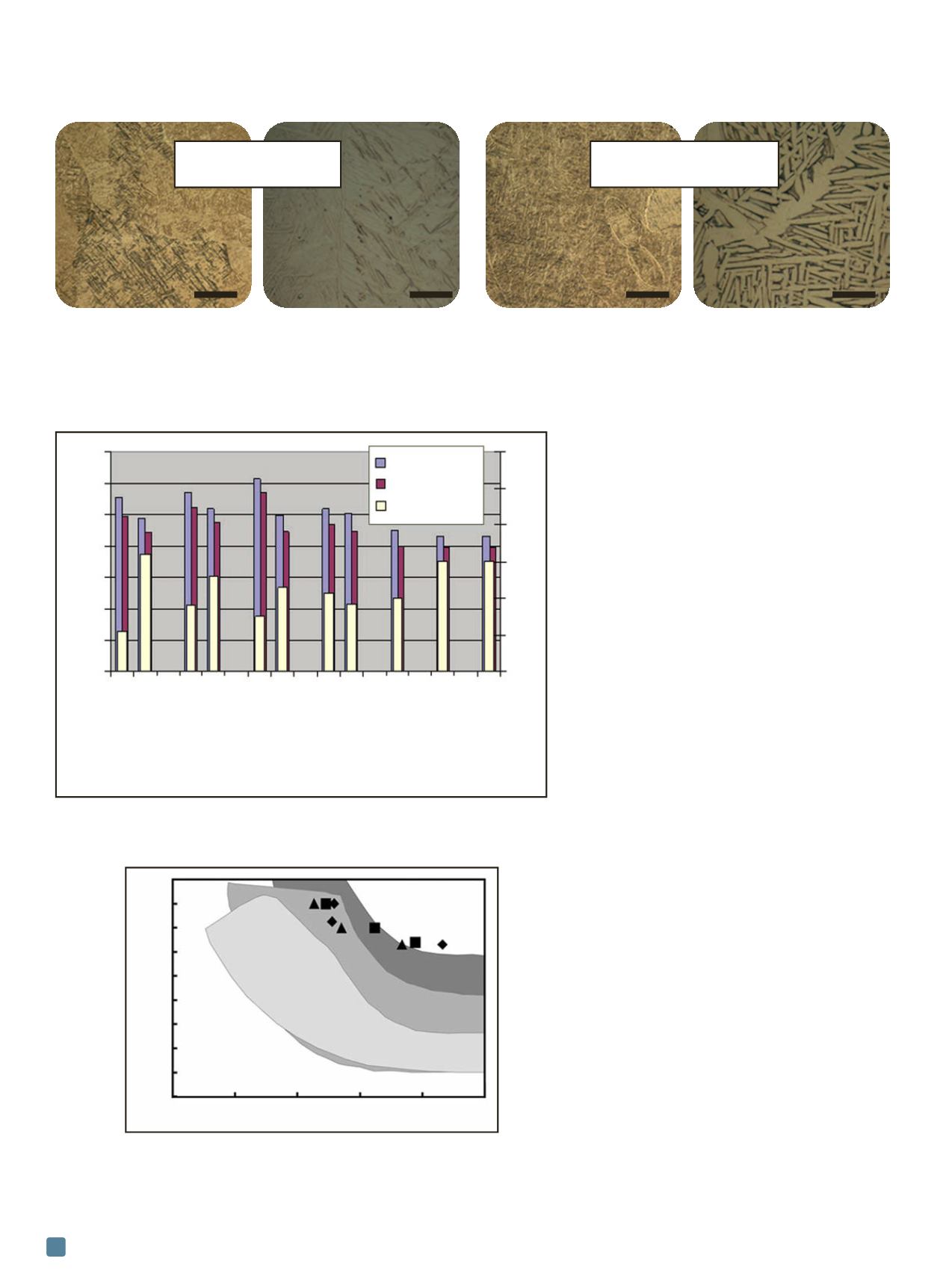
the HIP’d and aged material shows the expected grain
boundary of alpha and intergranular coarse alpha
plates. This microstructural transition from as-de-
posited to the HIP’d-aged condition is also reflected
through their tensile properties. While tensile strength
and yield strength is a little lower after HIP’ing and
aging, ductility improves significantly as a result of the
microstructure changing from martensitic to a trans-
formed beta (precipitated alpha) structure. As-
built electron beam processed material contains
a similar microstructure, although martensite is
replaced by a lamellar alpha phase.
Tensile properties of Ti-6Al-4V fabricated by
a number of additive manufacturing techniques
are shown in Fig. 8. All processes achieve
strength levels superior or comparable to con-
ventional material (cast, forged, and wrought an-
nealed). As-built materials in laser-based
processes such as DMD, LENS, and DMLS ex-
hibit less ductility due to formation of the
martensite phase. However, ductility can be im-
proved through subsequent HIP’ing and/or heat
treatment. As a result of reduced residual stress,
EBM-processed Ti-6Al-4V achieves greater duc-
tility when compared to laser-processed Ti-6Al-
4V. Fatigue properties were tested using many
different cycles. In general, as-built Ti-6-4 offers
fatigue resistance similar to cast and wrought
material, even without HIP treatment, as shown
in Fig. 9.
Additive manufacturing economics
Among the main benefits of powder bed fusion
processes is their ability to create hollow structures and
therefore achieve weight savings. The aerospace indus-
try, where weight savings can make significant impacts,
is actively looking into AM processes. A case study in-
volving a seat buckle for commercial passenger jets is a
prime example of this capability
[13]
.
A lightweight seat buckle with hollow structures was de-
signed based on an extensive finite element analysis study
to ensure adequate strength against shock loading. The
part was produced using a DMLS Ti-6Al-4V alloy. Replac-
ing a conventional steel buckle with a hollow AM titanium
buckle achieves weight savings of 85 g per buckle, a 55%
weight reduction. Applying this across an Airbus A380
with 853 seats results in weight savings of 72.5 kg. Accord-
ing to the project sponsor, Technology Strategy Board, UK,
this weight savings translates to 3.3 million liters of fuel
savings over the life of the aircraft, equivalent to $3 mil-
ADVANCED MATERIALS & PROCESSES •
FEBRUARY 2014
22
Fig. 7 —
Microstructure of DMD-built Ti6Al4V before and after HIP’ing. Courtesy of DM3D Technology.
200 µm
20 µm 200 µm
20 µm
As deposited microstructure;
cross-section along vertical
axis
Hipped and aged after deposition;
cross-section microstructure
along vertical axis
Fig. 8 —
Tensile strength, yield strength, and elongation of Ti-6Al-4V alloy built using
various AM processes: DMD (direct metal deposition)
[11]
, LENS (laser engineered net
shaping)
[12]
, DMLS (direct metal laser sintering)
[6]
, EB (electron beam melting)
[6]
, HIP
(hot isostatic pressing), HT (heat treatment).
Fig. 9 —
Comparison of room temperature fatigue properties of
Ti-6Al-4V processed by AM versus conventionally fabricated
Ti-6Al-4V.
n
,
t
, and represent properties in the three
orthogonal directions, x, y, and z respectively. Courtesy of
EADS/Jim Sears.
DMD
DMD, HIP + HT
LENS, HT
LENS, HIP
DMLS
DMLS, HIP + HT
EBM
EBM, HIP
Cast
Forged
Wrought, annealed
10
2
10
3
10
4
10
5
10
6
10
7
Cycles
1000
900
800
700
600
500
400
300
200
100
Stress, MPa
Wrought anneal
Cast plus HIP
Cast
1400
1200
1000
800
600
400
200
0
Strength, MPa
30
25
20
15
10
5
0
Elongation, %
UTS
YS
Elongation