



 23 / 54

lion, while the cost of making the buckles using DMLS is
only $256,000.
The direct manufacturing ability of AM technologies
also helps reduce manufacturing costs in the case of high
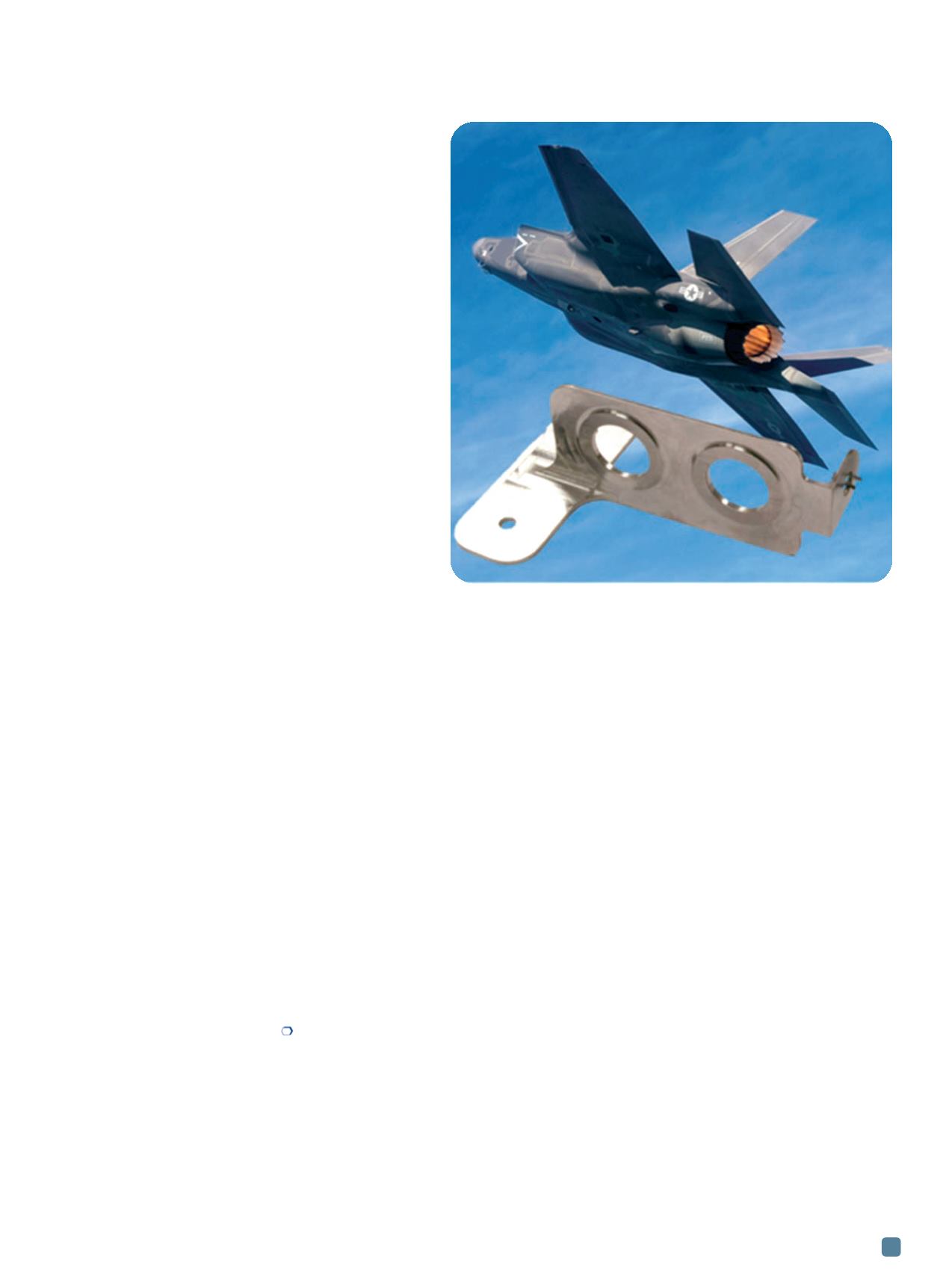
buy-to-fly ratio parts. For example, researchers at Oak
Ridge National Laboratory built a Ti-6A-4V Bleed Air Leak
Detect (BALD) bracket for the Joint Strike Fighter (JSF)
engine using EBM technology (Fig. 10)
[14]
. Traditional man-
ufacturing from wrought Ti-6Al-4V plate costs almost
$1000/lb due to a high (33:1) buy-to-fly ratio as opposed to
just over 1:1 for the AM-built part. Estimated savings
through AM is approximately 50%.
Direct deposition techniques such as DMD can not
only be used to create parts, but these technologies can
also be used for remanufacturing, repair, and/or feature
building on existing parts. Damaged aerospace titanium
components such as bearing housings, flanges, fan
blades, casings, vanes, and landing gears can be rebuilt
using these technologies at 20-40% of the cost of new
parts[11]. Worn flanges in jet engine casings have been
rebuilt using DMD at less than half the cost of new
parts. Extensive work is also underway to investigate
the feasibility of using such technologies to salvage
components that are mismachined during conventional
manufacturing. Successful realization of these efforts
will have a significant impact on the titanium manufac-
turing industry. While most of the commercial activi-
ties in the AM industry are concentrated in the U.S. and
Europe, significant efforts are underway in other parts
of the world as well, including China
[15]
.
Conclusions
Significant advances in additive manufacturing tech-
nologies over the past few years have led to the production
of fully functional parts using titanium and its alloys. While
powder bed fusion technologies offer the ability to build
hollow near-net shapes with finer resolution, directed en-
ergy-based technologies offer the ability to add features to
existing parts and remanufacture and repair damaged
parts, besides building parts directly from CAD data. Most
studies reveal that the properties of AM material are as
good as, or superior to, conventionally fabricated titanium
alloys. Matching the correct AM technology to the appli-
cation, along with proper design optimization, can achieve
significant savings by reducing both weight and scrap. The
aerospace and medical industries have so far been the
largest users of titanium AMmaterials, while other indus-
tries, such as automotive, are beginning to exploit the ben-
efits of AM titanium alloys as well.
Acknowledgements
The authors recognize input for this article and useful discus-
sionswith JimSears, RyanDeHoff, RichardGrylls, JessicaNehro,
AndersHultman, ScottThompson, LauraKinkopf,MichaelClo-
ran, DavidWhittaker, Karl D’Ambrosio, andMa Quin.
For more information:
Bhaskar Dutta is Chief Operating
Officer at DM3D Technology LLC, 2350 Pontiac Rd.,
Auburn Hills, MI 48326, 248/409-7900,
bdutta@dm3dtech. com, www.dm3dtech.com.
References
1. F.H. (Sam) Froes, Powder Metallurgy of TitaniumAlloys,
Advances in Powder Metallurgy.
Eds. Isaac Chang and
Yuyuan Zhao, Woodhead Publishing, Philadelphia, p 202,
2013.
2. Defense News,
p. 24, June 10, 2013.
3.
www.eos.info/additive_manufacturing/for_technology_ interested.4.
www.arcam.com/technology/additive-manufacturing.5.
www.dm3dtech.com/index.php/expertise-innovations/ experticeandinnovations-dmddtechnology.6.
www.morristech.com/Docs/Ti64ELI%20DataSheet.pdf.7. B. Dutta, et al.,
Adv. Mater. & Processes,
p 33-36, May 2011.
8. B. Dutta, et al., Rapid Manufacturing and Remanufac-
turing of DoD components Using Direct Metal Deposition,
9. The AMMTIAC Quarterly, Vol 6, No. 2, p 5-9, 2011.
10. Bhaskar Dutta, Harshad Natu, and Jyoti Mazumder, Near
net shape repair and remanufacturing of high value compo-
nents using DMD, TMS Proceedings, Vol 1: Fabrication, Ma-
terials, Processing and Properties, p 131-138, 2009.
11. Titanium Alloy Direct Deposited Products Ti-6Al-4V
Annealed. SAE Aerospace Material Specification (AMS)
4999A, Sept. 2009,
www.sae.org/technical/standards/ AMS4999A.12. Private communication, DM3D Technology, July 2013.
www.optomec.com/Additive-Manufacturing-Technol- ogy/Laser-Additive-Manufacturing.13.
www.manufacturingthefuture.co.uk/_resources/case- studies/TSB-AirlineBuckle.pdf.14. Ryan Dehoff, et al.,
Adv. Mater. & Processes,
Vol 171,
No. 3, p 19-22, 2013.
15. Private communication, Ma Quin, July 2013.
ADVANCED MATERIALS & PROCESSES •
FEBRUARY 2014
23
Fig. 10 —
BALD bracket for Joint Strike Fighter (JSF) built using EBM
technology. Courtesy of ORNL.