



 25 / 54

ADVANCED MATERIALS & PROCESSES •
FEBRUARY 2014
25
another 20,000 miles were added in the U.S.—before
even a single rail was laid west of the Mississippi.
As the railroads connected major Eastern cities
and pushed into the Midwest, demand for iron
kept moving west along with much of the U.S. pop-
ulation. For example, Chicago had one rail line and
a population of 29,000 in 1850. By 1860, it had 11
rail lines and 109,000 inhabitants. Demand for iron
created a boom in iron making west of the Al-
legheny Mountains in Pennsylvania as well as in
Kentucky and southeast Ohio, which was home to
more than 50 blast furnaces that supplied iron
throughout the Civil War.
John Fritz and other iron pioneers
An early pioneer from this period of iron mak-
ing is John Fritz. Born on a farm in eastern Penn-
sylvania in 1822, Fritz was apprenticed to the
blacksmith trade at age 16. After working in sev-
eral iron plants, he had enough experience to take
charge of a new facility in Johnstown, Pa., which
later became well known as the Cambria Iron
Company. An entrepreneur by the name of Daniel
Morrell had leased this unfinished Johnstown fa-
cility, in which two previous sets of investors had
gone broke trying to build an integrated mill to
produce railroad rails. Once fully developed, this
mill would use coke in its blast furnaces and incor-
porate both puddling furnaces and rolling mills.
Fritz’s first job was to make sure all machin-
ery was operating properly and could handle the
flow of iron in its progression from the blast fur-
nace to puddling furnaces to squeezers and finally
to the rolling mills. He discovered that the local
ores were not suitable for making rails, which re-
quired persuading the financially strapped prin-
cipals to buy better ore and pay the freight charges
to bring it to Johnstown. However, this did not
solve the problem of excessive scrap production
during rolling. The mill was losing money and
Fritz concluded that the current rolling method
was part of the problem.
The standard rolling method was to pass a hot
billet through the rolls and with pivoted tables on
the output side, the semi-finished rail was lifted
and shoved across the top roll to the entrance side
where it was again passed through a second groove
in the rolls to further reduce the metal to a partic-
ular rail shape. The process was repeated in suc-
cessively smaller openings until the final rail was
formed. Because rails were cracking during the
later rolling stages, Fritz determined that the metal
was too cold for the attempted reduction. His solu-
tion was to stack a third roll over the two working
rolls (with a second set of grooves between the sec-
ond and third rolls) so that the rail could be re-
duced in both directions. This helped keep the
metal hot due to both the faster reduction time and
shorter total rolling time.
Fritz designed and built the first three-high
rolling mill in 26 days. It was immediately success-
ful, and soon all rails manufactured in the U.S. were
made using this mill design. However, the task of
commissioning a new plant, solving numerous me-
chanical and metallurgical problems, and the con-
tinuous lack of adequate finances finally brought
Fritz to exhaustion. He wrote in his notes, “After
six years of as hard, laborious, faithful, vexatious
work as ever fell to the lot of man to do, I decided
to leave the scene of my early struggles and try my
fortunes elsewhere.” Fritz then joined the new
Bethlehem Iron Company where he spent the rest
of his career.
Wrought iron production wraps up
Wrought iron production reached its peak dur-
ing construction of the intercontinental railroads.
By 1880, it was being replaced by the new Besse-
mer process for making steel. Yet substantial pro-
duction of wrought iron continued for another 30
years, as it was highly valued for toughness and
corrosion resistance. For these reasons, the Eiffel
Tower was built with wrought iron rather than
steel. Although wrought iron is no longer pro-
duced, it will be remembered as the primary
method for iron making for most of human history.
For more information:
Charles R. Simcoe can be
reached at
crsimcoe@yahoo.com. For more metallur-
gical history, visit
www.metals-history.blogspot.com.
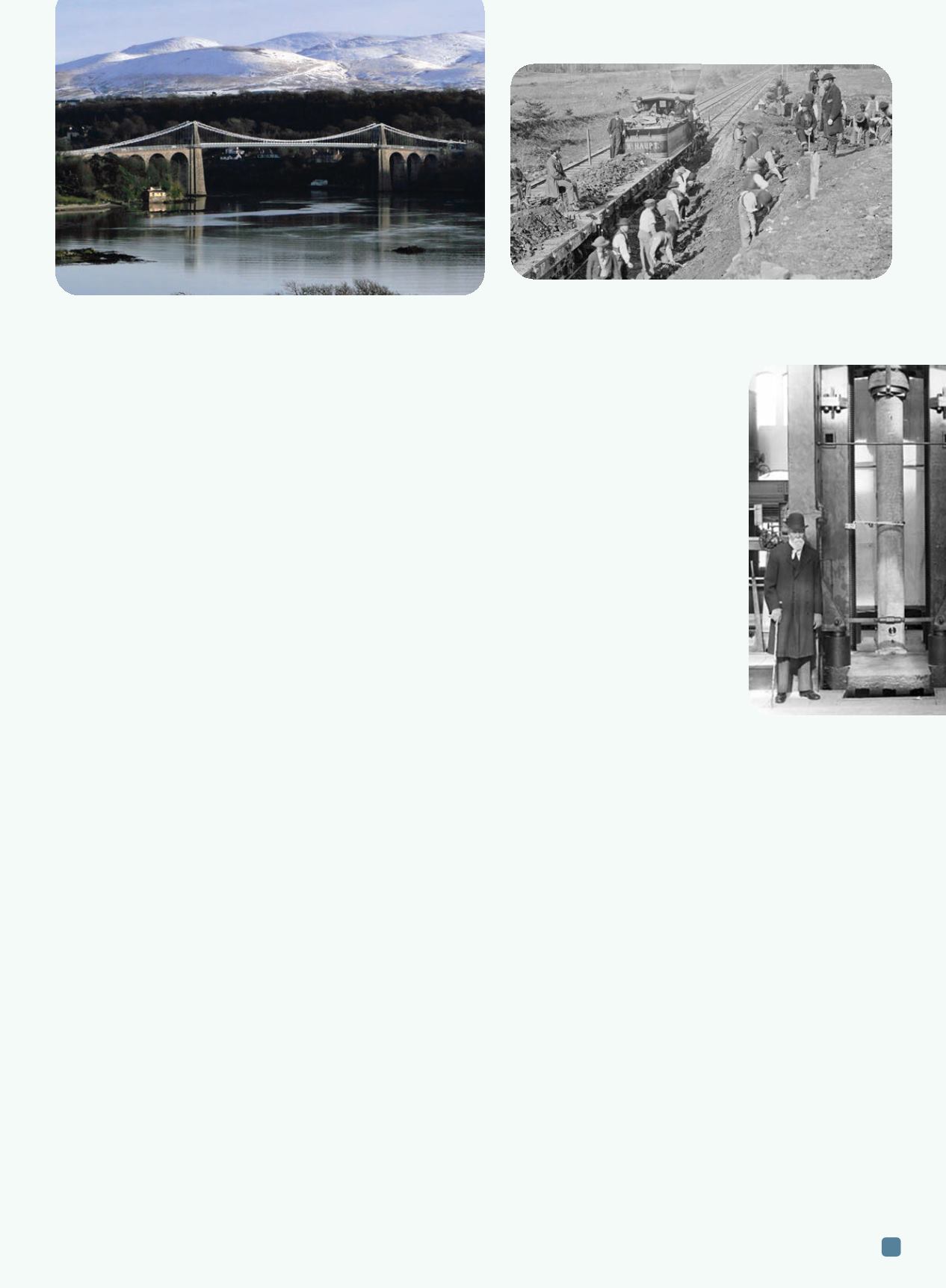
Workers building the Aquia Creek and Fredericksburg, Va.,
railroad. Wrought iron production reached its peak during
construction of the intercontinental railroads. Courtesy of the
U.S. National Archives.
Iron pioneer John Fritz
stands beside an
800,000-lb Riehle
testing machine, 1909.
Courtesy of Lehigh
University.
The Menai Suspension Bridge, UK, designed by Thomas Telford and
completed in 1826, features large amounts of wrought iron. Courtesy of
Bencherlite.