


 18 / 62

Alex Hudgins*
Brad James,*
FASM
Exponent Failure
Analysis Associates
Menlo Park, Calif.
ADVANCED MATERIALS & PROCESSES •
AUGUST 2014
18
F
asteners play a critical role in engineered
structures as a method of nonpermanent
joining for the aerospace, infrastructure,
civil, automotive, energy generation/distribu-
tion, and many other industries. Fastener fail-
ures can lead to disastrous consequences and
substantial financial losses. One of the most
common fastener failure modes is fatigue crack
initiation and growth. Inadequate design con-
siderations, material problems, insufficient pre-
load, loosening, and excessive loads can all
contribute to fastener fatigue.
Fastener failure background
Similar to other metallic components, fas-
tener failures include overload, corrosion-
related cracking, embrittlement, creep, and fa-
tigue. Fastener overload can occur upon in-
stallation or in service due to an externally
applied load. Fastener overload failure investi-
gation should include assessment of the mate-
rial properties to determine fastener strength,
as well as the loads that contributed to the
break. Stress corrosion cracking (SCC), or hy-
drogen embrittlement in some metals, repre-
sents an important failure mode in fasteners
due to the static tensile nature of the loading
in many applications. Given the expected
stresses on fasteners, the material and envi-
ronment must be carefully considered to
appropriately mitigate SCC or hydrogen em-
brittlement potential.
Hydrogen embrittlement can also be
caused by improper manufacturing conditions,
particularly in plating processes. To reduce hy-
drogen embrittlement in susceptible materials,
fasteners must be subjected to appropriate bak-
ing treatments. Creep failures can occur when
fasteners are subjected to sufficient stress at el-
evated temperatures. Again, stresses, materials,
and the environment (temperature) must be
considered to help mitigate creep damage and
potential failure.
Fastener fatigue
Fatigue is the most common form of frac-
ture of metal structures, accounting for up to
80% of all costs associated with fracture. Fas-
teners are no exception, as fatigue remains the
most common cause of fastener breaks. Fatigue
crack initiation and growth occurs when cyclic
stresses exceed the fatigue strength of local ma-
terial for a sufficient number of loading cycles.
Fastener material, geometry, stress amplitude,
mean stress, and assembly parameters all affect
fatigue performance
[3]
.
The fastener assembly process is one of the
most important, but often overlooked, contrib-
utors to fatigue performance. The cyclic-stress
amplitude imposed on a given fastener (and
therefore fatigue performance) is highly
dependent on preload. Specifically, increased
preload results in decreased cyclic stress-am-
plitude, particularly at loads below the clamp-
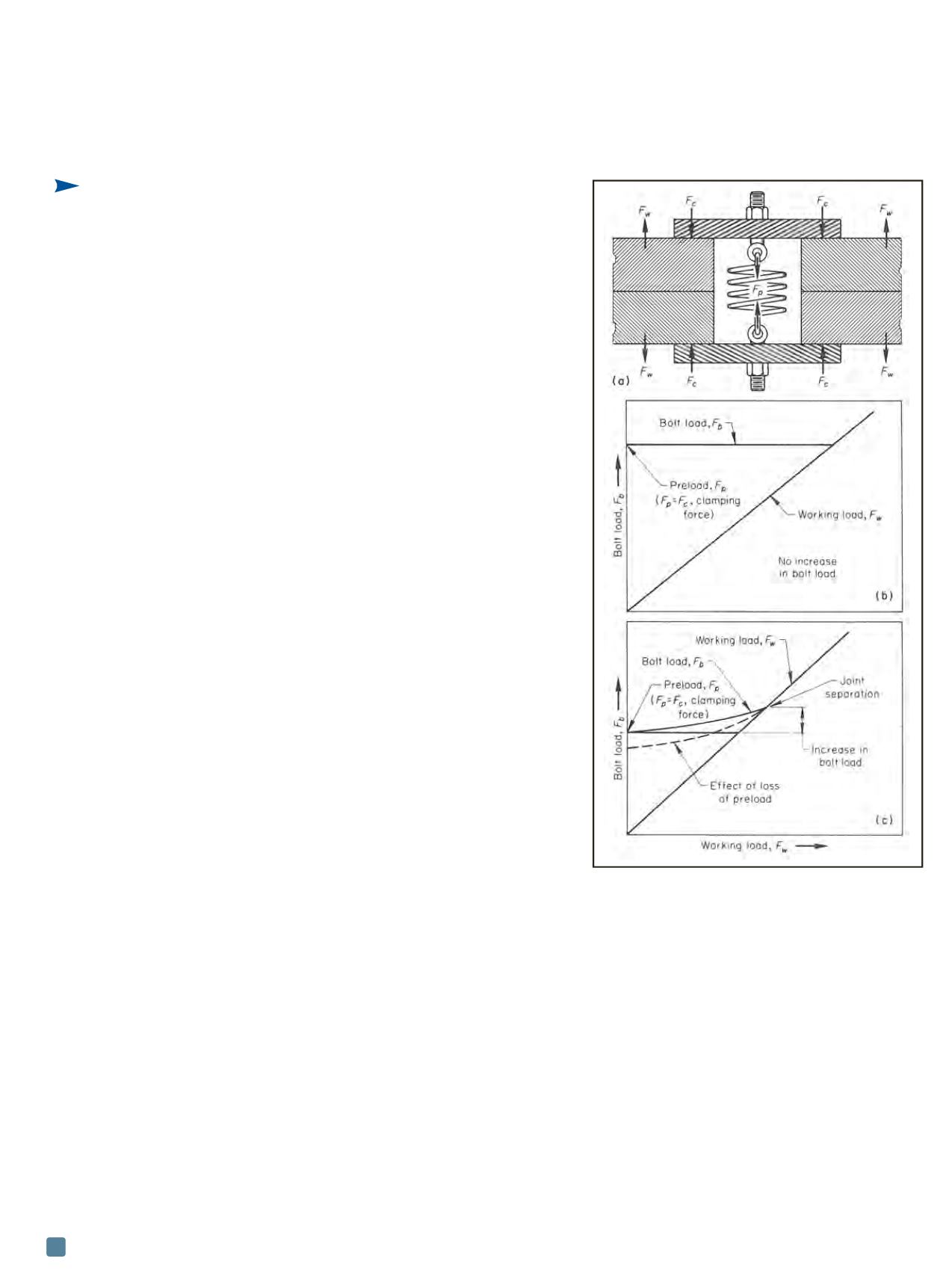
ing force imposed by the fastener. To illustrate,
Fig. 1 includes a series of schematics from the
ASMMetals Handbook
showing the differences
between an ideal joint (Fig. 1b) and an actual
Fatigue
of Threaded Fasteners
Fasteners play
a critical role
in many
engineering
structures, and
their failure
can result in
significant
consequences.
*Member of ASM International
Fig. 1 —
Schematics from the
ASM Metals
Handbook
highlight the difference between
ideal behavior shown in (b) and real behavior
shown in (c)
[3]
.