



 14 / 62

news
industry
Unexpected behavior of nanotubes discovered
Lydéric Bocquet, a visiting professor at Massachu-
setts Institute of Technology, Cambridge, conducted
tests on carbon nanotubes (CNTs) and boron nitride
nanotubes (BNNTs) and found that at least in terms of
one key property, friction, the two seemingly identical
types of tubes are not only different, but nearly oppo-
site in their characteristics: CNTs are so slippery that
they are described as having an extreme form of fric-
tionlessness called superlubricity. BNNTs, on the other
hand, display a very high level of friction—a completely
unexpected discovery.
Tests were carried out in an apparatus that allows a
nanotube to be suspended between two supports,
which can then pull it apart with precisely calibrated
force. The tubes—actually a set of nested pieces, much
like an old-fashioned telescope—eventually break
under the strain. One or more of the tubes can be
pulled out from within the others, like extending the
telescope. The force needed to pull one tube out of the
other can then be measured.
For more information:
Lydéric Bocquet,
lbocquet@mit.edu,
web.mit.edu.
New technique captures nanoscale fluid movies
Researchers at Caltech, Pasadena, applied a new imaging technique called 4D electron
microscopy to the nanofluid dynamics problem. The 4Dmicroscopy technique was created
and directed by Ahmed Zewail, the Linus Pauling Professor of Chemistry and professor of
physics, to advance understanding of the fundamental physics of chemical and biological
behavior. In 4D microscopy, a stream of ultra-fast-moving electrons bombards a sample in
a carefully timed manner. Each electron scatters off the sample, producing a still image
that represents a single moment, just a femtosecond in duration. Millions of still images can
then be stitched together to produce a digital movie of nanoscale motion. Single laser
pulses were used to melt the lead cores of individual zinc oxide nanotubes and then, using
4D microscopy, researchers captured how the hot pressurized liquid moved within the
tubes—sometimes splitting into multiple segments, producing tiny droplets on the outside
of the tube, or causing the tubes to break.
caltech.edu.
Laser system fabricates micro and submicroscale structures
Scientists of the Fraunhofer IWS, Germany, developed a unique solution to fabricate
structures at the micro and submicroscale. For the first time, scientists have a technology
that allows structuring of areas up to 500 × 500 mm
2
in only a few minutes. The compact
system can be adjusted to precisely meet individual user requirements and can be used to
fabricate arrays with structure widths from 150 nm to
20 µm. Scientists apply the direct laser interference
patterning (DLIP) technique for large area micro
structuring and functionalization processes. This
technique allows for large area and maskless lithogra-
phy to fabricate complex structures within one step.
Conventional structuring technologies are either too
slow (sequential procedure) or not flexible enough
(mask technique).
www.iws.fraunhofer.de.
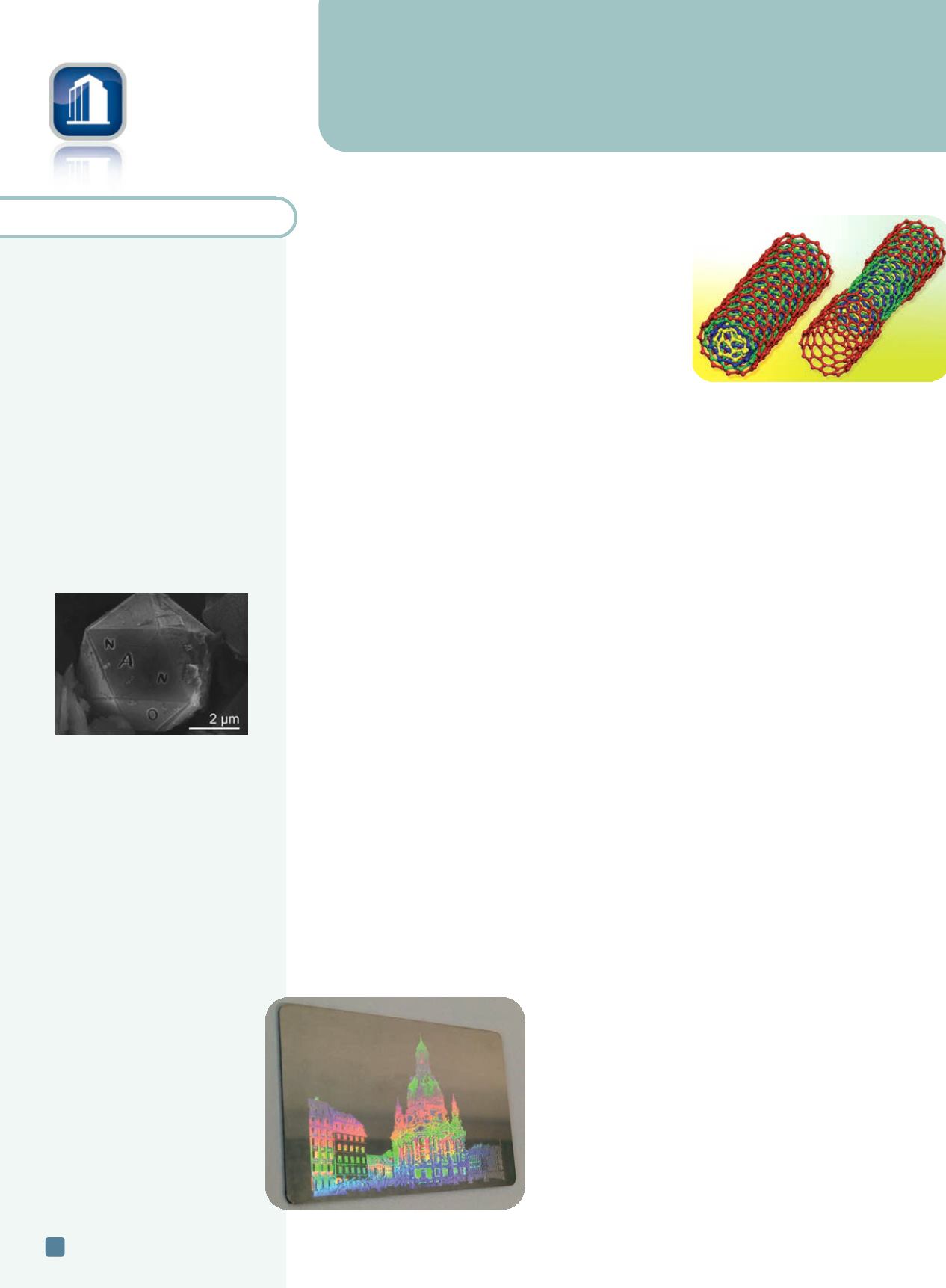
DLIP structured decorative element (Dresden Church of
our Lady) on stainless steel. Courtesy of Fraunhofer IWS
Dresden.
ADVANCED MATERIALS & PROCESSES •
AUGUST 2014
14
N
ANOTECHNOLOGY
briefs
University of Technology,
Sydney,
researchers are the first to etch
structures less than 100 nm in size
on the inclined surfaces of
diamond by using a variable
pressure scanning electron
microscope (SEM). Key to the
approach is use of an electron
beam in a water vapor
environment, which dissociates
surface-adsorbed water molecules
into radical fragments. The
resulting volatile reaction products
create voids on the surface when
they leave the diamond substrate.
By exploiting the high resolution,
precise beam steering capabilities
of an SEM, sub-100 nm lines were
etched on the inclined planes of a
single crystal diamond.
www.uts.edu.au.
A new technique can be used to
etch smaller structures on
diamond than was previously
possible. Courtesy of NPG.
Haydale,
UK, announces
publication of research showing its
functionalized graphene
nanoplatelets (GNP) significantly
improve the nanoreinforcement of
resin. Research was conducted by
the Material Science Department
at
The Aerospace Corp.,
El
Segundo, Calif. The report states
significant strength improvements
in toughened epoxy composites.
The reported increases are >2
times in tensile strength and
modulus of an epoxy composite
using a number of HDPlas O
2
-
functionalized GNP, manufactured
by Haydale. The addition of
increasing amounts of GNP results
in strength increases of more than
125% and toughness
improvements of 100% over that
of similarly cured, unreinforced
material.
haydale.com.
Illustration of tested characteristics
of multi-walled boron nitride
nanotubes, which consist of
several nested tubes that are each
just one atom thick. When attached
to a device that can pull apart the
tube from its two ends, the outer
tube cracks, allowing the
concentric tubes to separate.
Measuring the force required to
pull the ends apart reveals the
amount of friction between the
layers. Courtesy of the authors.