



 16 / 62

energy, steel, and concrete production needs to be reduced
dramatically over the coming decades. CO
2
capture and
storage is an important technology in reducing greenhouse
gas emissions. In the case of large-scale underground stor-
age of CO
2
in depleted gas reservoirs or aquifers, the in-
tegrity of carbon steel down-hole tubing is strongly
endangered by CO
2
corrosion due to much more severe en-
vironmental conditions than normally encountered in tradi-
tional oil and gas production. Severe corrosion problems
may occur due to unknown concentrations of impurities
such as oxygen, carbon monoxide, sulfur dioxide, or hydro-
gen sulfide that are inevitably present in exhaust gases. One
alternative could be the use of CRAs, but most likely at a
huge cost. CRAs may not be completely immune to corro-
sion attack due to the high salinity, impurities, temperature,
and design-caused crevices found in these service condi-
tions
[3,4]
.
Newand sustainable corrosion control concepts are needed
to ensure equipment integrity and achieve long, failure-free life-
times. Reliable material use requires suitable prediction mod-
els concerning corrosion behavior under such conditions.
Models are needed not only for lifetime prediction, but also for
a better understanding of the corrosionprocesses under condi-
tions of CO
2
sequestration. The respectivemodelsmust be de-
veloped and verified using experimental data. Testingmethods
with high repeatability and reproducibility need to be devel-
oped and standardized as well
[4]
.
Offshore wind energy:
Land-based wind farms have
reached a significant level of reliability. However, an addi-
tional challenge from a corrosion standpoint comes into play
when wind energy plants move offshore. All major compo-
nents are susceptible to corrosion and many
types are possible due to a much more severe
corrosive environment stemming from sea
spray and seawater conditions in conjunction
with higher wind forces. One of the main chal-
lenges is to prevent corrosion fatigue under
these severe environments
[5]
. For example,
coatings in general may have strain limits that
can be exceeded by the wind forces or the pe-
riodic action of rotating blades. Evaluation of
the effect of superimposed mechanical stresses
on corrosion protection systems is needed to avoid failures.
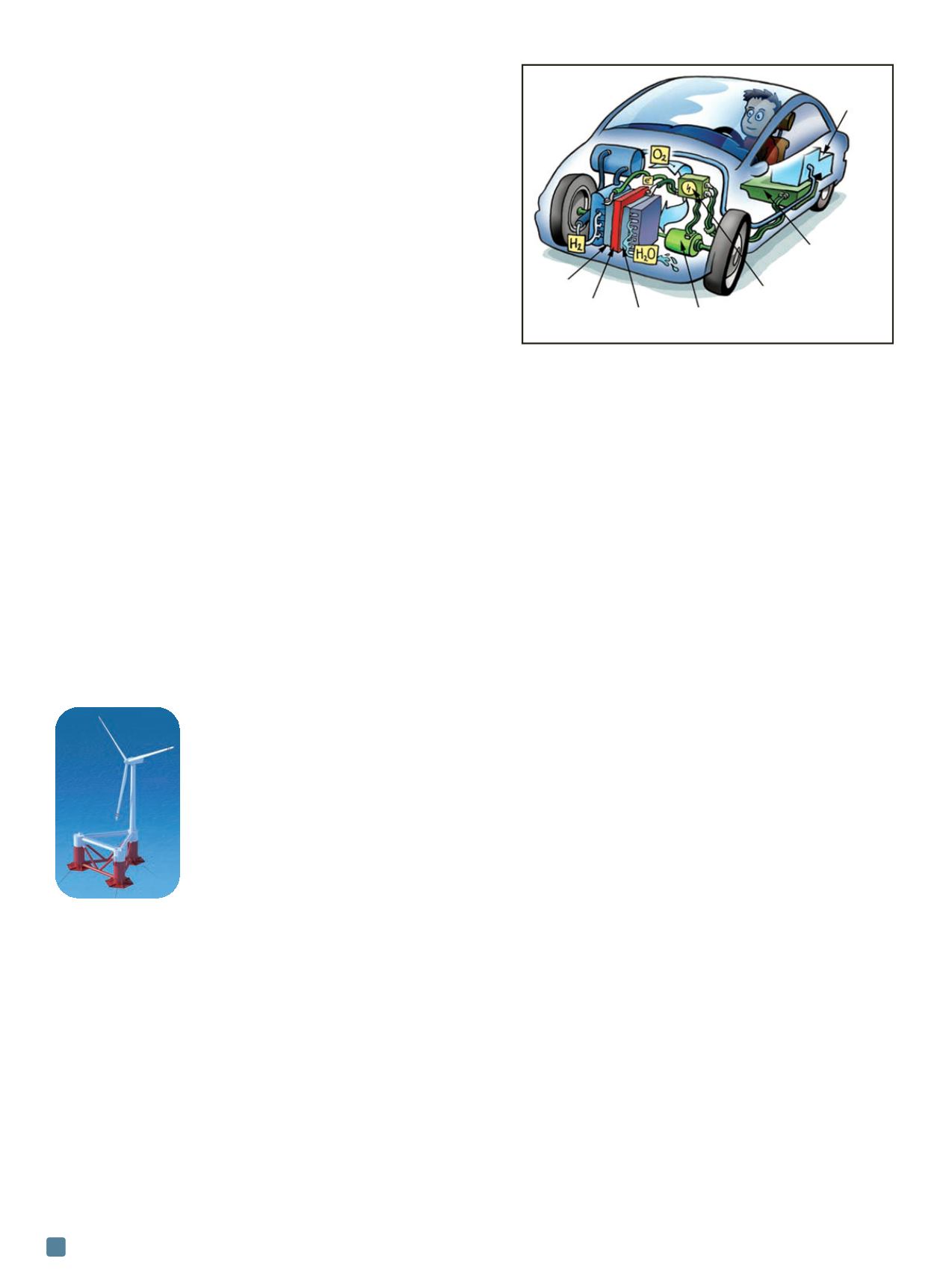
Fuel cells:
Independent of the type of fuel cell (proton
exchange membrane, solid oxide, or molten carbonate ver-
sions), the electrochemical reactions and reactant/product
gases within these cells promote harsh environments.
Therefore, corrosion of metal plates is something that is vir-
tually unavoidable over the required lifetime of a fuel cell. A
significant issue is corrosion of the bipolar plates, where a
compromise must be reached between high conductivity
and high corrosion resistance in the fuel cell environ-
ment
[6, 7]
. The solid oxide fuel cell (SOFC), in particular, op-
erates at intermediate (500°-700°C) or high (700°-900°C)
temperatures, which offer the advantages of fuel flexibility
and lower cost catalysts. Operation at elevated tempera-
tures, however, also results in high-temperature materials
degradation issues. A major issue is the resistance of these
materials to oxidation at elevated temperatures, where oxide
scales are formed that are usually not of high conductivity.
The oxidation of Fe-Cr interconnect materials also forms
Cr
2
O
3
with simultaneous volatilization of the oxide, which
results in Cr-poisoning of the cathode. In order to avoid
SOFC failures, development of very thin and protective—
yet highly conductive—oxide scales on the surface of inter-
connect alloys with long stability under operating conditions
is necessary.
Lightweight structures:
Lightweight materials are of high
importance to the transportation industry to reduce both
fuel consumption and greenhouse gas emissions. Alloys
based on both magnesium and titanium aluminides are of
special interest for certain applications due to a combina-
tion of their low specific density and mechanical properties.
Although magnesium is a light material, it is among those
with the least corrosion resistance, especially when in con-
tact with other metallic materials. Generally, the method of
modifying the alloy through alloying compounds for in-
creased corrosion resistance is limited and coating systems
must be developed.
Intermetallic titanium aluminides are another useful
alloy for lightweight construction, as they feature half the
weight of steel or nickel-base materials currently used in car
engines while offering similar mechanical performance. The
biggest drawback of these materials is, however, their lim-
ited oxidation resistance at temperatures above 700°-800⁰C.
Again, innovative surface protection systems are needed.
Corrosion failure prevention strategies
Given the severe environments materials will face as
critical enablers of future global energy industries, prevent-
ing corrosion failures requires developments in four key di-
rections according to the tetrahedron in Fig. 2, including
materials design, corrosion mitigation, lifetime prediction,
and inspection.
Materials design:
For the most challenging environ-
ments in which low cost, inexpensive metals may not be em-
ployed, corrosion-resistant alloys need to be developed.
CRAs can be designed based on principles that reduce the
number of corrosion failures by optimizing microstructure
and composition, and possibly employing nanotechnology.
Techniques such as grain-boundary engineering can be used
to design materials resistant to failure from intergranular
corrosion and stress corrosion cracking (SCC). Modern
high-performance computing has enabled the integrated
ADVANCED MATERIALS & PROCESSES •
AUGUST 2014
16
Fuel cell vehicle
Hydrogen
tank
Batteries
Anode
Power electronics
Membrane
Cathode Electro
engine