



 9 / 62

ADVANCED MATERIALS & PROCESSES •
AUGUST 2014
9
proton microscope was developed by an international collaboration consisting of Los Alamos
National Laboratory, GSI, the Technical University Darmstadt, and the Institute for Theoretical
and Experimental Physics, Russia. Similar to x-rays, protons can be used to radiograph objects,
generating images of them. Protons are able to penetrate hot dense matter that cannot be exam-
ined with light or x-rays. Proton radiography was originally invented at Los Alamos National
Laboratory in the 1990s, but has been adopted around the world. In the future, the technique will
be used at an accelerator currently under construction in Darmstadt called the Facility for An-
tiproton and Ion Research (FAIR) and at the proposed Matter and Radiation in Extremes
(MaRIE) facility at Los Alamos.
In their first experiments, researchers used a proton beam accelerated to an energy of 4.5
gigaelectronvolts (more than 98% of the speed of light) by the GSI accelerator facility. A spe-
cial setup of four quadrupole magnets served as optics to magnify objects with the beam. Ini-
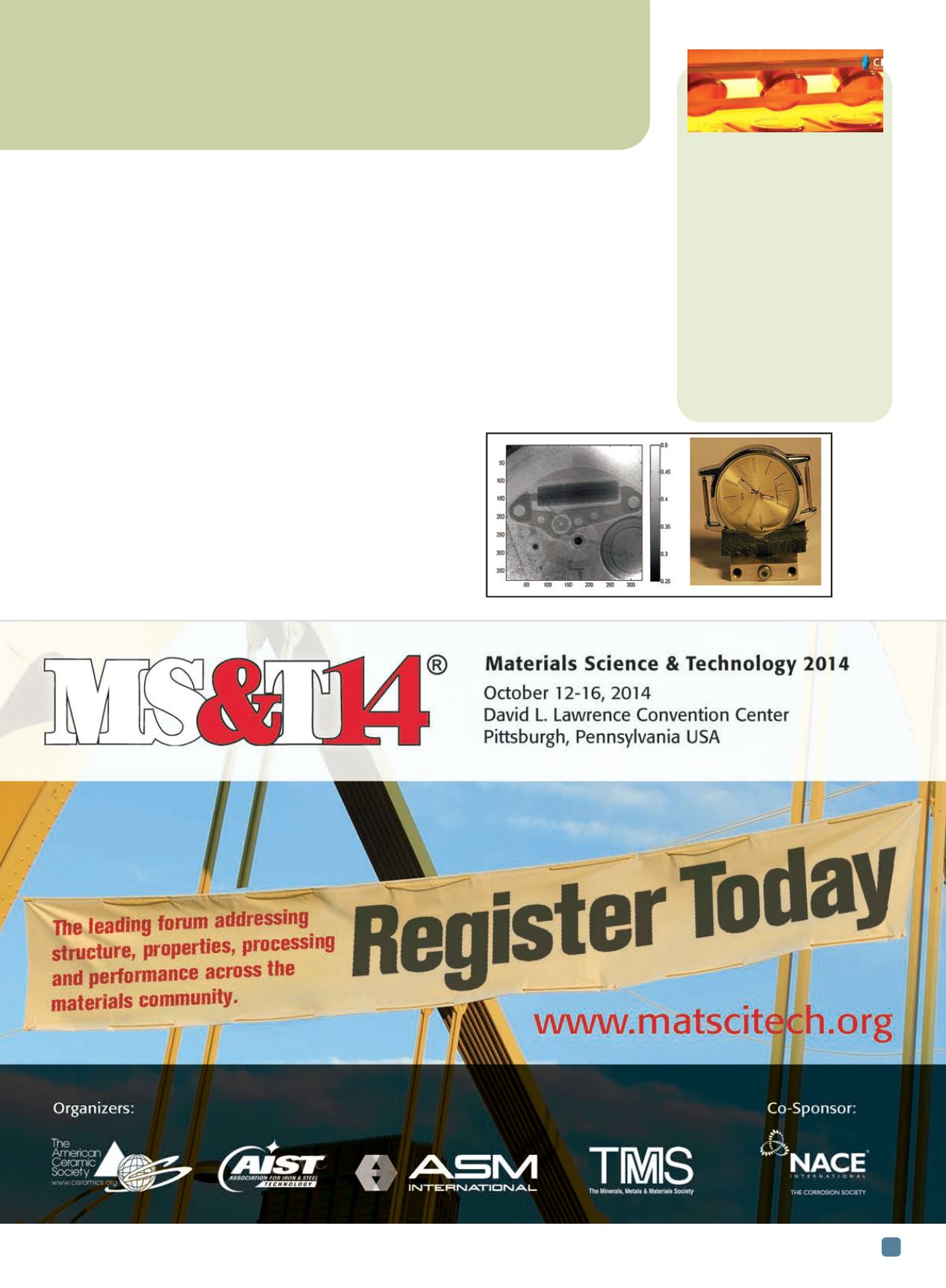
tially, different items such as sets of wires and a wristwatch were
radiographed. Scientists succeeded in resolving objects and
structures down to a size of 30 µm. The GSI facility achieved res-
olutions comparable to existing facilities in the U.S. or Russia.
Scientists plan to improve this to a value of up to 10 µm in ex-
periments this year. Another goal is to record image sequences of
moving objects.
lanl.gov.A wristwatch was one of the first items imaged by
the new proton radiography system. At left, the
inner workings of the mechanism are visible.
Instrumentation and controls com-
pany
Spectris plc,
the Netherlands,
acquired
La Corporation Scien-
tifique Claisse Inc.,
Canada, a
leader in sample preparation for
atomic spectroscopy analysis (in-
cluding x-ray), for an undisclosed
sum. Claisse designs, manufactures,
and sells consumables and instru-
ments used to prepare samples for
spectroscopic analysis in mining,
pharmaceutical, academic research,
and industrial applications. Claisse
will become part of the materials
analysis segment of Spectris and
will be integrated into PANalytical.
panalytical.com.