



 5 / 62

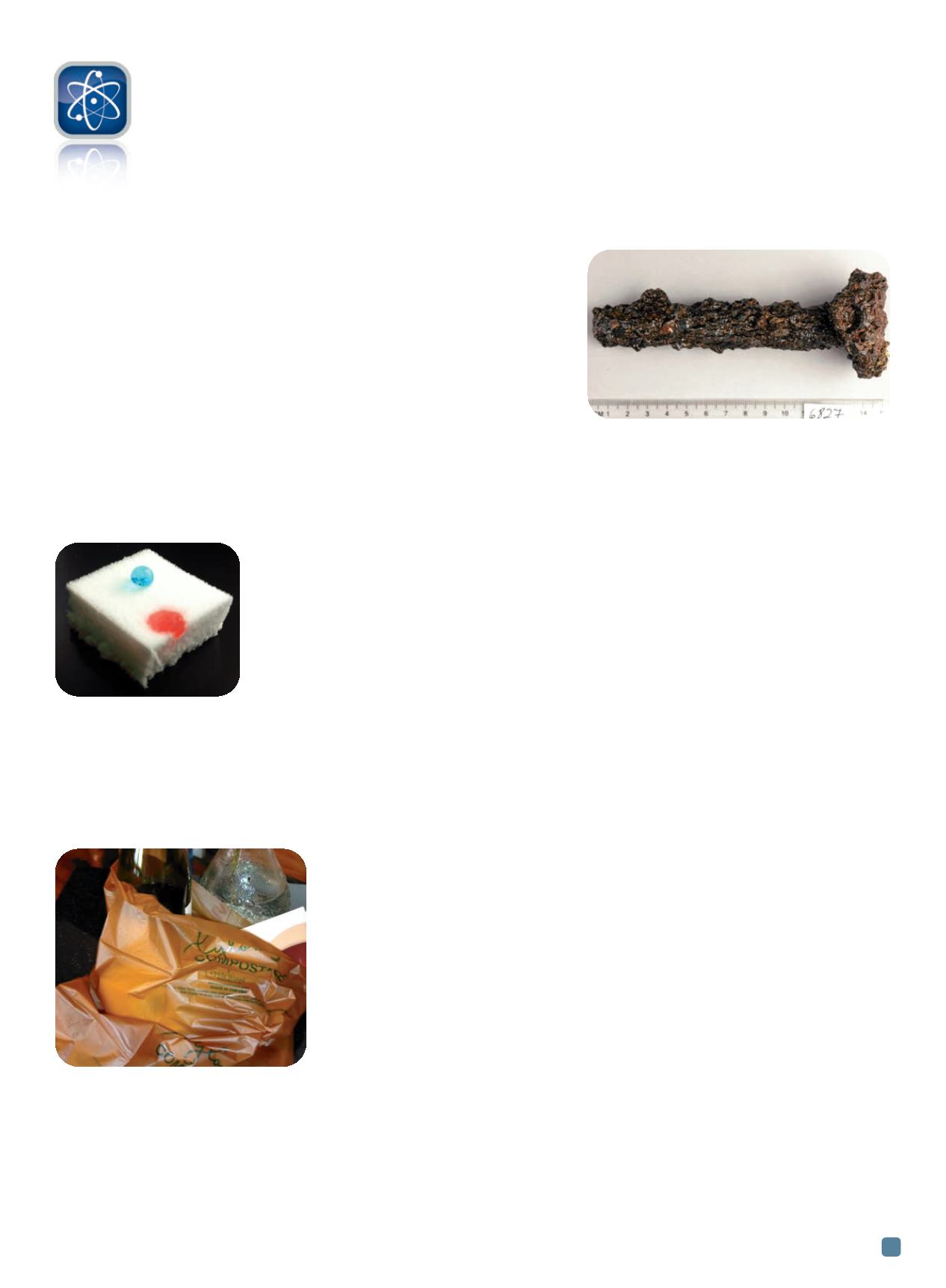
Ancient chisel found beneath Western Wall
A 2000-year-old stonemason’s chisel thought to have been used
in the construction of Jerusalem’sWesternWall was discovered along
with a number of Second Temple-era objects, according to an Israeli
archaeologist. Eli Shukron, an archaeologist working for the Israel
Antiquities Authority (IAA), found the chisel last summer during a
dig near a tunnel at the lower base of the WesternWall. Also known
as theWailingWall, the massive structure is venerated by Jews as the
sole remnant of their Second Temple, destroyed by the Romans in
70 A.D. To the Muslims, the Western Wall is revered as the Wall of
Buraq, where Muhammad tethered his winged horse Buraq after
being transported fromMecca to Jerusalem.
“The chisel was found inside rubble of stone chips that fell from the stonemasons working on the rocks com-
prising the Western Wall,” says Shukron. About 6 in. long, the metal tool features a flattened head as a result
of being repeatedly banged on rock. The IAA will not comment on the discovery until analysis of the chisel and
other findings is complete.
antiquities.org.il.
Soaking up oil spills with nanosponges
Swiss Empa researchers in collaboration with the University of Bordeaux, France,
developed a highly absorbent material that separates oil film from water and can be easily
recovered. The “silylated” nanocellulose sponges absorbed up to 50 times their own weight
of mineral oil or engine oil in lab tests and also kept their shape so they could be removed
from the water with pincers.
In one-step production, nanofibrillated cellulose (NFC) from cellulose plants is ex-
tracted from cellulose-containing materials like wood pulp, agricultural byproducts (such
as straw), or waste materials (such as recycled paper) by adding water and pressing aque-
ous pulp through several narrow nozzles at high pressure. This produces a suspension with
gel-like properties containing long and interconnected cellulose nanofibers.
When water from the gel is replaced with air by freeze-drying, a nanocellulose sponge is formed that ab-
sorbs both water and oil. Researchers modified the chemical properties of the nanocellulose in just one step by
admixing a reactive alkoxysilane molecule into the gel before freeze-drying, causing the nanocellulose sponge
to lose its hydrophilic properties, and only bind with oily substances.
www.empa.ch.
Easy compost plastic bags make headway
During three decades with Virginia Tech’s College of Natural Resources and
Environment, Wolfgang Glasser worked with many students as they advanced
the field of natural polymers. But the most recent breakthroughs came in part-
nership with two University of Arkansas graduates. When Nhiem Cao, a chem-
ical engineer, and Kevin Oden, an industrial engineer, had to write a business
plan to complete their MBA degrees, they planned to use lignin, a natural poly-
mer that helps form the cell walls of plants, for biodegradable plastic bags. Lignin
is a compound of plant cell walls that is discarded in the papermaking process.
Glasser began working with it because it was plentiful and inexpensive and can
be used to make “green” polymers.
“My ‘ah ha’ moment came when, in addition to viewing it from a resource
viewpoint, I realized its environmental benefits,” he recalls. “It could be com-
postable. Plastic bags and bottles needn’t last forever.” Together, the scientists
created Fayetteville, Ark.-based cycleWood Solutions. The company has pro-
duced single-use plastic bags, trash can liners, and meat bags, and is testing cups and plates. “The composta-
bility was tested by a commercial lab in Belgium, and the bags meet the requirements of disintegrating to
particles less than 2 mm in size in 180 days,” said Glasser. “The bags are made with natural components and
can be composted just like any other plant-based material.”
cyclewood.com.
ADVANCED MATERIALS & PROCESSES •
AUGUST 2014
5
interest
of material
A drop of oil (red) and water
(blue) on top of the silylated
sponge. Courtesy of Empa.
Compostable plastic bags are made with
lignin, a natural polymer that helps form the
cell walls of plants, and is discarded in the
papermaking process.
2000-year-old chisel. Courtesy of Clara Amit/IAA.