



 4 / 62

W
orld consumption of both captive and merchant hydrogen
will increase 3.5% annually through 2018 to more than 300
billion cubic meters, according to
World Hydrogen,
a new trends
report from market research firm The Freedonia Group Inc.,
Cleveland. Gains will be driven by increasing use in refinery hy-
droprocessing, especially in developing Asian countries. According
to analysts, the merchant market for hydrogen will expand more
than 5% annually as the need for hydrogen in petroleum refineries
exceeds available captive resources.
Over the past two decades, motor vehicle emissions regulations in de-
veloped countries have led to the need for low-sulfur and ultralow-sulfur
gasoline and diesel fuels, greatly increasing hydrogen consumption in pe-
troleum refining. This trend will continue to drive demand going forward
as developing countries address air quality
issues by enforcing more stringent clean
fuel regulations. Additionally, a shift in the
world’s crude oil supply toward heavier,
lower quality crudes and rising demand for
distillate fuels will support increased use of
hydrogen in refinery processes to break
down heavier petroleum fractions into
more valuable products.
In addition to refining needs, hydrogen
is also heavily used in chemical production,
as well as in the metals, electronics, and
thin-film solar industries. Further, the global
adoption of hydrogen energy technologies
continues to make headway and fuel cells
are expected to find increasing mainstream
commercial use. Despite technical chal-
lenges, the emergence of a hydrogen market
for fuel-cell-powered vehicles remains a possibility, say analysts.
Although the U.S. will remain the world’s largest hydrogen market in
volume terms, the greatest share of growth through 2018 is expected to
occur in China. With environmental concerns receiving heightened at-
tention, the country is expected to aggressively target motor vehicle emis-
sions by enacting and enforcing tighter clean fuel regulations. Countries
such as India and Russia, which will seek to export ultra-low sulfur fuels,
will experience the fastest gains. In contrast, demand for hydrogen in
most developed countries will grow only modestly, if at all. However, the
outlook in the U.S. and Canada will be more positive due to relatively low
energy and feedstock prices. Consumption in Western Europe and Japan
is expected to be weak as the refining and chemical industries in these
countries face stagnant domestic demand combined with a highly com-
petitive global market.
The merchant hydrogen industry is highly concentrated among four
leading suppliers—Air Products, Air Liquide, Praxair, and Linde—
together accounting for 90% of sales. For more information, call
440.684.9600 or visit
freedoniagroup.com.
ADVANCED MATERIALS & PROCESSES •
AUGUST 2014
4
spot l ight
feedback
market
Global hydrogen appetite
sees healthy growth
Rare earths data dilemma
The recent piece on rare earths [“Mar-
ket Spotlight,” June] could do with a bit
of clarification. The graph shows a huge
one-year gain, then a two-year drop
without a good explanation. China? Eco-
nomic graphs simply do not look like that
unless something big happens, as in
China refusing to sell rare earths to us
anymore:
The report also
fails to make note of
the most iconic use
of rare earths. Back
in my day (50s, 60s,
70s), everyone carried around a slug of
rare earths and used it 20, 50, even 100
times a day—the Zippo lighter. The so-
called “flints” in Zippos are actually an
alloy of rare earths called
mischmetal,
which is run of the mill ore, refined but
not separated into its component metals.
Interestingly, a fraction of a percent of
mischmetal added to molten cast iron in
place of magnesium makes very fine
nodular iron.
Chuck Dohogne
Rare earths rebuttal
The chart reflects the value of North
American rare earth shipments, which
are the product of both quantity and
price. The former does indeed fluctuate
around end-use market demand, but the
latter is rather sensitive. Much of the
swing reflects the latter.
Dr. Kevin Swift,
American Chemistry Council
Rare books find good home
Thank you for including the informa-
tion about ASM Life Member J. Gray
Bossard and his historical books and
files in need of a new home [“Feedback,”
June]. I am a collector and former steel
researcher now working in automotive. I
enjoy
AM&P
magazine very much and
have always held this publication high on
my reading list. I am especially enjoying
the “Metallurgy Lane” series that is run-
ning now.
Daniel L. Galiher
[Galiher and Bossard are now in touch to
discuss the historical collection.—Eds.]
We welcome all comments
and suggestions. Send letters to
frances.richards@asminternational.org.
Carl Auer
von Welsbach,
discoverer of
mischmetal.
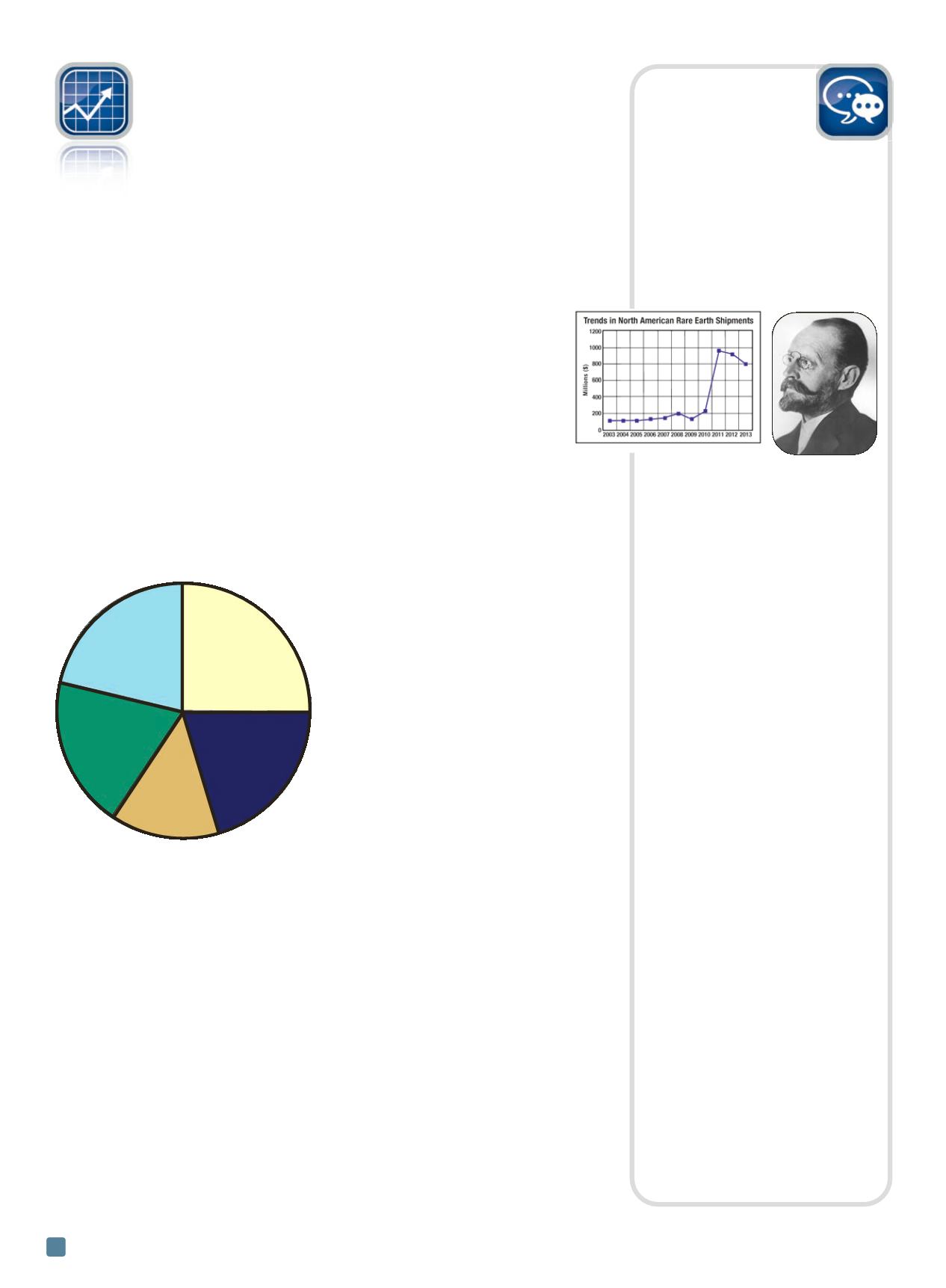
World Hydrogen Demand by Region, 2013
(255 billion cubic meters)
United
States
25.1%
Western
Europe
20.2%
China
14.1%
Other
Asia/Pacific
19.3%
All Other
21.3%
Source: The Freedonia Group Inc.