



 6 / 62

Predicting metal’s electrical response to extreme pressures
The semiconductor industry has long manipulated materials like silicon through the use
of pressure, a strategy known as strain engineering, to improve the performance of transis-
tors. But as the speed of transistors has increased, the limited speed of interconnects—the
metal wiring between transistors—has become a barrier to increased computer chip speed.
New research opens the door to a new variant of strain engineering that can be applied to the
metal interconnects, and other materials used to conduct or insulate electricity.
“We looked at a fundamental physical property, the resistivity of a metal, and show that
if you pressurize these metals, resistivity decreases. And not only that, we show that the de-
crease is specific to different materials—aluminum will show one decrease, but copper
shows another,” explains Nicholas Lanzillo, a doctoral candidate at Rensselaer Polytechnic
Institute, Troy, N.Y.
For more information: Nicholas Lanzillo, 518.276.6310,
rpi.edu.
British buildings use too much steel
New research from the University of Cambridge, UK, found
that the amount of steel used by the construction industry, and
the resulting carbon emissions, could be significantly lowered
by optimizing the design of new buildings in order to use less
material. Currently, to keep labor costs down, the construction
industry regularly uses double the material required by safety
codes. Analysis of more than 10,000 structural steel beams in 23
buildings across the UK found that on average, beams were only
carrying half the load they were designed for. Researchers also
found that building designs are exceeding Eurocode Safety Stan-
dards by a factor of two and are unnecessarily using double the amount of steel and con-
crete needed. Additionally, many buildings are being designed to last for 100 years but on
average are replaced after just 40.
By designing for minimum material rather than minimum cost, steel use in buildings
could be drastically reduced, leading to an equivalent reduction in carbon emissions, at
relatively low cost. The net result of avoiding over-design and early replacement is that the
UK could provide the same amount of built space with just 20% of the materials.
www.cam.ac.uk.
How to build a space laser
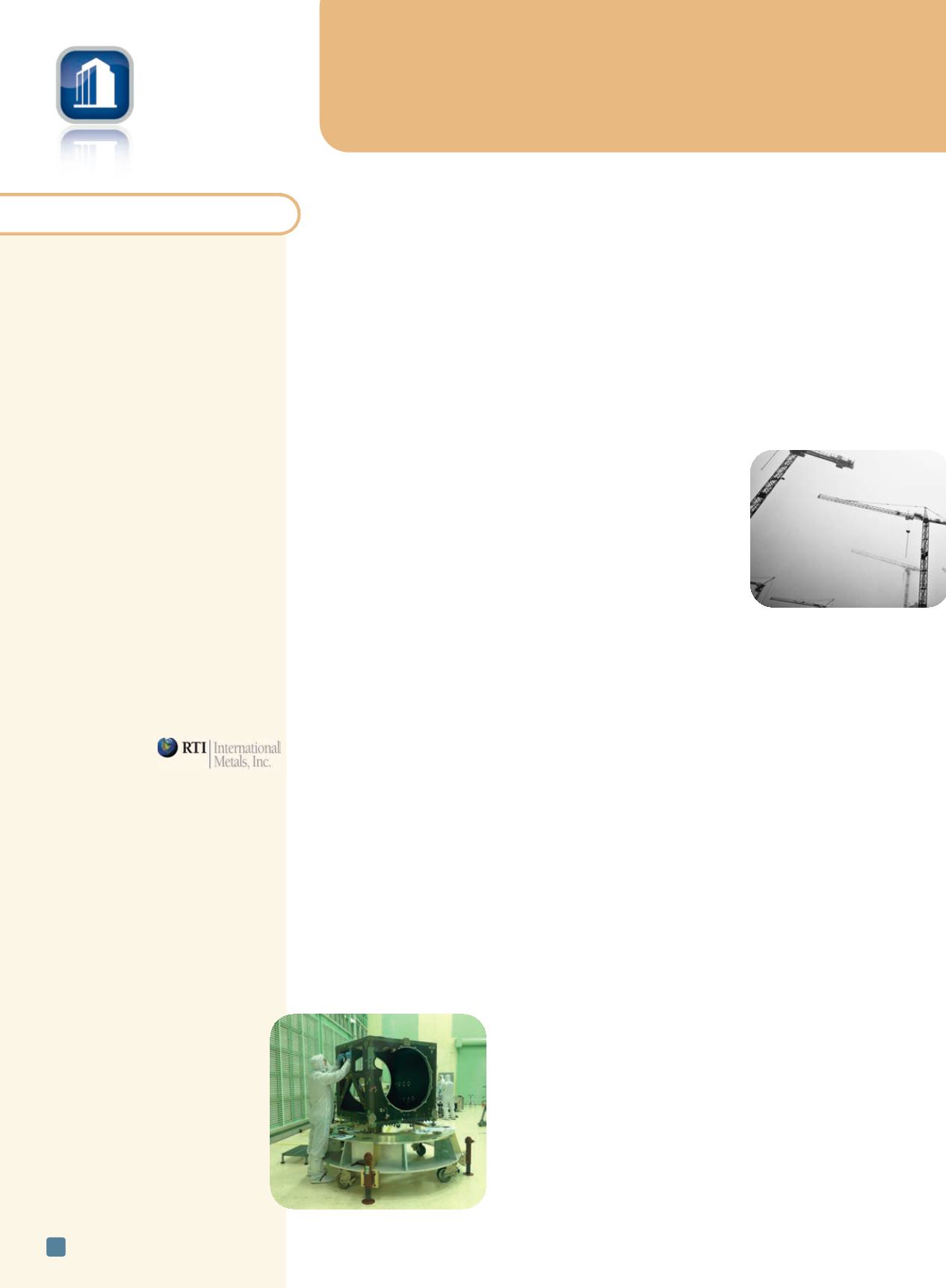
To construct a satellite that will measure all the bumps and dips of planet Earth, NASA
engineers started with a black box built of a composite honeycomb material to make it as
light as possible. The structure was precisely manufactured with an opening to allow lasers
to beam to Earth, and other windows sized for a telescope that will capture photons that
bounce off the planet and return to the satellite. The box was measured and marked to de-
note where the assembly of aligned mirrors, electronics, lasers, and photon detectors would
be attached. It must be tough enough to handle the rigors of a rocket launch and years in
a harsh space environment. Further, the box structure must be hardy enough to withstand
the tests engineers use to simulate those conditions.
ICESat-2’s instrument, the Advanced Topographic Laser
Altimeter System (ATLAS) will measure the elevation of
Earth’s surfaces, from ice sheets to forests to oceans. Six
beams will generate a more detailed elevation portrait than
a single beam of the original ICESat, which flew from 2003
to 2009. And with the beams paired, scientists will be able to
measure surface slope and better calculate height changes.
news
industry
briefs
AMG Advanced Metallurgical
Group N.V.,
the Netherlands,
announces that
AMG Titanium
Alloys and Coatings
was selected
by
SNECMA,
France, to provide
titanium aluminides for production
of the CFM International LEAP
engine. AMG’s TiAl materials will
be used to produce low-pressure
turbine blades for the engine,
which will be used in single aisle
aircraft. The new materials
withstand very high temperatures
(750°C) and will replace nickel-
base superalloys, reducing blade
mass and weight. This lightweight
material will reduce fuel
consumption by 15% compared to
the best engine in its class.
amg-nv.com,
snecma.com.
RTI International Metals Inc.,
Pittsburgh, acquired
Dynamet
Technology Inc.,
Boston, a
pioneer in titanium powder
metallurgy and supplier of near-net
shape titanium and titanium alloy
preforms and components to
commercial aerospace, defense,
biomedical, and industrial
customers.
Dynamet will be
included in RTI’s
Titanium Segment. Purchase terms
of the transaction were $15.5
million, plus potential future cash
consideration.
rtiintl.com,
dynamettechnology.com.
Wayne State University,
Detroit,
finalized a license agreement with
start-up company
Detroit
Materials Inc.
for a Wayne State
University patented portfolio of
high strength, low alloy steels and
cast irons for demanding
applications in the defense, off-
highway, tooling, and automotive
industries. Researchers have been
working to create advanced
materials with high yield strength,
fracture toughness, and ductility.
The result is a portfolio of bainitic
steels and austempered ductile
irons exhibiting an excellent
combination of mechanical
properties previously only available
in highly alloyed and costly exotic
steels.
wayne.edu.
M
ETALS
P
OLYMERS
C
ERAMICS
ADVANCED MATERIALS & PROCESSES •
AUGUST 2014
6
Courtesy of Andreas
Levers via Flickr.
An engineer checks ICESat-2’s box structure, shortly after its
arrival in a NASA cleanroom in May. Over the next two years,
engineers and technicians will attach electronics, optics, lasers, a
telescope and more to the box, testing its function at each step.
Courtesy of NASA’s Goddard Space Flight Center/Kate Ramsayer.