



 8 / 62

Imaging institute to accelerate materials development
The Department of Energy’s (DOE) Oak Ridge National
Laboratory, Tenn., launched the Institute for Functional Imag-
ing of Materials to accelerate discovery, design, and deploy-
ment of new materials. The facility will meld world-class
capabilities in imaging, high-performance computing, materi-
als science, and other scientific disciplines to probe materials.
The new institute also creates a focal point for ORNL’s
core capabilities: The lab is home to several major DOE Of-
fice of Science user facilities, including the fastest supercom-
puter in the U.S., the world’s most intense pulsed neutron
beam, and world-class facilities for electron/atom probe and
scanning probe microscopy; mass spectrometry; and opti-
cal, x-ray, and chemical imaging. Its Center for Nanophase
Materials Sciences, chemical sciences division, and materials science and technology divi-
sion provide state-of-the-art imaging capabilities.
ORNL’s newest institute will integrate computing and experimentation in real-time to
allow researchers to capture and analyze immense data streams. That new knowledge will
enable scientists to tailor materials to improve efficiency of tasks such as converting solar
energy to electricity, transporting energy to the grid, and converting chemical to electrical
energy in batteries.
ornl.gov.Self-propelled robot detects pipe leaks
Explosions caused by leaking underground gas
pipes frequently make headlines, but methods to ad-
dress such failing infrastructure have lagged far be-
hind. Leaks are typically found using aboveground
acoustic sensors, which listen for faint sounds and vi-
brations caused by leakage, or in-pipe detectors,
which sometimes use video cameras to look for signs
of pipe breaks. However, these systems are slow and
can miss small leaks altogether.
Researchers at Massachusetts Institute of Tech-
nology (MIT), Cambridge, and King Fahd University
of Petroleum and Minerals in Saudi Arabia devised a
robotic system that can detect leaks at a rapid pace
and with high accuracy by sensing a large pressure change at leak locations. The new sys-
tem “can detect leaks of just 1 to 2 mm in size, and at relatively low pressure,” says Dimitrios
Chatzigeorgiou, a Ph.D. student in mechanical engineering at MIT. The small robotic de-
vice can move as fast as 3 mph through pipes and is almost entirely automated. Such ro-
bots could eventually be put into a system of pipes and left in place indefinitely, conducting
automatic, nonstop system monitoring.
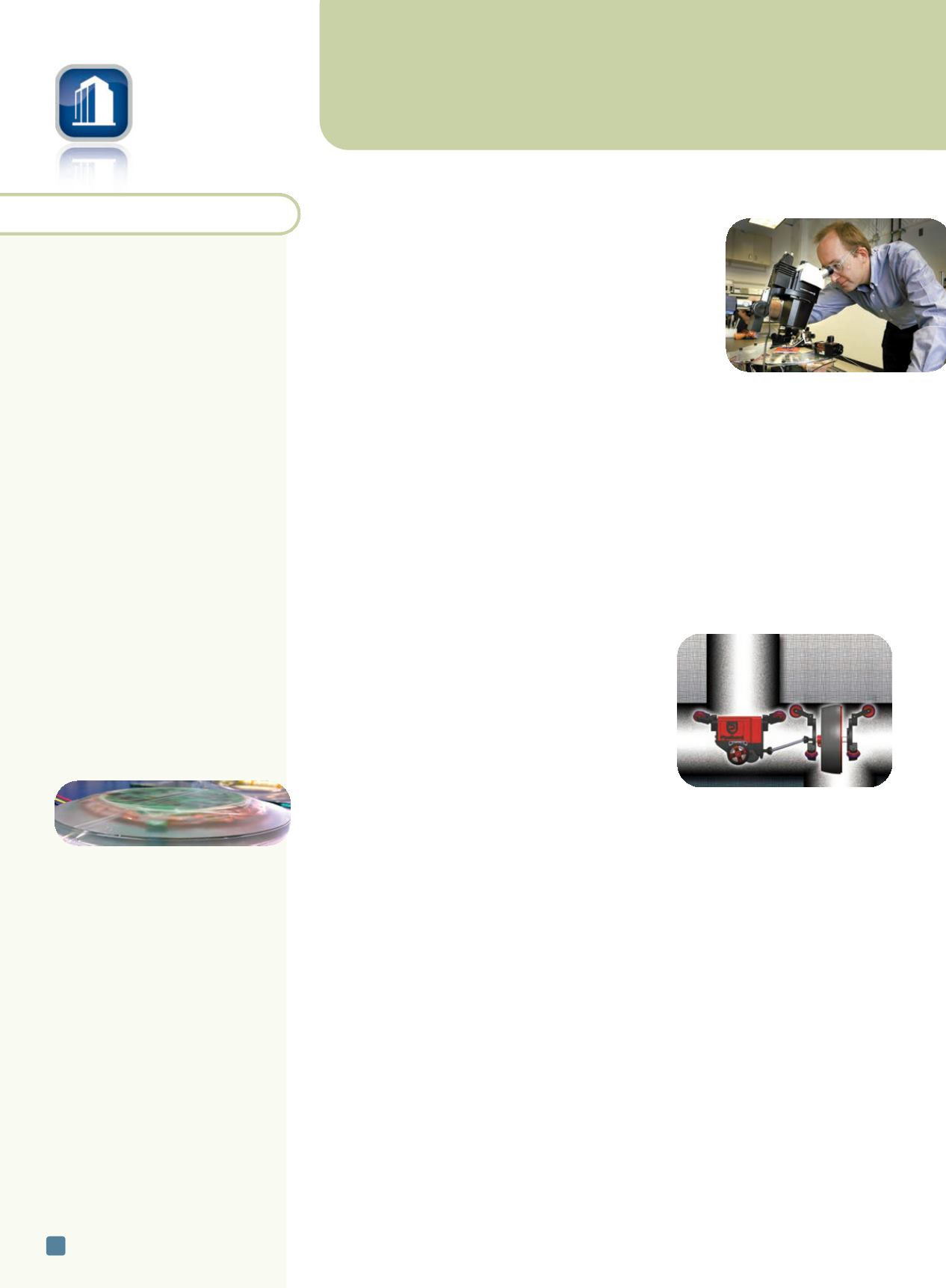
The device consists of two parts—a small robot with wheels to propel it through pipes
and a drumlike membrane that forms a seal across the width of the pipe. When a leak is en-
countered, liquid flowing toward it distorts the membrane, pulling it slightly toward the
leak site. That distortion can be detected by force-resistive sensors via a carefully designed
mechanical system and the information sent back through wireless communications. Due
to the membrane’s sensitivity, the team believes the system can detect leaks one-tenth to
one-twentieth the size of those that can be detected by current methods.
For more infor-
mation: Dimitrios Chatzigeorgiou,
dchatzis@mit.edu,
mit.edu.
Using protons to capture microscopic images
A new facility that uses protons to take microscopic images was recently commissioned
at the ring accelerator of the Helmholtz Centre for Heavy Ion Research (GSI) in Germany. The
briefs
Element Materials Technology,
the Netherlands, acquired
Accutek
Testing Laboratory,
Fairfield,
Ohio, a materials testing business
serving the aerospace and medical
device sectors. Accutek, a
specialist in a wide range of
mechanical tests, metallurgical
tests, weld services, and
consultation, is based in a 54,000-
sq-ft laboratory in Cincinnati. The
lab is Nadcap accredited for both
metallic and nonmetallic materials
testing.
element.com.
Nanoelectronics research center
imec
and
Ghent University,
both
in Belgium, and their partners in
the European FP7 project known
as
SmartFiber
demonstrated what
is reportedly the world’s first
miniaturized fiber-optical sensor
system than can be fully
embedded in a composite material.
The achievement paves the way
toward smart composites that
enable continuous, automatic
structural health monitoring of
composite materials used in tidal
blades, wind turbines, airplanes, or
marine structures, for example.
www.smartfiber-fp7.eu.
“Interrogator” (10 cm diameter)
after embedding in a protective
epoxy shell with shape optimized
for minimal impact on composite
structural strength.
The University of Notre Dame,
South Bend., Ind., and
General
Electric Co.
will build a $36 million
research and test facility with the
goal of making better massive gas
turbines used by aircraft, power
plants, and the oil and gas
industry. The facility will include
five test bays to allow researchers
to simulate full-scale engine
operating environments.
Construction is scheduled to begin
this summer at the former
Studebaker Corp.
site in South
Bend, which closed in 1963.
nd.edu,
ge.com.
ADVANCED MATERIALS & PROCESSES •
AUGUST 2014
8
T
ESTING
C
HARACTERIZATION
news
industry
Sergei Kalinin is the inaugural
director of ORNL’s Institute
for Functional Imaging of
Materials. Courtesy of Jason
Richards, ORNL.
Illustration of robotic device that can
speed through pipes, pinpointing
leaks more accurately than existing
methods. Courtesy of Christine
Daniloff/MIT.