


 38 / 54

ADVANCED MATERIALS & PROCESSES •
FEBRUARY 2014
38
i
T
S
S
e
10
The
Journal of Thermal Spray
Technology (JTST),
the official
journal of the ASM Thermal
Spray Society, publishes contri-
butions on all aspects—funda-
mental and practical—of
thermal spray science, including
processes, feedstock manufac-
ture, testing, and characteriza-
tion. As the primary vehicle
for thermal spray information
transfer, its mission is to syner-
gize the rapidly advancing thermal spray industry and related
industries by presenting research and development efforts
leading to advancements in implementable engineering ap-
plications of the technology. Articles from the October and
December issues, as selected by
JTST
Editor-in-Chief Chris-
tian Moreau, are highlighted. The December issue features
papers from the 2012 Asian Thermal Spray Conference, or-
ganized by guest editor Dr. Seiji Kuroda. The last two articles
highlighted below are from this special issue. In addition to
the print publication,
JTST
is available online through
www.springerlink.com. For more information, please visit
www.asminternational.org/tss.“Improved Thermal Cycling Durability
of Thermal Barrier Coatings
Manufactured by PS-PVD”
S. Rezanka, G. Mauer, and R. Vaßen
The plasma spray-physical vapor deposition (PS-PVD) process
shows promise for the manufacture of thermal barrier coatings
(TBCs). The durability of PS-PVD manufactured columnar TBCs
is strongly influenced by the compatibility of the metallic bond-
coat (BC) and ceramic TBC. Earlier investigations show that a
smooth BC surface is beneficial for durability during thermal cy-
cling. Further bond improvements between BC and TBC could be
achieved by optimizing the formation of the thermally grown
oxide (TGO) layer. In the present study, parameters of pre-heating
and deposition of the first coating layer were investigated in order
to adjust TGO growth. The durability of PS-PVD coatings was
improved while maintaining a much higher deposition rate in
comparison to EB-PVD. Improved thermal cycling lifetimes more
than two times higher than conventionally sprayed TBCs were
measured in burner rigs at ~1250°C/1050°C surface/substrate ex-
posure temperatures.
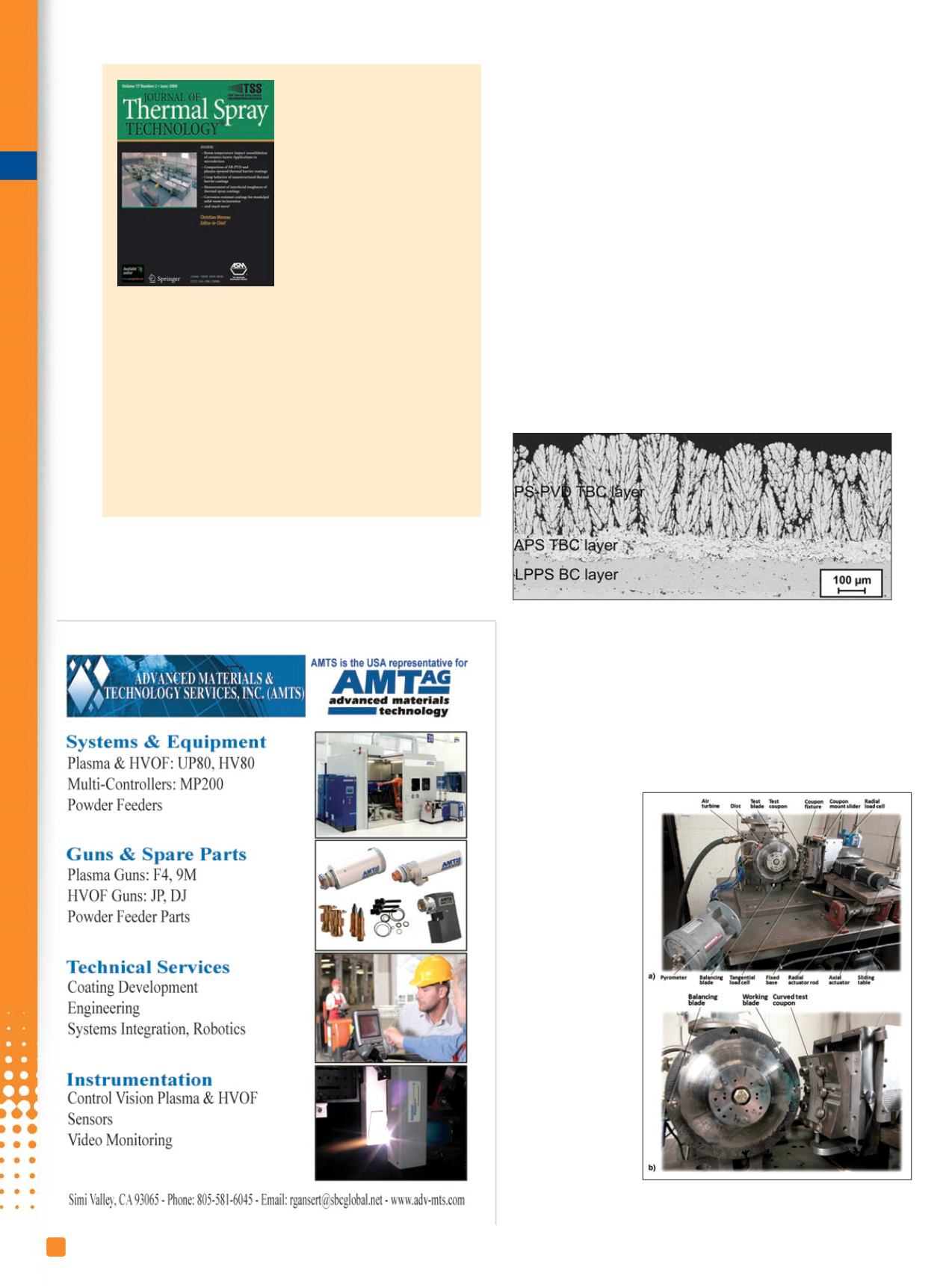
Scanning electron micrograph (back-scattered electron image) of
double-layer system with 50 lm APS layer.
“Tribological Characterization of
Plasma-Sprayed CoNiCrAlY-BN Abradable
Coatings”
E. Irissou, A. Dadouche, and R.S. Lima
Plasma spray torch parameters were varied to produce a set of
abradable coatings exhibiting a broad range of porosity levels (34-
62%) and superficial Rockwell hardness values (0-78 HR15Y).
Abradability tests
were performed using
an abradable-seal
test rig, capable of
simulating opera-
tional wear at dif-
ferent rotor speeds
and seal incursion
rates (SIRs). Tests
determined rubbing
forces and quanti-
fied blade and seal
wear characteristics
for slow and fast
SIRs. Erosion wear
performance and
ASTMC633 coating
adhesion strength
test results are also
reported. For opti-
mal abradability
performance, coat-
ing hardness needs
to be lower than 70
(a) General view of the abradable test rig.
(b) Close-up view of the test section.
JTST HIGHL IGHTS