



 33 / 54

O
ne of the many
threats the U.S. mil-
itary must con-
stantly defend against is
particularly insidious and ad-
vances imperceptibly as it
silently erodes the integrity
of military, municipal, and
global infrastructures—cor-
rosion. It is an ever present
and relentless enemy that varies in both intensity and hos-
tility, and combating it requires considerable time and ex-
pense.
Based on extensive research, the U.S. Army and Army
Corps of Engineers recently coordinated a new front in the
war against corrosion by employing potent emerging tech-
nologies that promise a more effective, yet lower-cost de-
fense than current protective methods achieve. Considered
the military’s center of expertise for corrosion prevention
based on its responsibility for structures such as locks,
dams, and bridges, the Army Corps of Engineers is
presently conducting these procedures under the most rig-
orous conditions because its interests include a vast infra-
structure constructed in some of the world’s most extreme
environments.
Challenges
In the past, anti-corrosive approaches used almost ex-
clusively by the military to protect steel structures con-
sisted of a three-part process that was proven to be
effective, but costly. This technology, largely unchanged
for three decades, begins with a base coat heavily loaded
with zinc as the primary defense. However, the density of
the zinc results in an inherently unstable and brittle base
coat. The second, intermediate coat provides a barrier to
moisture and oxygen, reducing the brittleness issue. The
third and final coat imparts color and surface finish.
Surface preparation and material application represent
the major expenses related to painting large structures. The
traditional, three-coat system is both cumbersome and
costly. Another drawback is the high lead content, which
can create environmental issues during application and
often requires extensive precautions when being removed
or in preparation for repainting. While not common, issues
with adhesion failure related to high zinc levels also can
occur. Other problems can arise when inadequate or incor-
rect surface preparations cause serious and sometimes cat-
astrophic peeling after a relatively short time due to poor
bonding between the surface and zinc-rich base layer.
Solutions
As a result of these challenges, the
Army and the Army Corps worked
with Tesla NanoCoatings to develop
an enhanced defense against corro-
sion. Over the past eight years, this
included the testing and documenta-
tion of a new carbon nanocoating
that provides superior corrosion pro-
tection through a two-coat system
that is applied like paint, acts like
plating, and relies on a much lower
zinc content to eliminate an interme-
diate coat.
Lost conductivity resulting from
reduced zinc content is offset by
highly conductive carbon nanotubes
(CNTs) that self-assemble into rope
structures. In addition to enhanced
conductivity, nanotechnology also
imparts 5-10 × the adhesion strength
compared to traditional methods. This
builds stability into an inherently un-
stable primer, making adhesion fail-
ure far less likely.
CNTs help create a base layer that
is not only highly conductive, but also
abrasion-resistant, tough, and flexi-
ble. In addition, it is cost effective as it eliminates an entire
application step, features a lifecycle that can last twice as
long as traditional coating systems, and requires no special
training to apply. It is also compatible with conventional
paint application equipment and is formulated with a lower
lead content to reduce environmental issues in application
and removal.
Results and conclusions
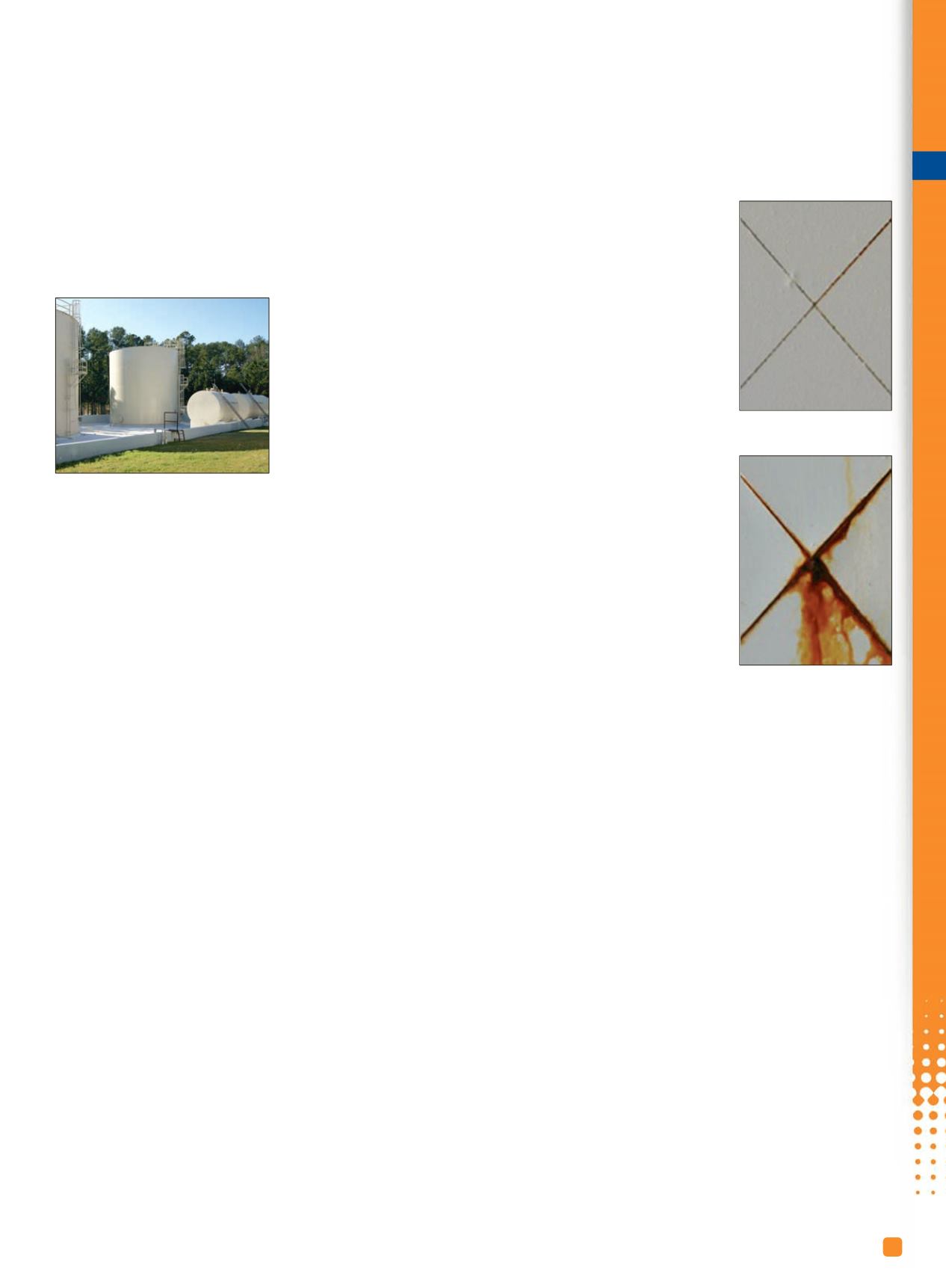
Based on the results of initial standardized testing, the
Army Corps of Engineers deployed the Teslan coating
from Tesla NanoCoatings in a number of field demonstra-
tion projects such as fuel tanks, pipelines, water towers,
and bridges at military installations throughout North Car-
olina and Washington. Due to the significance of Tesla’s
technology, the U.S. Army identified its corrosion technol-
ogy as a “technical solution.”
While the Army Corps of Engineers continues to moni-
tor the performance of its present demonstration projects,
Teslan has begun test applications in various other indus-
tries including petrochemical facilities and oil and gas well
sites where corrosion is a common problem.
iTSSe
For more information:
Todd Hawkins is president of Tesla
NanoCoatings Inc., 1311 20th St SW, Massillon, OH 44647,
330/837-1840,
www.teslanano.com.
i
T
S
S
e
5
ADVANCED MATERIALS & PROCESSES •
FEBRUARY 2014
33
Nanocoating Provides
Superior Corrosion Protection
Via Two-Coat System
Todd Hawkins
Tesla NanoCoatings Inc.
Massillon, Ohio
Fig. 2 —
Standard 3-coat
system, 12.9 total mils.
Fig. 1 —
Teslan 2-coat
system, 8.5 total mils.