


 37 / 54

i
T
S
S
e
9
ADVANCED MATERIALS & PROCESSES •
FEBRUARY 2014
37
A
s part of a research project funded by the National
Science Foundation and Rolls Royce Inc., scien-
tists developed a novel method of measuring
stress and damage in the protective ceramic coatings ap-
plied to turbine engine blades to prolong their life. Blades
are exposed to some of the most intense heat generated by
the engine, and their reliability is crucial to extending en-
gine performance. The thermal barrier coatings that pro-
vide insulation between the cooled blade and the hot gases
in the engine are highly stressed and age over time eventu-
ally resulting in failure.
Maintenance crews currently rely on visual blade in-
spections to judge wear and tear along with a routine main-
tenance schedule based on engine performance data
accumulated over time. If the protective ceramic coating
is severely damaged internally, cracked, or chipped, the tur-
bine blades can be damaged and even melt under the en-
gine’s intense temperatures. Amore quantitative approach
to determine the remaining life of the coating is desired so
that good blades can be returned to service while coatings
near the end of their life can be replaced.
A process that uses laser technology to measure stress
and damage in the ceramic coatings by exciting the bond-
ing material between the coating and metallic blades was
recently refined by UConn researchers. A low power laser
is focused through the coating and the energy from the
laser makes the bonding material fluoresce and that fluo-
rescence is stress-dependent. During the process, the wave-
length of light emitted by the fluorescence can be measured
to determine how strong the bond is, how much viable
coating is left, and whether the blade is damaged and prone
to failure.
Previous lab correlation work indicates that when the
coating is first made, it is very high stress because the bond
between the coating and metal is stronger. As the coating
cracks, the stress becomes less and less, and when it be-
comes too low, it simply flakes off. Determining this stress
is key to predicting remaining life. However, applying this
technique to actual hardware from an engine exposed new
challenges.
Turbine jet engines—because they draw in huge quan-
tities of outside air—are notorious for accumulating a lot of
dust and other contaminants during performance, which
makes testing the stress of engine blade coatings difficult.
The contaminant on the turbine blades is highly irregular
and in some places it is very thick and in others very thin.
Attempting to sand it off would damage the ceramic coat-
ing itself and using chemicals would eat through the coat-
ing as well.
To get around this, a technique was developed that uses
a pulsing laser to blast off the fine layer of contaminants,
without damaging the underlying ceramic coating or
blades. The laser is focused to a sufficient energy density
to ionize the contaminants, ripping them off the surface and
making them glow. Each laser pulse strips away about 1 µ
of material at a time. By monitoring the ionization process
with a spectrometer, the chemical composition of the re-
moved material can be determined and the point at which
all the contaminant is removed can be detected.
After the surface has been cleaned, the stress meas-
urement can be performed. The technique has been de-
veloped into an instrument that can automatically clean
an area on a blade and perform stress maps across the
surface of the blade. It is a unique application of the same
technology used by the Mars Rover to determine the
chemical composition of rocks, and by art experts to re-
store valuable paintings to their original condition if they
have been touched up or altered over time.
Development of an application for the technology to
make it more portable for use while engines are still in
service and attached to a plane is underway.
iTSSe
For more information:
Mike Renfro is UTC associate profes-
sor of engineering innovation and associate department head,
University of Connecticut, 860/486-5934,
renfro@engr.uconn. edu, www.uconn.edu.
Method Measures Ceramic Coating
Stress and Damage
on Turbine Blades
Researchers are supplying the aerospace
industry with innovative technologies to
support the next generation of more
efficient and reliable aircraft.
Mike Renfro
Eric Jordan
University of Connecticut, Storrs
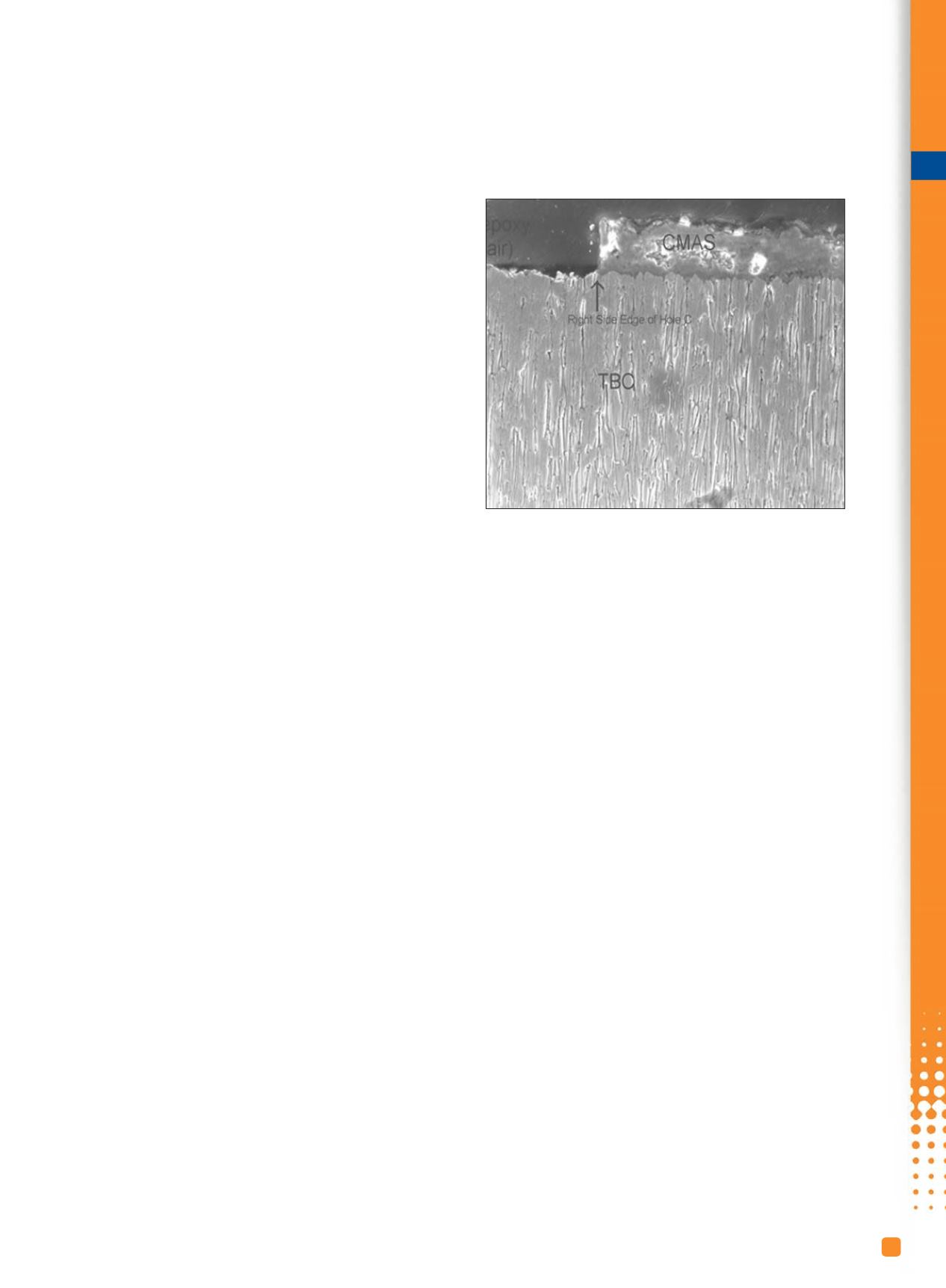
Fig. 1 —
An image showing the successful laser ablation of
contaminants from the thermal barrier coating on the surface
of a turbine engine blade. Courtesy of Michael Renfro/
Surface & Coatings Technology.