



 40 / 54

and 50 HR15Y for slow and fast blade incursion rate conditions,
respectively. Erosion wear performance, as well as coating cohe-
sive strength, was shown to be a function of coating hardness. Cur-
rent results define coating specifications in terms of hardness and
porosity for targeted applications.
“Fundamental Cost Analysis
of Cold Spray”
O. Stier
The cost structure of the cold spray (CS) process is analyzed
using a generic cost model applicable to all current types of CS
systems and applications. The cost model was originally devel-
oped at Siemens and is easy to use and sufficiently accurate.
Process costs depend on gas stagnation properties and are dis-
cussed. Results indicate that high pressure is generally favorable,
He-N
2
blends possess economic potential, and He recovery saves
costs in high volume production (even when He-N
2
blends are
used). The cost model determines the cost-optimal He concentra-
tion of the propellant gas for a given application. CS is, among
others, suited to spray bond coatings on gas turbine blades and of-
fers cost-saving potential, as shown.
i
T
S
S
e
12
40
ADVANCED MATERIALS & PROCESSES •
FEBRUARY 2014
JTST HIGHL IGHTS
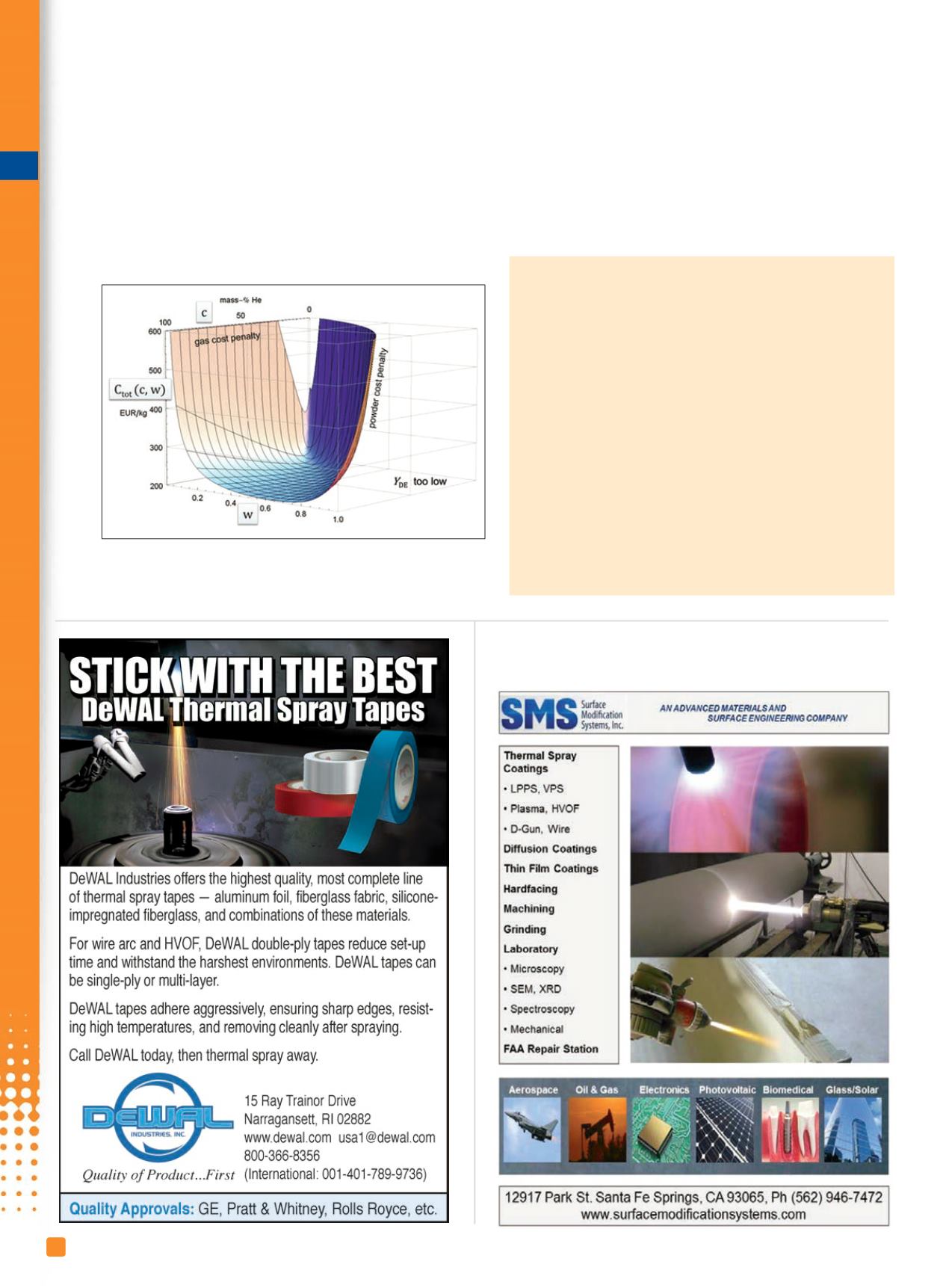
Dependence of the total costs, C
tot
, of cold-sprayed MCrAlY
coatings on the He mass fraction c of the propellant gas and the
powder-to-gas mass loading ratio w when He is recovered with
85% capture efficiency.
Education Course:
Introduction to Thermal Spray
May 5-6, 2014
ASM Headquarters
Materials Park, Ohio
Instructor: Richard A. Sayman
As the thermal spray profession has changed, so has
the need to ensure safe and consistent methods for ther-
mal spray operators. Leaders in the Thermal Spray So-
ciety compiled their knowledge and experience to
provide a comprehensive, easy-to-understand course.
This course provides a strong knowledge and awareness
of the five critical areas of thermal spray: Safety, prepa-
ration, troubleshooting, spraying, and keeping records,
and the required tasks associated with these areas.
Visit
www.asminternational.org/educationto learn more.