



 11 / 54

ADVANCED MATERIALS & PROCESSES •
FEBRUARY 2014
11
S
URFACE
E
NGINEERING
news
industry
briefs
Abakan Inc.,
Miami, completed
Phase I and II of its PComP
nanocomposite coatings growth
and expansion strategy, which
involved installing additional
powder microencapsulation
equipment to double throughput
and added more nanoparticle
production equipment and
sintering furnaces to expand
production to 18 tons per year.
Phases III and IV are scheduled to
expand production to 60 and then
180 tons per year throughout this
year. Further growth and
expansion plans call for the
acquisition of up to 10 U.S.-based
thermal spray production
businesses that serve the growing
oil and gas sector.
www.abakaninc.com.
New coatings developed with
European Union
support enable
the release of healing agents in
response to changes in the
environment. The novel
nanomaterials and coating
technologies were developed by
the EU-funded project
Multi-level
protection of materials for
vehicles by “smart”
nanocontainers (MUST).
Miniature containers
(nanocontainers) were loaded with
healing agents and incorporated
into multilayer coatings. Changes
in the environment release the
agents and help transport them
throughout the coating. Some of
MUST's top performers include
pre-treatments and primers for
corrosion inhibition in automobile
and aircraft components.
http://cordis.europa.eu.
Magnetic pollen replicated for tailored adhesion
Researchers at the Geor-
gia Institute of Technology,
Atlanta, created magnetic
replicas of sunflower pollen
grains using a wet chemical,
layer-by-layer process that
applies highly conformal iron
oxide coatings. The replicas
possess natural adhesion
properties inherited from the
spiky pollen particles while
gaining magnetic behavior,
allowing for tailored adhesion
to surfaces. Researchers
chose particles from the sunflower (Helianthus annuus). The sunflower pollen grains are
nearly spherical, but covered with spikes that can entangle with the hairs on bees’ legs, or
adhere to surfaces via van der Waals forces at nanometer-scale distances, explains Profes-
sor Ken Sandhage.
The burr-like pollen particles were washed with chloroform, methanol, hydrochloric acid,
and water to clean the surfaces and expose hydroxyl groups for chemically attaching their
coating. Iron oxide was applied using an automated, layer-by-layer surface sol-gel process
developed earlier for coating diatom shells made of silica. Reaction of the iron oxide precur-
sor with the hydroxyl groups on the surface of the pollen particles results in highly confor-
mal coatings.
For more information: Ken Sandhage, 404/894-6882,
ken.sandhage@mse.gatech. edu, www.gatech.edu.
Tougher dies for automotive manufacturing
Manufacturers need processes
that increase the lifetime of dies and
reduce setup times, such as laser
metal deposition. A universal, repro-
ducible process for practical indus-
trial use is lacking, however. This
deficiency was remedied by re-
searchers from the Fraunhofer Insti-
tute for Production Technology IPT,
Germany. They rebuilt a conventional
five-axis milling machine so that it
could be used to alloy forming dies
automatically via laser. The machine
can be embedded into the current
manufacturing process and increase
the lifetime of dies by more than
150%. The new process also improves
the quality of components and makes
it possible to plan setup times with greater precision.
In addition to the laser metal deposition machine, another key part of
the system is the integrated CAx software, which allows all the requisite
laser surface treatment processes to be controlled in a clear and repro-
ducible manner. All necessary process parameters are transmitted to the
machine without the need for any interface. Processes can be simulated in
detail and optimized in advance of actual processing operations.
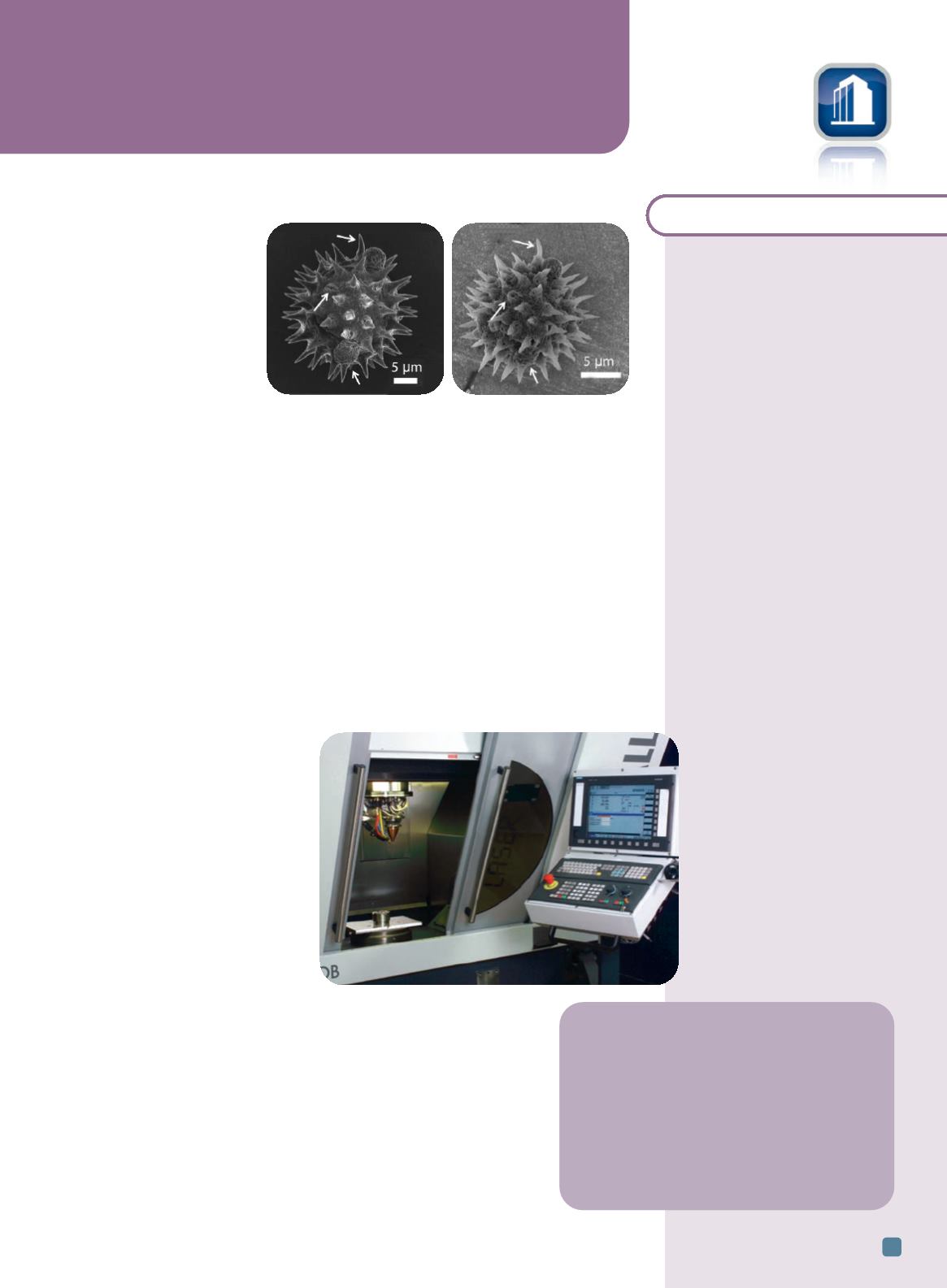
www.ipt.fraunhofer.de/en.html.SEM images of a pollen particle (left) coated with iron oxide
and a replica of the same particle (right) after firing at 600°C
to remove the organic material and crystallize the iron oxide.
Arrows point to features preserved by the process. Courtesy
of Brandon Goodwin and Ken Sandhage.
Alcoa,
Pittsburgh, developed a proprietary surface finish-
ing technology that enables consumer electronics compa-
nies to use aerospace-grade aluminum to make thinner,
lighter, and stronger mobile devices. ProStrength Finish-
ing Technology is a process that allows mobile device
manufacturers to design clear or color-anodized durable
surfaces using high strength, heat treatable aluminum al-
loys employed in the aerospace and defense industries.
Using high strength alloys could reduce the thickness and
weight of a device by more than 50%. Being able to use
aerospace-grade alloys promotes the trend toward ever
thinner and lighter mobile devices.
www.alcoa.com.
Using laser metal deposition makes
the forming die from Mühlhoff
Umformtechnik GmbH more robust.
Courtesy of Fraunhofer IPT.