



 10 / 54

news
industry
briefs
Researchers at DOE’s
SLAC
National Accelerator Laboratory
and
Stanford University,
Calif., say
they built the first battery electrode
that heals itself, potentially opening
a new and commercially viable path
for making next-generation lithium
ion batteries. The secret is a
stretchy polymer that coats the
electrode, binds it together, and
spontaneously heals tiny cracks
that develop during battery
operation.
www6.slac.stanford.edu.
Stanford researcher Chao Wang
holds a solid piece of the
self-healing polymer used to
protect silicon battery
electrodes. Courtesy of Brad
Plummer/SLAC.
The
U.S. Army Research
Laboratory
extended
UC Santa
Barbara’s Institute for
Collaborative Biotechnologies
(ICB) contract, providing an
additional $48 million over three
years to support research inspired
by biological systems. ICB
supports basic research in six
themes inspired by nature, such
as the structure of sea sponges
and adhesion of gecko feet.
Themes range from
understanding complex biological
systems on a cellular level to
engineering synthetic materials
inspired by natural models.
www.ucsb.edu.
A composite of multiwalled
carbon nanotubes and carbon
black serves as the matrix for in
situ nucleation and growth of
Pt nanocrystals. Courtesy of
Peter Allen/UCSB.
Modeling metamaterials makes strides
A team led by Ecole polytechnique
fédérale de Lausanne (EPFL), Switzerland,
found a way to create computational models
that can be applied to a range of metamateri-
als—artificial materials with properties not
normally found in nature. Metamaterials are
made of microscopic pieces of common ma-
terials like metals or plastics, which are
arranged in precise repeating patterns, giving
them unusual properties. For example, pat-
terns designed at subwavelength sizes can af-
fect and manipulate light or sound waves in unconventional ways.
The best way to predict the full spectrum of metamaterial properties is through
computer modeling, which requires some mathematical abstraction. A team led by Jan
Hesthaven developed a computational approach that seeks to improve modeling ef-
forts. An approach called the discontinuous Galerkin method, a class of numerical
methods for solving differential equations, as well as a set of differential equations
known as Maxwell’s equations that describe how electromagnetic waves propagate in
space and time, are used to model metamaterials. In order for a computer model to
work, equations must be translated from continuous functions into discrete or noncon-
tinuous ones.
Building on previous efforts, researchers developed a new way to solve Maxwell’s equa-
tions specifically for metamaterials. The new method can greatly improve computer mod-
eling of these materials, allowing faster discovery, design, and manufacturing of new forms
and structures, says Hesthaven.
www.epfl.ch.
New approach to create 2D hybrid materials
Researchers at the
DOE’s Oak Ridge
National Laboratory
(ORNL), Tenn., and
the University of
Tennessee, Knoxville,
created a new tech-
nique to form a 2D,
single-atom sheet
of two different mate-
rials with a seamless
boundary. The team
combined two com-
pounds, graphene and boron nitride, into a single layer only one atom thick.
One method to combine materials into heterostructures is epitaxy, in which one ma-
terial is grown on top of another so both have the same crystalline structure. To grow the
2D materials, the team directed the growth process horizontally instead of vertically.
Graphene was first grown on copper foil, etched to create clean edges, and then boron ni-
tride was grown using chemical vapor deposition. Instead of conforming to the structure
of the copper base layer as in conventional epitaxy, the boron nitride atoms took on the
crystallography of the graphene.
Not only did the technique combine the two materials, it also produced an atomically
sharp boundary, a 1D interface, between them. This method can be applied to other com-
binations of 2D materials, assuming the different crystalline structures are similar enough
to match one another, according to ORNL’s An-Ping Li.
For more information: An-Ping Li,
865/576-6502,
apli@ornl.gov,
www.ornl.gov.ADVANCED MATERIALS & PROCESSES •
FEBRUARY 2014
10
E
MERGING
T
ECHNOLOGY
Metamaterials have properties not normally
found in nature and are useful in advanced
optics.
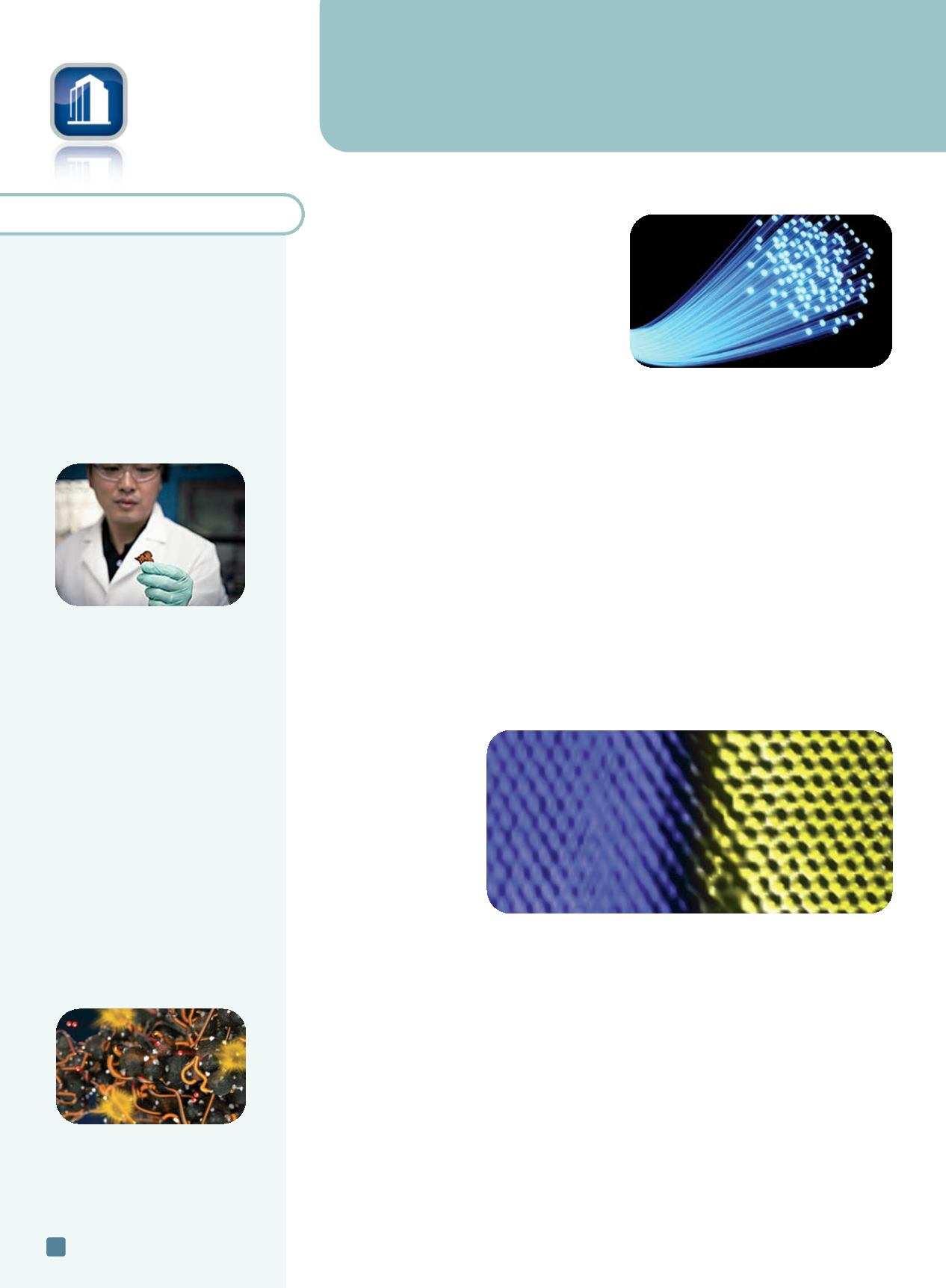
Colorized scanning tunneling microscope image shows a single-atom
sheet composed of graphene (blue) combined with hexagonal boron
nitride (yellow). Courtesy of ORNL.