


 34 / 58

edfas.org
ELECTRONIC DEVICE FAILURE ANALYSIS | VOLUME 19 NO. 2
34
sensitivity, spatial resolution, and robust statistical analy-
sis to broaden the range of applications in failure analysis
addressed by nanoscale IR spectroscopy.
REFERENCES
1. G.E. Moore: “CrammingMore Components onto Integrated Circuits,”
Proc. IEEE
, 1998,
86
, pp. 82-85.
2. G.L. Carr, D. DiMarzio, M.B. Lee, and D.J. Larson, Jr.: “Infrared
Microspectroscopy of Semiconductors at the Diffraction Limit,”
Semiconductor Characterization
, W.M. Bullis, D.G. Seiler, and A.C.
Diebold, Ed., AIP Press Conf. Proc., Woodbury, NY, 1996, pp. 418-21.
3. R.J. Nemanich: “Raman Spectroscopy for Semiconductor Thin Film
Analysis,”
MRS Proc.
, 1986,
69
, pp. 23-38.
4. M.K.F. Lo, A. Dazzi, C.A. Marcott, E. Dillon, Q. Hu, K. Kjoller, C.B. Prater,
and S. King: “Nanoscale Chemical-Mechanical Characterization of
Nanoelectronic Low-kDielectric/Cu Interconnects,”
ECS J. SolidState
Sci. Technol.
, 2016,
5
, pp. 3018-24.
5. A. Dazzi and C.B. Prater: “AFM-IR: Technology and Applications in
NanoscaleInfraredSpectroscopyandChemicalImaging,”
Chem.Rev.
,
Article ASAP, 2016, doi: 10.1021/acs.chemrev.6b00448.
6. B. Lahiri, G. Holland, and A. Centrone: “Chemical Imaging beyond
theDiffraction Limit: Experimental Validationof thePTIRTechnique,”
Small
, 2012,
9
, pp. 439-45.
7. F. Lu, M. Jin, and M.A. Belkin: “Tip-Enhanced Infrared Nanospec-
troscopy via Molecular Expansion Force Detection,”
Nature Photon.
,
2014,
8
, pp. 307-12.
8. A. Dazzi, J. Saunier, K. Kjoller, andN. Yagoubi: “Resonance Enhanced
AFM-IR: A NewPowerful Way to Characterize Blooming on Polymers
Used in Medical Devices,”
Int. J. Pharm.
, 2015,
484
, pp. 109-14.
ABOUT THE AUTHORS
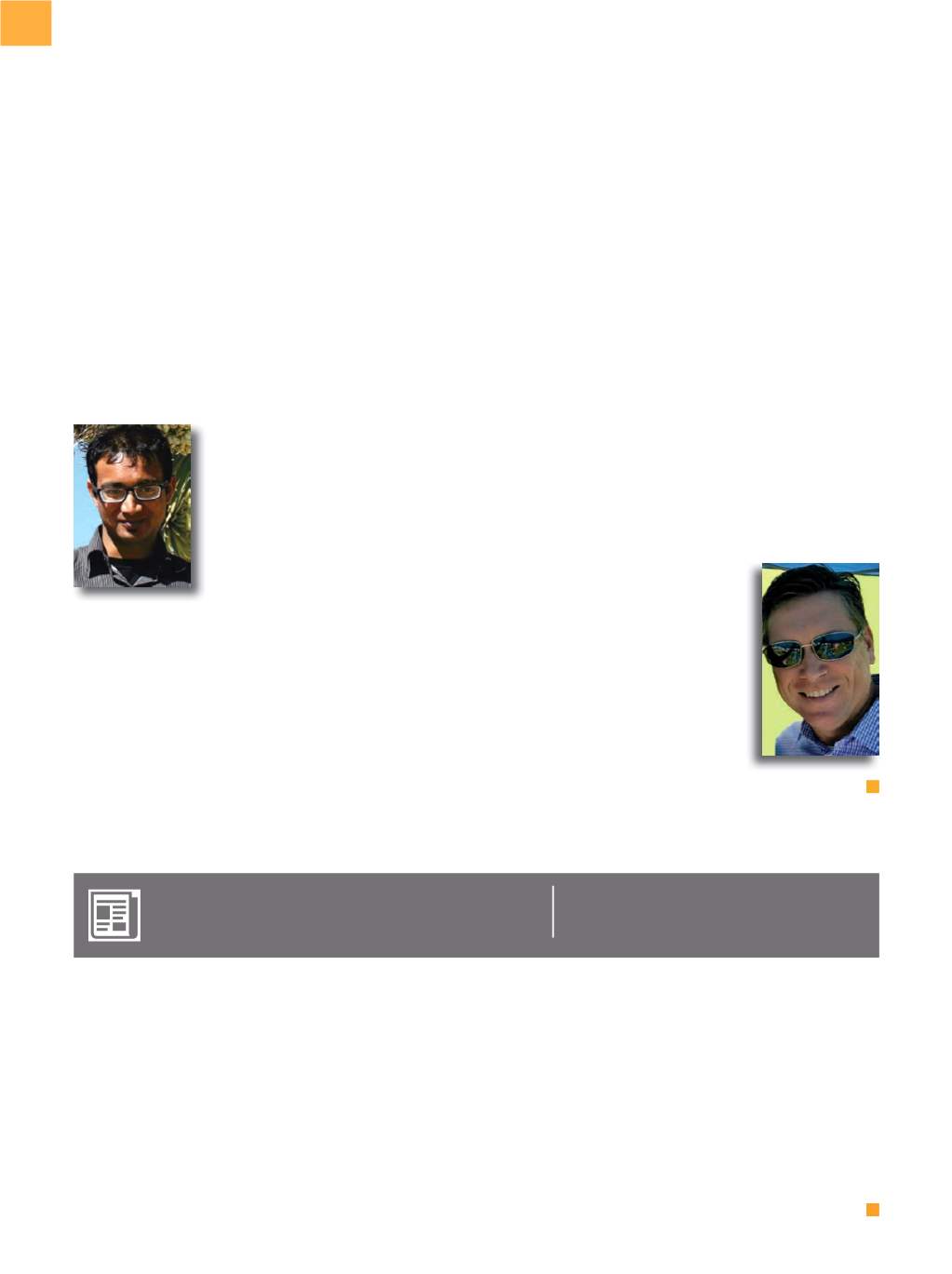
Anirban Roy
is an applications scientist at Anasys Instruments Corp. in Santa Barbara, Calif.
He received a Ph.D. in experimental physical chemistry from the University of Southern California,
where his research involved development and implementation of different ultrafast spectroscopic
techniques to explore laser-induced dynamics of active biomolecules, for example, DNA and amino
acids, in liquids. Dr. Roy holds a B.Sc. from Jadavpur University and a M.Sc. from the Indian Institute
of Technology Kanpur, majoring in chemistry.
Jay Anderson
is currently the North American sales manager for Anasys
Instruments. His former experience includes AFM, FTIR, Raman, and other
spectroscopy and metrology techniques. Jay’s experience within spectroscopy and AFM is uniquely
suited for applications involving nanoscale chemical spectroscopy and imaging. He attended Old
Dominion University and received a B.S. in electrical engineering with an emphasis on chemistry.
Jay works as a technical writer and has assisted in developing instruments for narcotic detection,
improved attenuated total reflectance integration, automatic accessory recognition, and other
instrumentation developments.
ESREF 2017
The 28th European Symposium on Reliability of Electron Devices (ESREF ’17) will take place
September 25 to 28,
2017
, in Bordeaux, France. The international symposium continues to focus on recent developments and future direc-
tions in quality, robustness, and reliability research of materials, devices, components, and circuits for nano-, micro-,
power-, optoelectronics, and MEMS sensors. It provides the leading European forum for developing all aspects of reli-
ability management as well as innovative microstructure and techniques for present and future electronics. At ESREF
2017, the aeronautics, space, and embedded systems industries will provide specific topics, such as radiation hardening,
very long-term reliability, high-/low-temperature challenges, obsolescence and counterfeit issues, wide band-gap power
devices for electric aircraft, and other embedded system applications.
For more information, visit esref2017.sciencesconf.org.
NOTEWORTHY NEWS