


 40 / 58

edfas.org
ELECTRONIC DEVICE FAILURE ANALYSIS | VOLUME 19 NO. 2
40
“WHAT STARTS HERE CHANGES THE WORLD:”
RESEARCH HIGHLIGHTS FROM THE
UNIVERSITY OF TEXAS AT AUSTIN,
MICROELECTRONICS RESEARCH CENTER (MRC)
Michael R. Bruce, Consultant
mike.bruce@earthlink.netI
n the November 2016 issue of
EDFA
, research
from the University of Texas at Austin’s
Department of Physics was emphasized.
In this issue, research from the university’s
Microelectronics Research Center (MRC) is
highlighted. The MRC was originally founded
by Professor (Emeritus) Ben Streetman in 1984.
The MRC mission is “to perform education,
research, and development in materials and
electronic devices.” The center is funded by the
National Science Foundation.
[1]
Research areas focus on
newdevices and integrated circuits, physics of small-scale
devices, device processing, advanced crystal growth, and
new approaches to device packaging and interconnects.
The MRC emphasizes an interdisciplinary approach and
industry collaboration.
Professor Jack Lee
[2]
is one of the most well-known
members of theMRC. He has taughtmany semiconductor
short courses for industry, including some at Advanced
Micro Devices while I was there. As a student of Chenming
Hu, he won the Best Paper at the IEEE International
Reliability Physics Symposium for his studies on SiO
2
gate
dielectric reliability.
[3]
Since then, Dr. Lee has won many
awards. His current research at the MRC focuses on fer-
roelectrics and high-k gate dielectric materials.
[4-7]
Professor Sanjay Banerjee, current director of the
MRC, runs theNanoelectronics andNovel Devices Lab. He,
too, is well known in the industry and has won numerous
awards.
[8]
His book,
Solid State Electronic Devices
, written
with Ben Streetman, is a very popular textbook for device
physics courses. Dr. Banerjee’s current research interests
are MOS and nanostructure device modeling, Si-Ge-C
heterostructures, photovoltaics, and ultrashallow junc-
tion technology.
UNIVERSITY HIGHLIGHT
Professor Edward Yu administers the Nanoscale Char-
acterization and Devices Group.
[9]
His group conducts
researchonphotovoltaics plus other technologies for gen-
erating and storing energy, nanoscale imaging and char-
acterizationusing scanning probe technologies, and semi-
conductor materials and solid-state nanostructure
devices.
Professor Paul Ho directs the Interconnect and
PackagingResearchGroup.
[10]
His research covers 3-D inter-
connects, chip packaging, electromigration, nanodevices,
low-k materials, stress migration, and time-dependent
dielectric breakdown. Some of his articles on the study
of stresses in through-silicon vias and electromigration
have been highlighted in
EDFA
magazine’s peer-reviewed
literature column.
[11-13]
Professor Li Shi’s research group (Nanomaterials and
Thermo-Fluids Laboratory) haswon numerous awards for
its research, which covers thermal management of nano-
electronic devices, solar cells, and nanoscale transport
phenomena.
[14,15]
His research group uses scanning probe
microscopy techniques to characterize thermal transport
in nanostructure devices, which has led to a better under-
standing of transport processes in nanomaterials.
[16-19]
Some of his articles were featured in the February issue’s
peer-reviewed literature column.
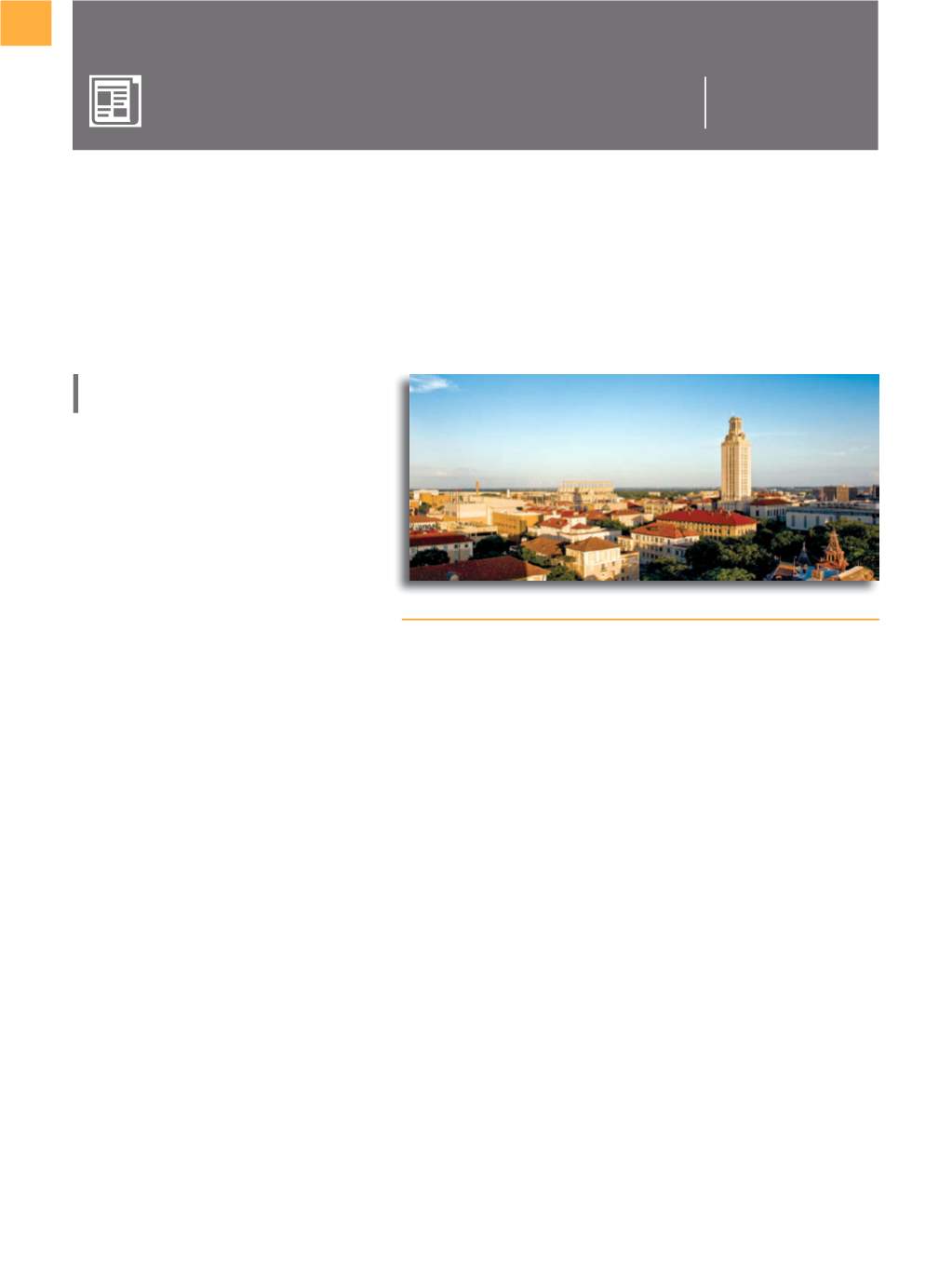
The University of Texas at Austin