


 46 / 58

edfas.org
ELECTRONIC DEVICE FAILURE ANALYSIS | VOLUME 19 NO. 2
46
approach to AFM design has the potential to significantly
reduce the complexity and cost of the instrument. One of
the attractive aspects about MEMS is that you can mass
produce them, building hundreds or thousands of them
in one shot, so the price of each chip would only be a few
dollars. As a result, you might be able to offer the whole
miniature AFM system for a few thousand dollars.”
A reduced size and price tag also could expand the
AFM’s utility beyond current scientific applications. “For
example, the semiconductor industry might benefit from
these small devices, in particular, companies that manu-
facture the silicon wafers fromwhich computer chips are
made,” Moheimani said. “With our technology, youmight
have an array of AFMs to characterize the wafer’s surface
to findmicrofaults before the product is shipped out.” The
labprototype is a first-generationdevice, Moheimani said,
and the group is already working on ways to improve and
streamline the fabrication of the device.
“This is one of those technologies where, as they say,
‘If you build it, theywill come.’ We anticipate findingmany
applications as the technologymatures,”Moheimani said.
Moheimani’s research has been funded by UT Dallas
startup funds, the Von Ehr Distinguished Chair, and the
Defense Advanced Research Projects Agency.
TERAHERTZ CHIPS OFFER NEWWAY OF
SEEING THROUGH MATTER
Electromagnetic pulses lasting one millionth of a
millionth of a second may hold the key to advances in
medical imaging, communications, and drug develop-
ment. However, the pulses, called terahertz waves, have
long required elaborate and expensive equipment to use.
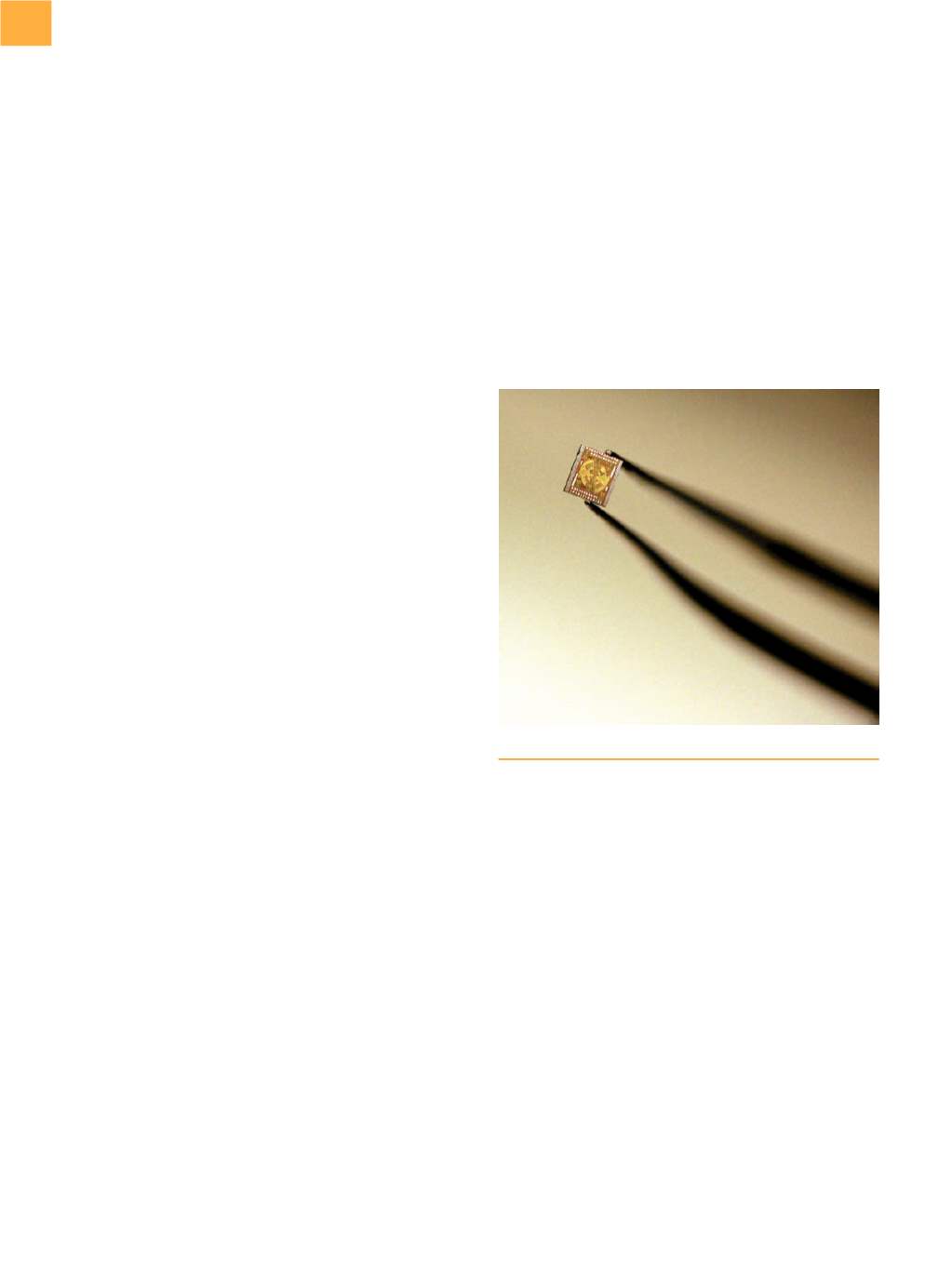
Now, researchers at Princeton University (Princeton,
NJ) have drastically shrunk much of that equipment,
moving from a tabletop setup with lasers and mirrors to
a pair of microchips small enough to fit on a fingertip.
In two papers recently published in the
IEEE Journal of
Solid-State Circuits
, the researchers describe one micro-
chip that can generate terahertz waves, and a second
chip that can capture and read intricate details of these
waves.
“The system is realized in the same silicon chip tech-
nology that powers all modern electronic devices, from
smartphones to tablets, and therefore costs only a few
dollars to make on a large scale,” said lead researcher
Kaushik Sengupta, a Princeton assistant professor of
electrical engineering.
Terahertz waves are part of the electromagnetic spec-
trum—the broad class of waves that includes radio, x-rays,
and visible light—and sit between the microwave and
infrared light wavebands. The waves have some unique
characteristics that make them interesting to science. For
one, they pass through most nonconducting material, so
they could be used to peer through clothing or boxes for
security purposes, andbecause they have less energy than
x-rays, they do not damage human tissue or DNA.
Terahertz waves also interact in distinct ways with
different chemicals, so they can be used to characterize
specific substances. Known as spectroscopy, the ability
to use light waves to analyze material is one of the most
promising—and the most challenging—applications of
terahertz technology, Sengupta said.
Fingertip-sized microchip capable of generating terahertz
To do it, scientists shine a broad range of terahertz
waves on a target and thenobserve how thewaves change
after interactingwith it. The human eye performs a similar
type of spectroscopy with visible light: We see a leaf as
green because light in the green light frequency bounces
off the chlorophyll-laden leaf.
The challenge has been that generating a broad range
of terahertz waves and interpreting their interaction with
a target requires a complex array of equipment, such as
bulky terahertz generators or ultrafast lasers. The equip-
ment’s size and expensemake the technology impractical
for most applications.
Researchers have been working for years to sim-
plify these systems. In 2016, Sengupta’s team reported
a way to reduce the size of the terahertz generator and
the apparatus that interprets the returning waves to a
millimeter-sized chip. The solution lies in reimagining how
an antenna functions. When terahertz waves interact with
a metal structure inside the chip, they create a complex