


 44 / 62

iTSSe
TSS
A D V A N C E D M A T E R I A L S & P R O C E S S E S | F E B R U A R Y 2 0 1 6
4 4
iTSSe
TSS
14
JTST
HIGHLIGHTS
The
Journal of Thermal Spray Technolo-
gy (JTST),
the official journal of the ASM
Thermal Spray Society, publishes con-
tributions on all aspects—fundamental
and practical—of thermal spray science,
including processes, feedstock manu-
facture, testing, and characterization.
As the primary vehicle for thermal spray
information transfer, its mission is to
synergize the rapidly advancing thermal spray industry and
related industries by presenting research and development
efforts leading to advancements in implementable engineer-
ing applications of the technology. Articles from the January
issue, as selected by
JTST
Editor-in-Chief Armelle Vardelle
and Lead Editor André McDonald, are highlighted here. This
issue features papers based on presentations at ITSC 2015.
In addition to the print publication,
JTST
is available online
through
springerlink.com. For more information, please visit
www.asminternational.org/tss.“PYRAMIDAL FIN ARRAYS PERFORMANCE
USING STREAMWISE ANISOTROPIC
MATERIALS BY COLD SPRAY ADDITIVE
MANUFACTURING”
Yannick Cormier, Philippe Dupuis, Bertrand Jodoin,
and Antoine Corbeil
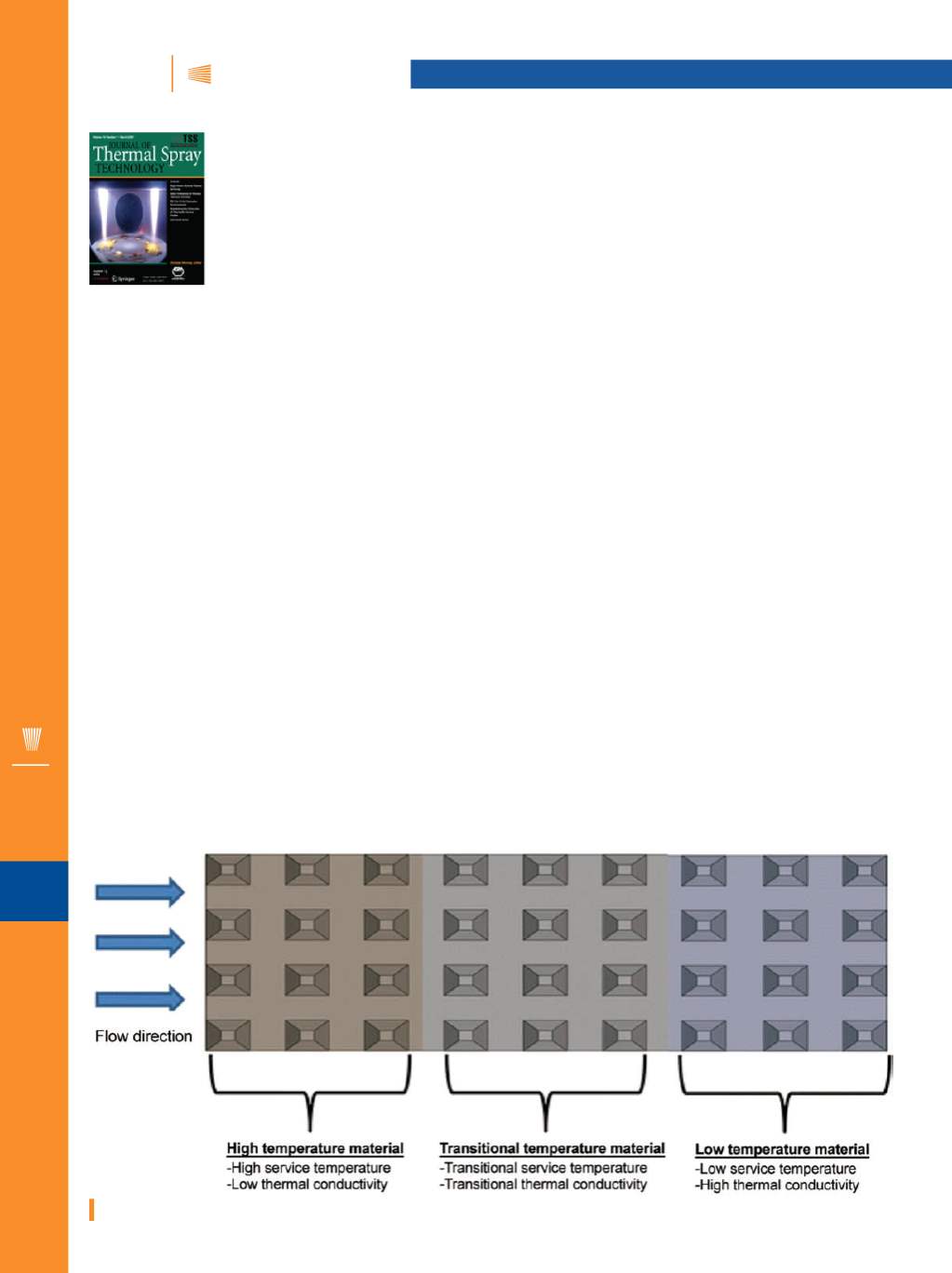
This work evaluates the thermal and hydrodynamic per-
formance of pyramidal fin arrays produced using cold spray
as an additive manufacturing process. Near-net-shaped pyra-
midal fin arrays of pure aluminum, pure nickel, and stainless
steel 304 were manufactured. Fin array characterization such
as fin porosity level and surface roughness evaluation was
performed. The thermal conductivities of the three different
coating materials were measured by laser flash analysis. The
results obtained show a lower thermal efficiency for stainless
steel 304, whereas the performances of the aluminum and
nickel fin arrays are similar. This result is explained by look-
ing closely at the fin and substrate roughness induced by the
cold gas dynamic additive manufacturing process. The multi-
material fin array sample has a better thermal efficiency than
stainless steel 304. Thework demonstrates the potential of the
process to produce streamwise anisotropic fin arrays as well
as the benefits of such arrays.
“LASER PATTERNING PRE-TREATMENT
BEFORE THERMAL SPRAYING—A TECHNIQUE
TO ADAPT AND CONTROL THE SURFACE
TOPOGRAPHY TO THERMO-MECHANICAL
LOADING AND MATERIALS”
Robin Kromer, Sophie Costil, Jonathan Cormier,
Laurent Berthe, Patrice Peyre, and Damien Courapied
Coating characteristics are highly dependent on sub-
strate preparation and spray parameters. Hence, the surface
must be adaptedmechanically andphysicochemically to favor
coating/substrateadhesion. Conventional surfacepreparation
methods such as grit blasting are limited by surface embrittle-
ment and produce large plastic deformations throughout the
surface resulting in compressive stress and potential cracks.
However, laser patterning is suitable for preparing the sur-
face of sensitive materials. No embedded grit particles are
observed, and high quality coating can be achieved. Further,
laser surface patterning adapts the impacted surface by cre-
ating a large anchoring area. Optimized surface topographies
can then be elaborated according to the materials as well as
their applications. This paper compares the adhesion bond
strength for two surface preparation methods, namely grit
blasting and laser surface patterning for two materials used
Schematic of a multi-material fin array separated into three sections.