


 46 / 62

iTSSe
TSS
A D V A N C E D M A T E R I A L S & P R O C E S S E S | F E B R U A R Y 2 0 1 6
4 6
iTSSe
TSS
16
JTST
HIGHLIGHTS
in aerospace applications: 2017 aluminum alloy and AISI 304L
stainless steel coated with NiAl and YSZ, respectively. Laser
patterning significantly increases the adherence values for
similar contact areas due to a mixed mode failure (cohesive
and adhesive failures). The coating is locked in the pattern.
“MODULAR COATING FOR FLEXIBLE
GAS TURBINE OPERATION”
J.R.A. Zimmermann, J.C. Schab, A. Stankowski,
P.D. Grasso, S. Olliges, and C. Leyens
In heavy-duty gas turbines, the loading boundary con-
ditions of MCrAlY systems are weighted differently for various
operation regimes as well as for each turbine component or in-
dividual part locations. For overall optimized component pro-
tection, it is of interest to produce coatings with flexible and
individually tailored properties. In this context, ALSTOM devel-
oped an Advanced Modular Coating Technology (AMCOTEC)
based on several powder constituents, each imparting specific
properties to the final coating, incombinationwithanewappli-
cation method, allowing in-situ compositional changes. With
this approach, coating properties such as oxidation, corrosion,
and cyclic lifetime can be modularly adjusted for individual
component types and areas. For demonstration purposes, a
MCrAlY coating with modular ductility increase was produced
using the AMCOTEC methodology. The method was proven to
be cost effective and highly flexible, enabling fast composi-
tional screening. A calculation method for final coating com-
position was defined and validated. The modular addition of a
ductility agent enabled increasing the coating ductility with up
to factor 3 with only a slight decrease in oxidation resistance.
An optimum composition with respect to ductility is reached
with the addition of 20 wt%of the ductility agent.
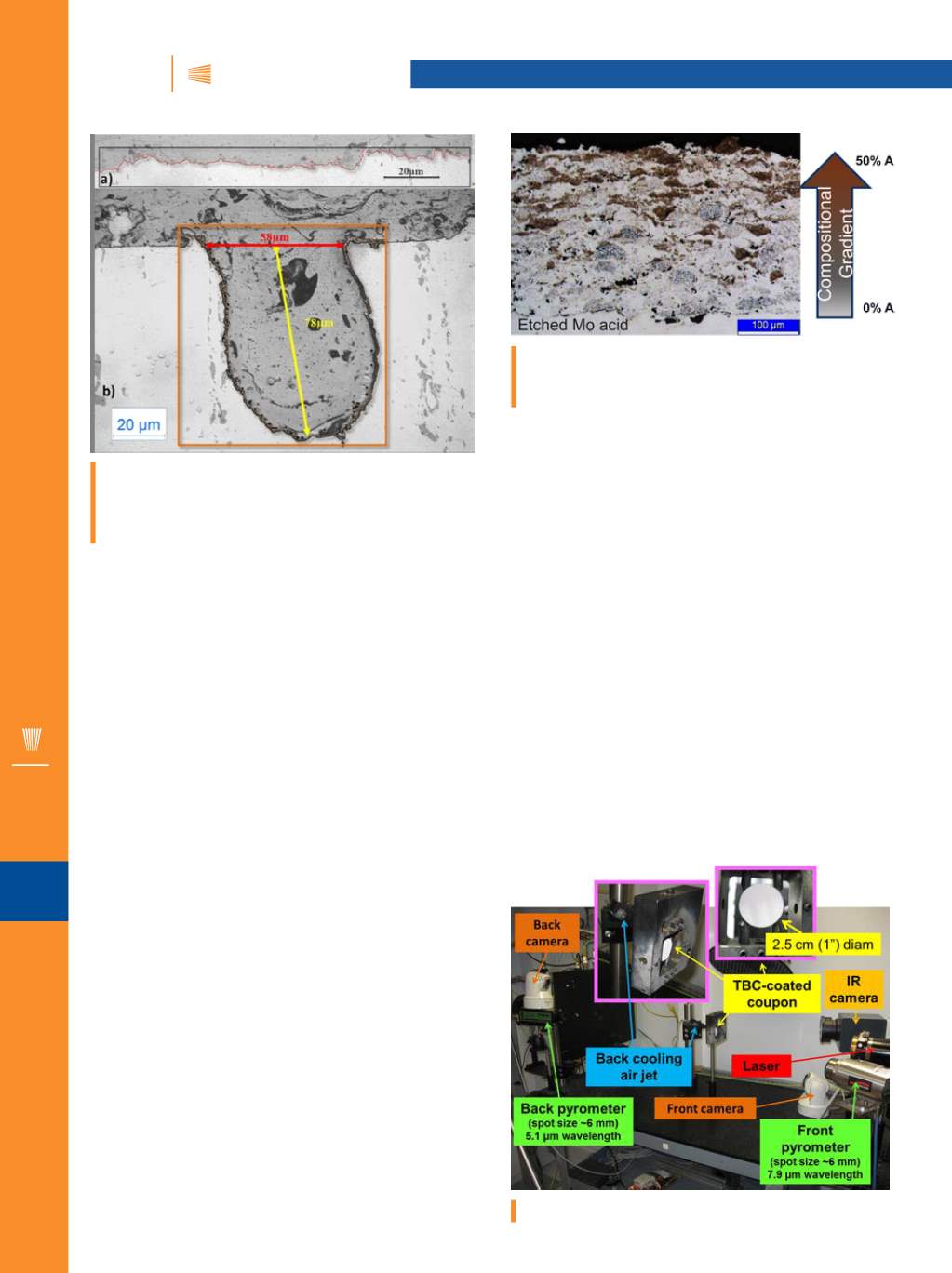
Image analysis of surface area with laser surface texturing—
shown in red is the interface computed for one keyhole (each
keyhole adds 11× the adhesion area compared to a plane
surface).
“THERMAL GRADIENT BEHAVIOUR OF TBCs
SUBJECTED TO A LASER GRADIENT TEST RIG:
SIMULATING AN AIR-TO-AIR COMBAT FLIGHT”
Rogerio S. Lima, Basil R. Marple, and P. Marcoux
A computer-controlled laser test rig (using a CO
2
laser) of-
fers an interesting alternative to traditional flame-based ther-
mal gradient rigs in evaluating thermal barrier coatings (TBCs).
The temperature gradient between the top and back surfaces
of a TBC system can be controlled based on the laser power
and a forced air back-face cooling system, enabling the tem-
perature history of complete aircraft missions to be simulated.
An air plasma spray-deposited TBC was tested and, based on
experimental data available in the literature, the temperature
gradients across the TBC system (ZrO
2
-Y
2
O
3
YSZ top coat/Co-
NiCrAlY bond coat/Inconel 625 substrate) and their respec-
tive frequencies during air-to-air combat missions of fighter
jets were replicated. The missions included (i) idle/taxi on the
runway, (ii) take-off and climbing, (iii) cruise trajectory to ren-
dezvous zone, (iv) air-to-air combat maneuvering, (v) cruise
Bright fieldmicroscopic image of a graded MCrAlY-based coating
(after etching) produced with the incremental addition of pow-
der A. Brownish phase corresponds to ductility agent A.
Thermal gradient laser rig of the NRC.