


 36 / 62

iTSSe
TSS
A D V A N C E D M A T E R I A L S & P R O C E S S E S | F E B R U A R Y 2 0 1 6
3 6
iTSSe
TSS
6
FEATURE ARTICLE
THERMAL SPRAY ALUMINUM COATINGS
FOR SPLASH ZONE STRUCTURES—PART II
Recent advances in thermal spray techniques enable thermal spray aluminum coatings to reliably
protect offshore structures in splash zones. Part I of this article appeared in the November/December
2015 issue of iTSSe.
Deepashri D. Nage,
L&T Hydrocarbon Engineering Ltd., Mumbai, India
O
ffshore structures are exposed to various corrosion
zones depending on sea level as datum. Both sub-
merged steel surfaces and steel immersed in mud are
typically not coated, instead relying solely on cathodic protec-
tion due to slow predicted corrosion rates. Splash zones in the
-3 to +6 m range of Mean Sea Level (MSL) encounter the most
severe degradation due to continuous contact with highly aer-
ated sea water splashes. This zone requires special protective
care by exotic painting techniques because cathodic protec-
tion is ineffective.
To shield splash zone structures from corrosion and
other environmental degradation, coating is the best pro-
tective measure. Coatings for this zone have evolved from
Monel sheath to high build epoxy and other organic for-
mulations. Recent advances in thermal spray techniques
have found thermal spray aluminum coatings (TSAC) to be
an effective protection method in splash zones. Although
thermal spray of just a few microns thick offers corrosion
resistance and functional properties in precision jobs, there
is concern about whether or not it is effective when applied
to very large structures. This article focuses on challenges as
well as successful implementation of TSAC by arc spray on
splash zone structures. Here we look at an oil and gas plat-
form recently installed off the east coast of India.
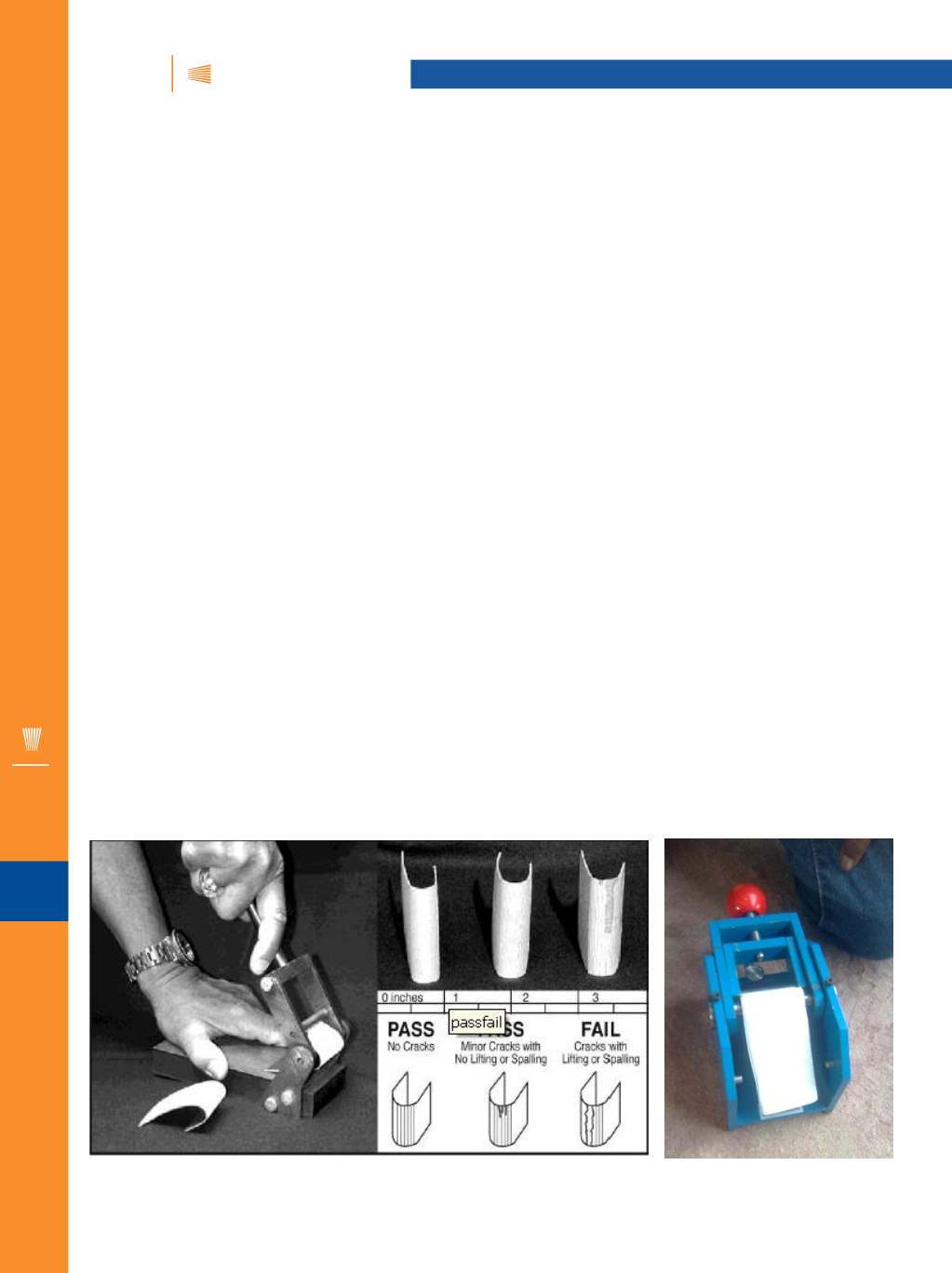
Figures 4 and 5 illustrate bend tests (ASTM D522) and
adhesion tests (ASTM D4541), respectively, performed for
every shift, each operator, and adhesion on the companion
coupon. Figure 6 shows TSAC application on an actual job
and the components of an offshore jacket coated with TSAC.
Figure 7 shows the TSAC job completed and installed in In-
dian waters.
CHALLENGES FACED IN IMPLEMENTING TSAC
Coating of piping, equipment, and structural compo-
nents is generally the final step in the sequence of fabri-
cating equipment—or an entire plant—after all assembly/
fabrication work is complete. Because TSA coating is a hot
process with certain limitations, individual pieces should be
coated at the component level with the connecting joints
coated upon assembly. Although the companies and ther-
mal spray applicators who are able to handle this magni-
tude of coating work are limited, a proper qualification and
readiness was ensured within this particular project’s time-
line and specifications.
Aluminum metallic coatings offer several advantages,
including excellent corrosion protection of steel due to the
cathodic protection phenomenon, consumables with no
shelf life expiration, zero volatile organic compounds, and
Fig. 4 —
From left to right, bend test method (ASTM D522) and photograph of test performed on TSAC sample.