


 43 / 62

ADVANCED MATERIALS & PROCESSES •
AUGUST 2014
43
JTST HIGHL IGHTS
i
T
S
S
e
11
“Synchronization of Suspension Plasma
Spray Injection with the Arc
Fluctuations”
J. Krowka, V. Rat, S. Goutier, and J.F. Coudert
Some difficulties encountered in suspension plasma spray
include poorly controlled heat and momentum transfers be-
tween the plasma and material and plasma instability. To im-
prove this method, arc fluctuations are often reduced. This
paper offers an alternative to the injection of reactive mate-
rial in an arc jet. The principle is to produce a pulsed laminar
plasma jet combined with phased injection of liquid droplets.
The particular design of the plasma torch works at moderate
power and follows a resonant mode. Droplets are injected
using a piezoelectric device, based on drop-on-demand
method, triggered by the voltage signal sampled at the torch
connections. Results are evaluated by a time-resolved imaging
technique that shows how trajectories are influenced the mo-
ment at which droplets penetrate the plasma jet.
“Low Thermal Conductivity
Yttria-Stabilized Zirconia Thermal Barrier
Coatings Using the Solution Precursor
Plasma Spray Process”
Eric H. Jordan, Chen Jiang, Jeffrey Roth,
and Maurice Gell
Thermal barrier coatings (TBCs) primarily insulate underly-
ing metal from high temperature gases in gas turbine engines. As
a result, low thermal conductivity and high durability are the pri-
mary properties of interest. In this work, the solution precursor
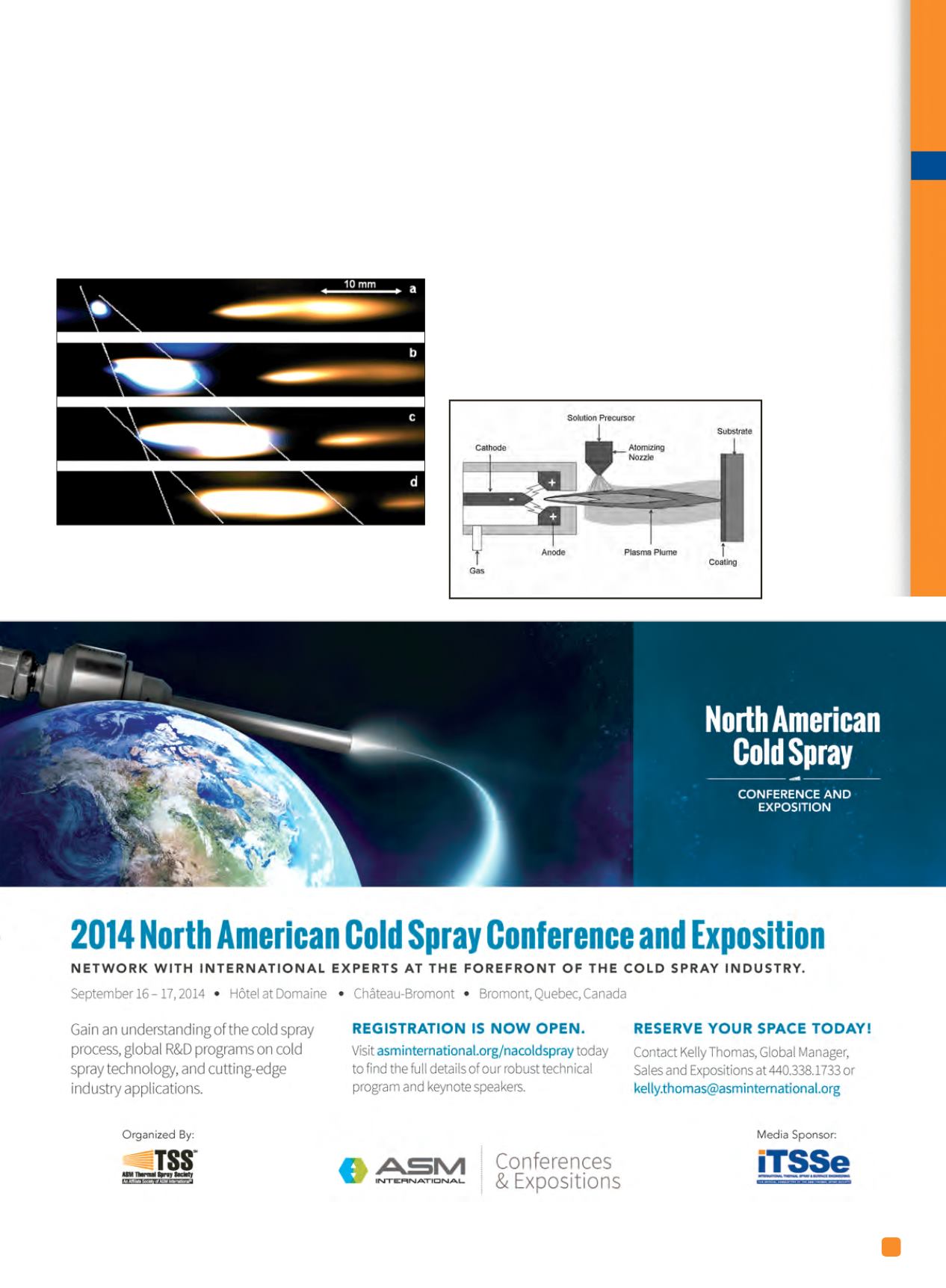
Fast imaging (6000 frames/s, time aperture 100 µs) of
synchronized injection of TiO
2
suspension in nitrogen pulsed
arc plasma jet for the injection time delay t
j
= 260 µs. Time is
increased by 166 µs between successive pictures (a), (b), (c),
and (d) (enhanced on-line).
Schematic
diagram of solution
precursor plasma
spray with
atomizing nozzle.