


 27 / 62

In this example, the desired part is a boss rising from
flat plate. Using traditional subtractive methods, a large
amount of material waste occurs as the rectangular billet
material is removed to create the boss and mounting plate.
With a material like titanium, this is a long and expensive
process. In contrast, with near-net manufacturing, a
smaller rectangular piece of titanium is joined to a large,
flat titanium plate. This creates a tailored blank that ap-
proximates the final part shape, minimizing the amount of
machining and waste and thus saving a significant amount
of money. In order to join two pieces of titanium so that
the resulting part is just as strong as if it had been milled it
out of titanium billet, one option to consider is linear fric-
tion welding (LFW). Figure 4 provides a brief description
of the LFW process.
LFW offers the ability to accurately, quickly, and repeat-
edly join twomaterials such that the resulting bond or joint is
as strong—if not stronger—than the parent materials being
joined. It can do this not just for titanium, but for nearly any
metal or combination of metals. LFW has been used to join
copper to aluminum, steel to titanium, and dozens of other
useful combinations. As a member of the solid state bonding
family of technologies, which includes rotational friction
welding and friction stir welding, LFWdoes not use any filler
material such as that used in traditional welding and brazing.
Specific features of LFW include:
• Ability to join parts of any geometry
• Joints can be formed with cross-sectional areas
>10 sq. in.
• Minimal material loss
• Materials typically joined in 3-5 seconds
• Accurate bonds with tolerances of 0.002 to 0.005 in.
• Formation of extremely repeatable welds
• Eliminates deformation and deterioration of
original parts
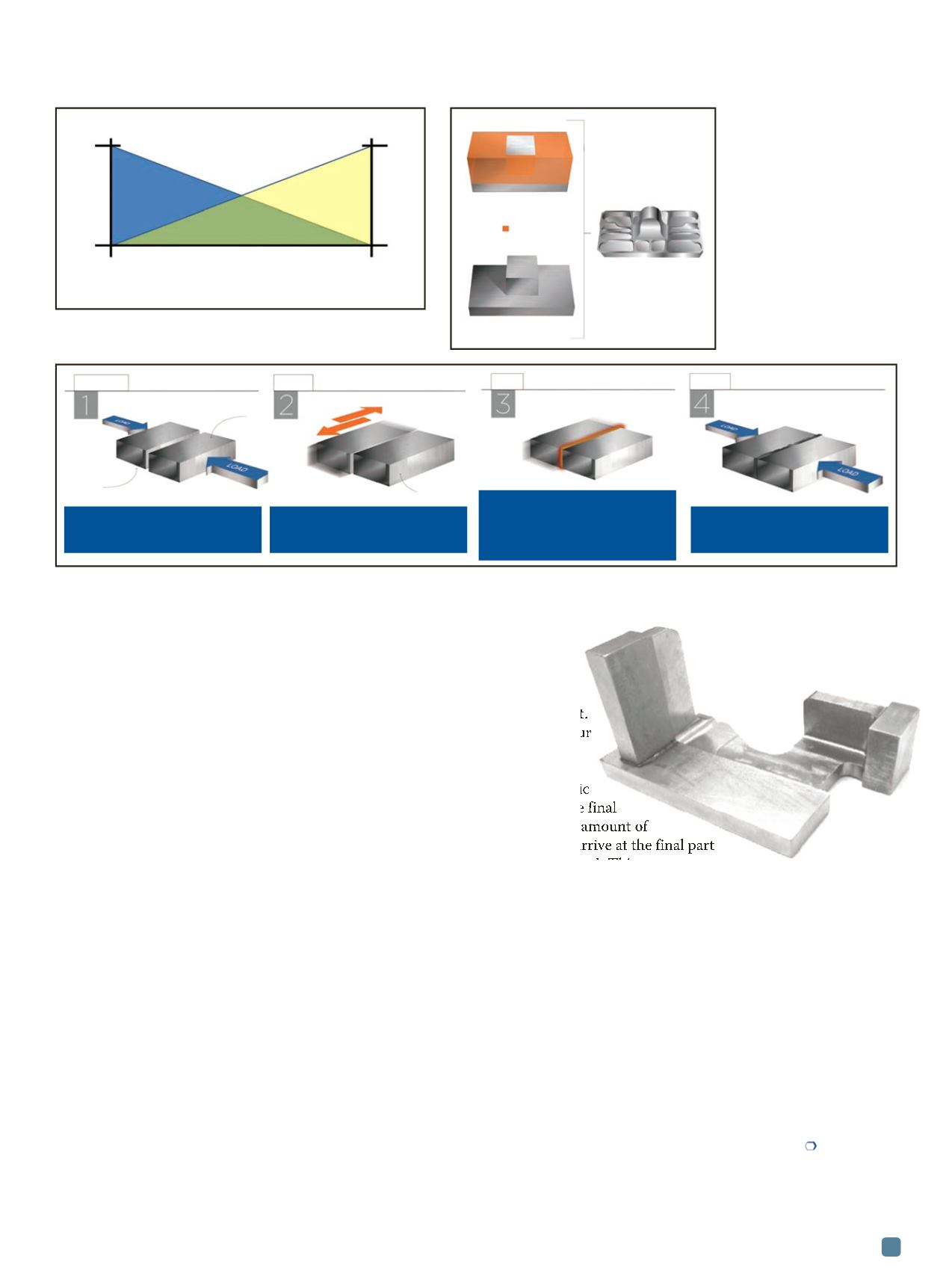
Figure 5 shows
how LFW can be
used to create a tai-
lored blank for a fic-
tional aerospace part.
The image shows four
regular rectangular
blocks joined using
LFW to create a basic
representation of the final
part. The minimum amount of
milling required to arrive at the final part
shape is also illustrated. This exam-
ple is highly representative of aero-
space structural parts that can be
made using near-net manufacturing
processes enabled by LFW.
Despite its advantages, LFW is
often viewed as cost prohibitive, because machines tend to
be large, complex, and expensive. The cost factor is why
LFW machines are primarily used to produce high-value
parts, such as bladed disks for jet engines. More recently
however, new technology has entered the market, radically
decreasing both machine cost and complexity. LFW is now
financially viable for nearly any market, from automobile
axles to fire sprinklers to pipe, building a commercially ac-
ceptable bridge between the subtractive manufacturing of
yesterday and the additive manufacturing of tomorrow.
For more information:
John Hinds is chief operating officer,
APCI LLC, 4143 Technology Dr., South Bend, IN 46628,
574.234.8295,
johnh@apcisystems.com,
apcisystems.com.
ADVANCED MATERIALS & PROCESSES •
AUGUST 2014
27
Fig. 2 —
Near-net manufacturing fills the middle ground of
grain size, between 100% additive and 100% subtractive
methods. Courtesy of APCI LLC.
Fig. 3 —
Traditional
subtractive manufacturing
processes waste
significantly more material
than near-net processes
such as linear friction
welding. Courtesy of
APCI LLC.
Fig. 4 —
Linear friction welding process workflow. Courtesy of APCI LLC.
Fig. 5 —
Linear friction welding
can be used to create tailored
blanks for aerospace parts. Four
rectangular blocks are joined to
create a basic representation of
the final part.Courtesy of TWI Ltd.
Additive Subtractive
manufacturing
manufacturing
100%
100%
0%
0%
Much smaller than
finished part
“Grain size” of
constituent
components
Equal to or larger
than finished part
Near-net
manufacturing
Traditional
manufacturing billet
Waste
Completed
component
LFW near-net blank
Stationary
The moving component is made
to oscillate laterally, rather than
rotationally.
Moving part
Hyper motion
Stationary
Friction occurs across the entire
surface ensuring weld times
are short.
The lateral motion of the weld
eliminates the need for a
symmetrical part, so the LFW
process can be used to join
almost any shape and geometry.
Residual stress of the joint is
significantly lower and in some
cases eliminated.
Preheat Scrub Heat Forge