


 46 / 70

iTSSe
TSS
A D V A N C E D M A T E R I A L S & P R O C E S S E S | J U L Y / A U G U S T 2 0 1 5
4 6
iTSSe
TSS
10
JTST
HIGHLIGHTS
The
Journal of Thermal Spray Technolo-
gy
(
JTST
), the official journal of the ASM
Thermal Spray Society, publishes con-
tributions on all aspects—fundamental
and practical—of thermal spray science,
including processes, feedstock manu-
facture, testing, and characterization.
As the primary vehicle for thermal spray
information transfer, its mission is to syn-
ergize the rapidly advancing thermal spray industry and relat-
ed industries by presenting research and development efforts
leading to advancements in implementable engineering appli-
cations of the technology. Articles from the June and August
issues, as selected by
JTST
Editor-in-Chief Christian Moreau,
are highlighted here. In addition to the print publication,
JTST
is available online through
springerlink.com. For more infor-
mation, visit
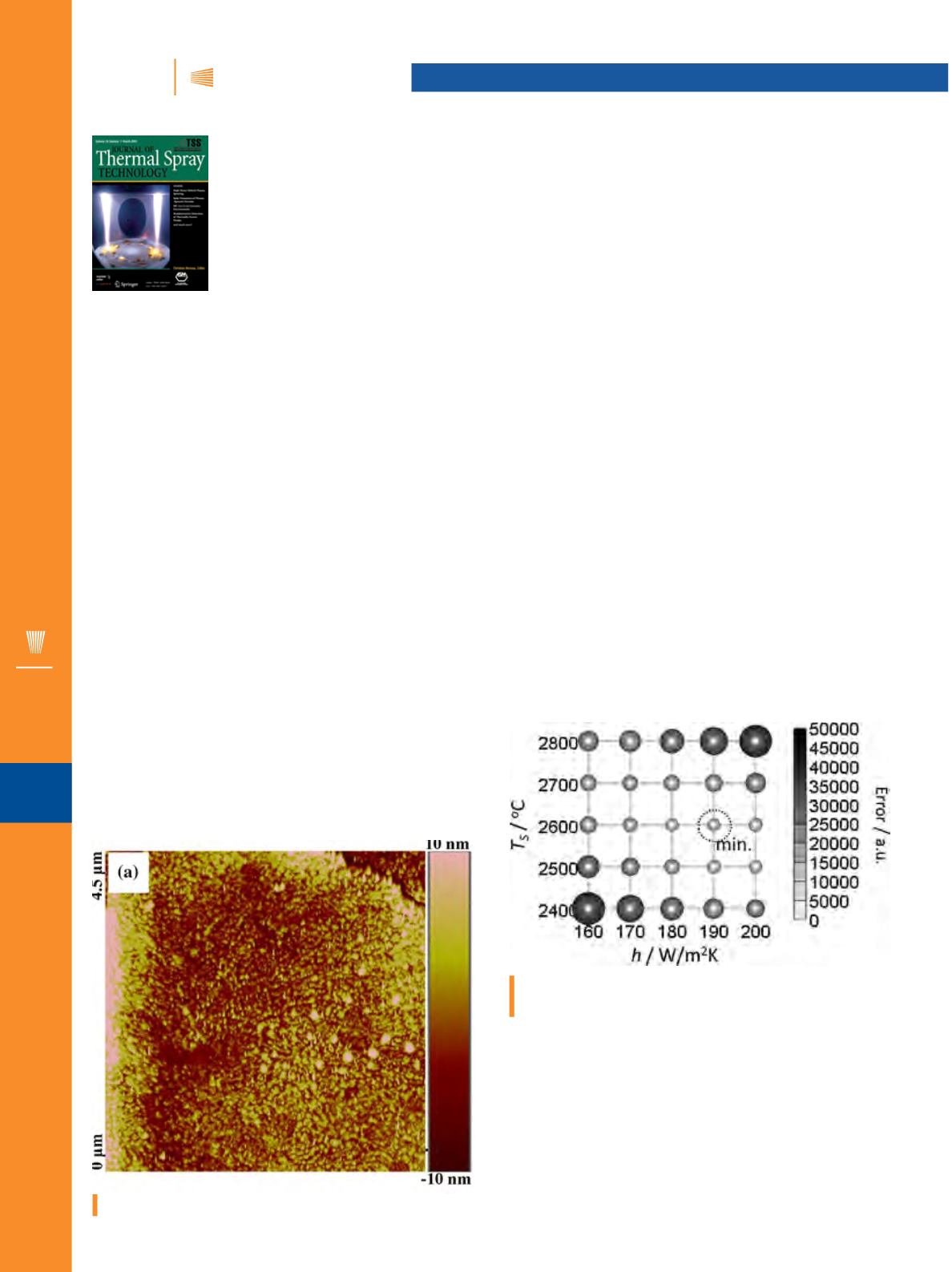
asminternational.org/tss.“MORPHOLOGY AND SIZE EVOLUTION OF
INTERLAMELLAR TWO-DIMENSIONAL PORES
IN PLASMA-SPRAYED LA
2
ZR
2
O
7
COATINGS
DURING THERMAL EXPOSURE AT 1300°C”
Tao Liu, Xiao-Tao Luo, Xu Chen, Guan-Jun Yang,
Cheng-Xin Li, and Chang-Jiu Li
La
2
Zr
2
O
7
(LZO) is expected to be one of the promising
thermal barrier coating materials for application in high-tem-
perature conditions (1200°C). However, high-temperature ex-
posure causes sintering, which heals interlamellar 2D pores
and intrasplat pores. This sintering increases stiffness and
thermal conductivity of thermal barrier coatings, consequent-
ly reducing durability. In this study, LZO coating and splat were
deposited by atmospheric plasma spraying and were exposed
to 1300°C for different durations to find a possible critical
opening of 2D pores above which they are free from sintering.
The evolution of the parameters of residual 2D pores in the
coating and the surface morphology of LZO splat were char-
acterized. There is a critical opening width for 2D pores above
which grain bridging does not occur across the gaps. Accord-
ingly, pores with an opening larger than this critical width are
free from sintering across the 2D pores despite surface rough-
ening of splats, whereas pores with an opening less than the
critical width sinter rapidly at the early stage of thermal expo-
sure through the formation of grain bridges.
“A NUMERICAL STUDY ON GENERATION
MECHANISM OF VERTICAL CRACKS IN TOP
COAT OF TBCs DURING APS DEPOSITION”
K. Ito, H. Kuriki, and M. Enoki
Clarification of crack generation mechanisms in the top
coat of the thermal barrier coatings (TBCs) during atmospher-
ic plasma spray is important to improve TBC reliability. Finite
element analyses of stress and strain during deposition were
conducted with a layer-by-layer method to understand the
cracking behaviors. Stress relaxation by generation of vertical
cracks was expressed as an elasto-plastic behavior of the coat-
ing. The effects of preheating temperature of the substrate
and plasma power on crack development were analyzed by
changing the initial and atmospheric temperatures in simu-
lation, respectively. Simulation results of radial strain explain
experimental results of crack monitoring by non-contact laser
acoustic emission.
AFM surface morphology of LZO splat as-sprayed.
Temperature error between the experiment and analysis sub-
strate’s center.
“DETERMINATION OF THE MECHANICAL
PROPERTIES OF PLASMA-SPRAYED
HYDROXYAPATITE COATINGS USING THE
KNOOP INDENTATION TECHNIQUE”
Md. Fahad Hasan, James Wang, and Christopher Berndt
The microhardness and elastic modulus of plas-
ma-sprayed hydroxyapatite coatings were evaluated using
Knoop indentation on the cross-section and top surface.