



 42 / 70

iTSSe
TSS
A D V A N C E D M A T E R I A L S & P R O C E S S E S | J U L Y / A U G U S T 2 0 1 5
4 2
iTSSe
TSS
6
TECHNICAL SPOTLIGHT
PLASMA-SPRAYED HEAT SHIELDS OFFER
THERMAL MANAGEMENT OPTIONS
Heat shields help protect vehicle-critical components that could delaminate and fail if exposed to
high temperatures for any length of time.
T
hermal management problems in vehicles are often
difficult to address, leading to a wide array of prob-
lem-solving products, frommuffler wraps to composite
coatings. One strategy is to use heat shields. Their purpose is
simple—to shield sensitive components from heat emitted
from engines and manifolds. This can be achieved either by
insulating hot components to prevent heat from spreading
under the hood or by reflecting it away from vulnerable areas.
Heat shields range from thermal wraps to purpose-built
shieldsmolded to suit specific components. Many heat shields
are constructed from steel or aluminum. Some feature fiber-
glass between two metal layers, while others are constructed
of lightweight materials such as carbon composites.
Regardless of composition, heat shielding can be used in
avarietyof thermalmanagement applications. Critical compo-
nents such as batteries can be protected from damaging heat
that may be radiated from a high-performance engine. Heat
shields can also be used to protect bodywork thatmay contain
materials such as carbon fiber, which could delaminate and
fail if exposed to excessive temperatures for any length of time.
HEAT SHIELDS PROTECT DRIVERS
AND RACE CAR COMPONENTS
In one approach, Zircotec, UK, is developing a range of
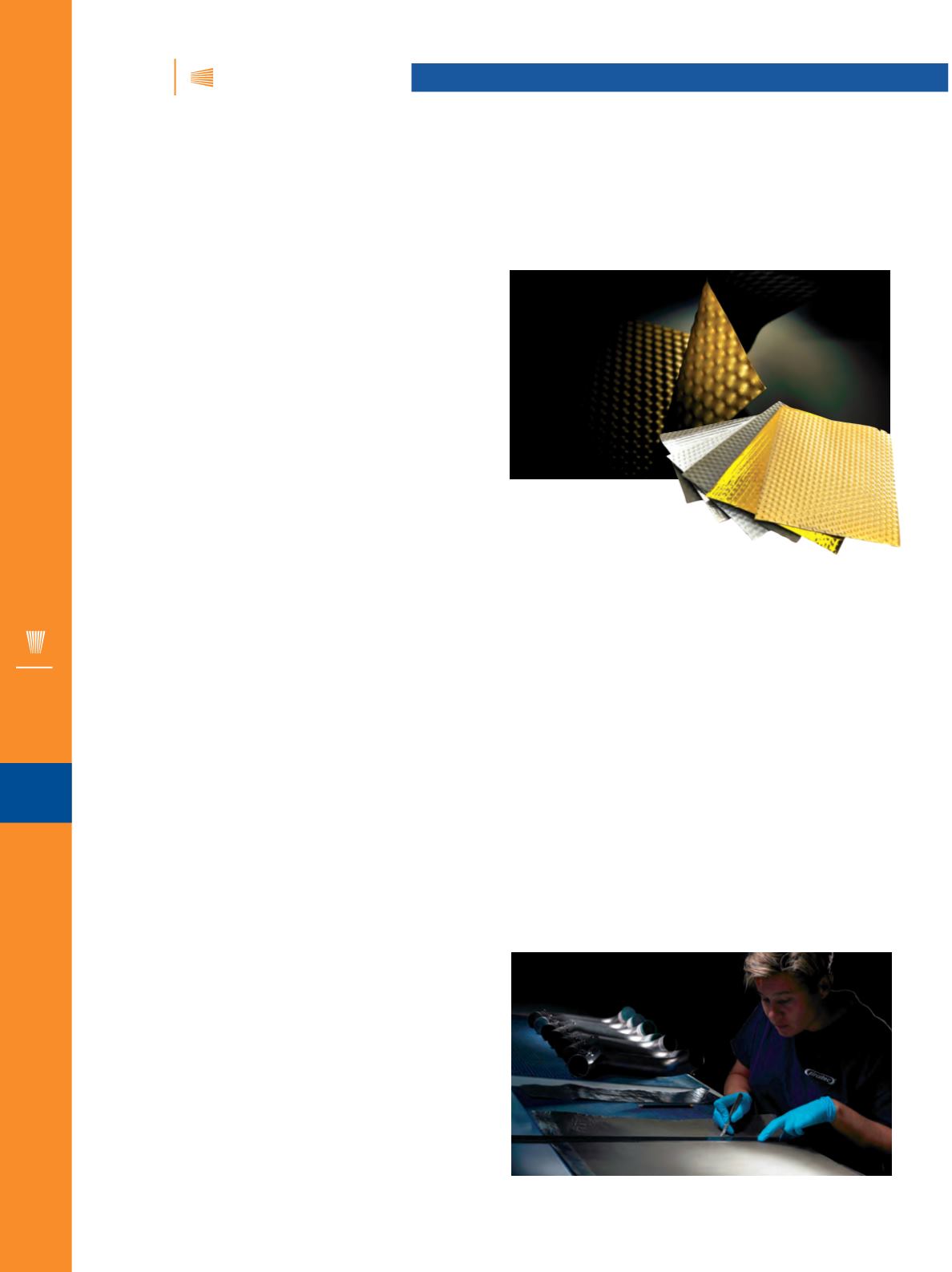
heat shields under the ZircoFlex name (Fig. 1). All products in
this range feature ceramic platelets applied via plasma spray
onto a metal substrate to create a heat shield that adds addi-
tional temperature resistance to standard pressed aluminum
versions found on today’s automobiles.
Ranging from an ultrathin single layer to triple layers—
yet still very thin—this range of heat shields offers users many
options to suit diverse applications. For example, ZircoFlex I
can reduce surface temperatures by 64%, with reductions of
77% and 85%possible with the new double and triple-layered
options.
To date, these heat shields are used in a host of automo-
tive applications. Just glance at any F1 starting grid and cars
sporting ZircoFlex will be well represented. The heat shield
can be fitted quickly and easily, so plenty of F1 andmotorsport
teams have been known to keep a spare supply to solve ther-
mal management issues that may arise at the track.
OTHER APPLICATIONS FOR HEAT SHIELDS
ZircoFlex heat shields are also popular in the resto-
ration and maintenance of classic automobiles. As modern
fuels and engine modifications result in higher combustion
Fig. 1 —
Comprising a
sandwich structure of ceramic
and stainless steel, ZircoFlex Form
means engineers can benefit from ceramic coat-
ing protection together with the strength and ability to form struc-
tures (a). The blend of materials enables Form to protect drivers and
componentry fromboth conductive and reflective heat (b).
Fig. 2 —
ZircoFlex can be cut to shape.
temperatures, under-bonnet heat in classic autos tends to be
higher than the levels they were originally built to tolerate.
Without sufficient thermal protection, radiant heat can cause
fuel to evaporate inside the carburetor, as well as damage oth-
er sensitive components. According to Zircotec engineers, its
heat shields offer a simple solution to reflect heat away from
such components so that classic vehicles can remain on the
road (Fig. 2).
Further, the ceramic surface can be painted without af-
fecting the insulation properties of the embedded platelets,
so heat shields can be used in classic car restoration projects
without the need to deviate fromperiod-correct color palettes.
(a)
(b)