



 43 / 70

iTSSe
TSS
A D V A N C E D
M A T E R I A L S
&
P R O C E S S E S | J U L Y / A U G U S T
2 0 1 5
4 3
iTSSe
TSS
7
TECHNICAL SPOTLIGHT
With the automotive industry downsizing engines and
incorporating tighter packaging, comprehensive heat manage-
ment is becoming a pressing concern for manufacturers and car
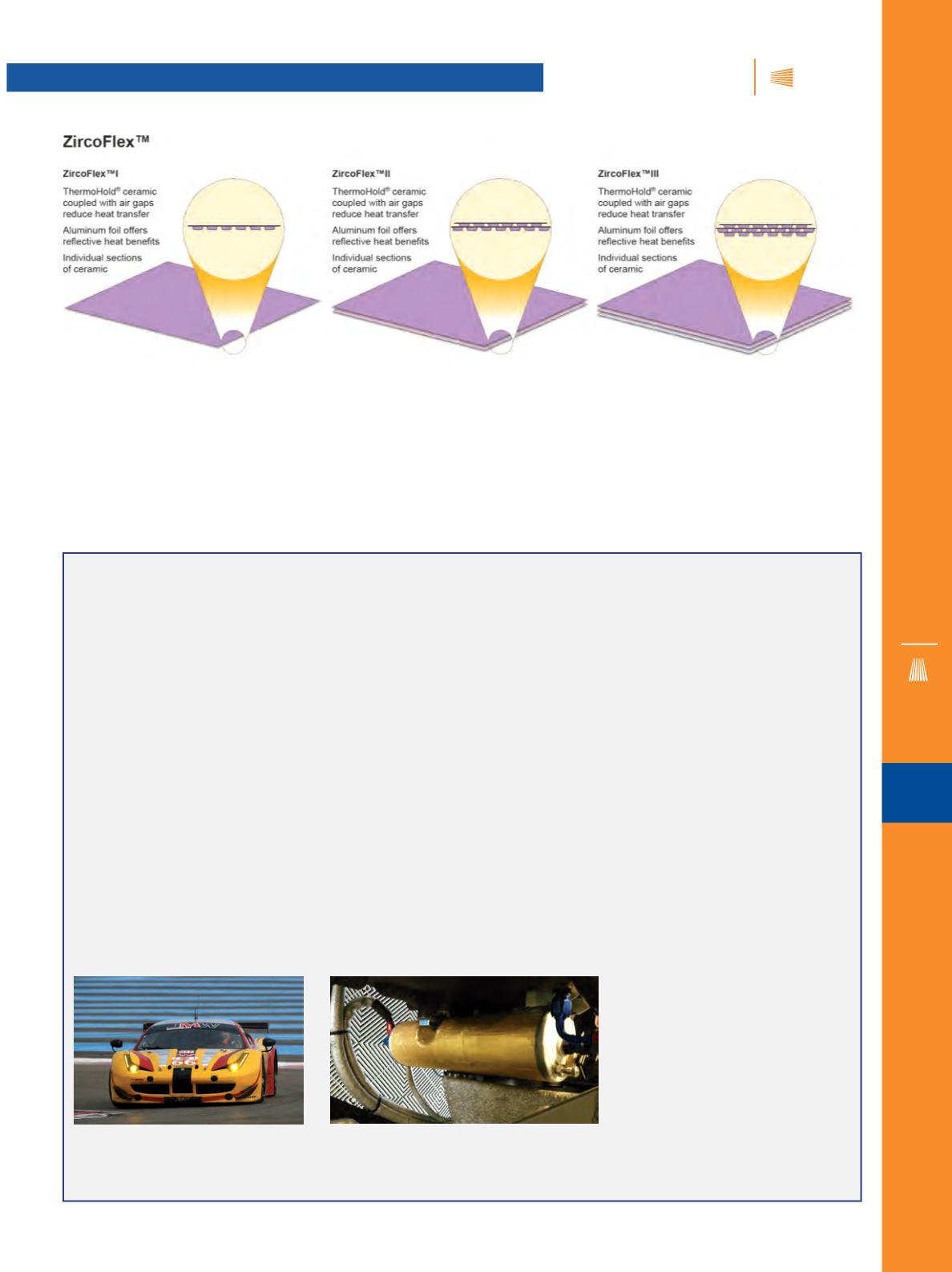
enthusiasts alike. Flexible heat shields offer another thermal
management tool (Fig. 3).
iTSSe
For more information:
Peter Whyman is sales director at Zir-
cotec Ltd., 22 Nuffield Way, Abingdon Oxon, OX14 1RL, +44 1235
546050,
zircotec.com.
Fig. 3 —
A range of ZircoFlex sheets is available with different performance levels.
ZircoFlex heat shields improve transmission and gear
shift reliability along with lowering cockpit temperatures in
long distance races. Ferrari race teamJMWMotorsport is using
these heat shields on the gearbox and bulkhead of the team’s
Ferrari 458 (Fig. 4) to reflect heat away from the transmission’s
regulator and control cockpit temperatures (Fig. 5). Situated
in a high-temperature environment, the gearbox is often con-
sidered the Achilles heel of sports car racing, as it endures un-
der-bonnet heat and strain from drivers making rapid shifts
during long stints at race pace. Regulating the transmission’s
air pressure is crucial to ensuring that optimal gear shifts are
sustained throughout long races.
“Maintaining the transmission’s air pressure at 10 bar is
important,” says JMW Motorsport race engineer Davey Nicho-
las. “If the unit heats up, it can cause the pressure to rise, risk-
ing damage to the seals that can affect shifting. With engines
and transmissions being the most costly items to service, we
want to do all we can to control this.”
Driver concentration is also critical to success in endur-
ance racing. Heat can sap energy and erode levels of alert-
ness resulting in miss-shifts or engine damage. To solve such
issues, ZircoFlex can be used on bodywork and bulkheads to
shield the cabin from engine bay heat. Such thermal manage-
ment can also bypass the need to use performance-draining
air conditioning systems.
Further, the lightweight and easy-to-fit application of the
shield combined with the ability to reduce temperatures by
85% enables engineers to delete bulkier heat shields, reduc-
ing a car’s overall weight.
Nicholas is keen to achieve such weight savings with
JMW’s 458. “We hope that the effectiveness of ZircoFlex will
enable us to remove the bulky glass fiber shield previously
fitted—that would reduce weight and improve under-bonnet
airflow,” he says.
As tight packaging becomes more prevalent in mo-
torsport and automotive manufacturing, ZircoFlex offers
engineers the option to place tem-
perature-sensitive components close
to heat sources without impinging
on performance and reliability. The
ability to install the heat shield with
high-temperature adhesive or metal
fasteners presents both race teams
and OEMs with a material that can
be applied during manufacturing or
at later retrofitting and aftermarket
modification stages.
CASE STUDY
Fig. 4 —
JMWMotorsports continues its
technical partnership with Zircotec, using
the ZircoFlex heat shield on its Ferrari 458.
Fig. 5 —
JMWMotorsport is using ZircoFlex heat
shields to reflect heat away from the transmis-
sion’s regulator.