


 37 / 62

T
hermal spray technology was invented in the late
1800s to restore worn metal parts and provide surface
protection. Initially known as “metallizing,” it became
more popular during World War II for fast repair of tanks
and other vehicles in high demand.
Today, thermal spray encompasses a
whole family of coating processes
used to apply metals, polymers, ce-
ramics, cermets, and other combina-
tions of materials to a wide variety of
metallic, polymeric, composite, and
ceramic substrates.
Generally, feedstock materials are
projected toward the substrate in a liq-
uid, semi-liquid, or solid state to apply
coatings with thicknesses greater than
100 µm. Traditionally, feedstock mate-
rials (in powder, wire, or rod forms) are
melted by combustion or electric
arc/plasma, and then accelerated
against the substrate by a high-veloc-
ity gas jet. In newer thermal spray
processes, such as cold spray, special
feedstock materials are accelerated by
a supersonic gas jet to conform a deposit in the solid-state.
Combustion-based thermal spray processes include
powder flame spray, wire flame spray, detonation spray,
high velocity oxygen fuel (HVOF), and warm spray (lower
temperature HVOF that uses nitrogen to cool combustion
gases). Electric arc-based processes include plasma spray,
arc wire spray, and their variations. The extremely high
temperatures (>10,000°C) of plasma spray make it suitable
for depositing elevated temperature materials, such as ce-
ramics. On the other end, the new cold spray family in-
cludes processes such as downstream injection (low
pressure) and up-stream injection (high pressure) which
rely on the ability of the materials to deform at high im-
pact velocities and at low process temperatures.
Traditionally, thermal spray has been widely used in
the aerospace industry. Over the past few decades, and
driven by the need to improve fuel efficiency, thermal
spray is increasingly used in a wide range of automotive
applications requiring corrosion and wear resistance, ele-
vated temperature resistance, enhanced lubricity, and di-
mensional restoration. Examples include:
• Plasma spraying of Molybdenum for piston heads
• Plasma spraying of Mo-Ni-Cr for performance valve
seats
• Twin-arc spray of various materials on top of resistance
spot welds to improve aesthetics in luxury cars
• Plasma spraying of ceramic thermal barriers on
exhaust manifolds, turbo-charge components, and
diesel combustion chambers
• Twin-arc wire spray of aluminum to improve
corrosion resistance
• Plasma transferred wire arc to improve tribological
properties of cylinder bores in engine blocks made of
low silicon aluminum castings
Plasma transferred wire arc process overview
One of the most recent success stories for thermal spray
in the automotive industry involves the development of
plasma transferred wire arc (PTWA) for aluminum engine
blocks. Driven by the demand to increase fuel efficiency,
automakers are placing emphasis on decreasing overall ve-
hicle weight as well as improving engine efficiency by re-
ducing internal friction losses. Consequently, over the past
few decades there has been a strong push to produce engine
blocks made of light cast alloys, such as aluminum-silicon
cast alloys.
Hyper-eutectic aluminum-silicon cast alloys with sili-
con content higher than 12.6 wt% offer excellent tribolog-
ical properties for engine block applications. However,
their high silicon content makes them difficult to cast and
machine, and therefore too expensive to produce. Unfortu-
nately, the generally preferred A356 hypo-eutectic alloy
(around 7-8% silicon) displays poor tribological character-
istics for engine applications compared to high silicon al-
loys but it is cheaper to produce. Therefore, low-silicon
aluminum blocks require reinforcement of the cylinder
i
T
S
S
e
5
ADVANCED MATERIALS & PROCESSES •
AUGUST 2014
37
Plasma Transferred Wire Arc Process
Fortifies Aluminum Engine Blocks
Julio Villafuerte*
CenterLine (Windsor) Ltd.
Windsor, Ontario
*Member of ASM International and ASM Thermal Spray Society
Wire (+)
Atomizing
gas
Molten
particles
Cathode
(-)
Plasma gas
Plasma
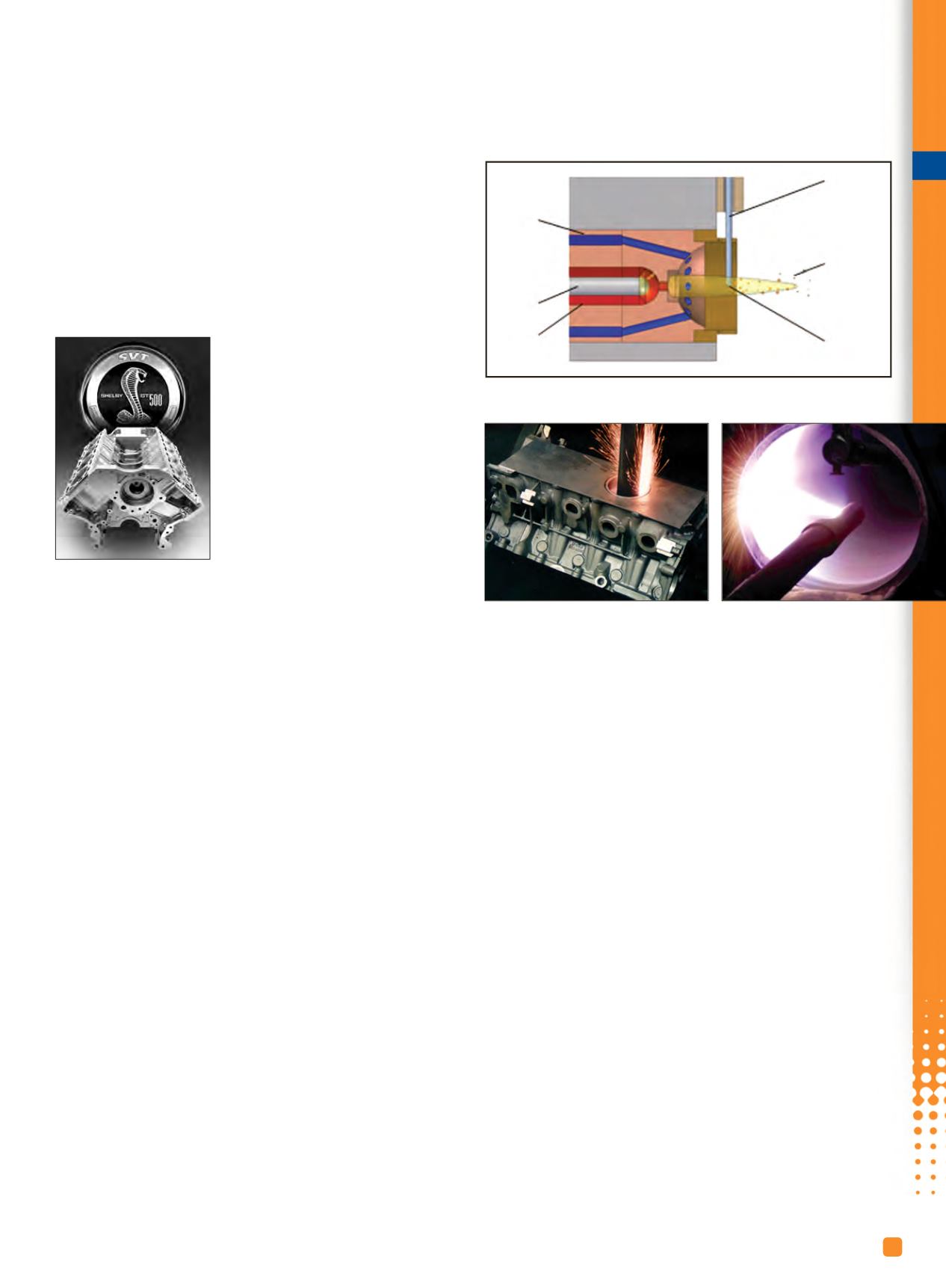
Fig. 1 —
Schematic of the plasma transferred wire arc (PTWA) torch
commercial system. Courtesy of Comau
[9]
.
Fig. 2 —
Application of ferrous materials on internal surfaces of
engine blocks by PTWA.
The new all-aluminum
engine block manufactured
by Honsel uses Ford’s
patented plasma transferred
wire arc (PTWA) cylinder
liner technology to reduce
weight and increase
efficiency.