



 48 / 50

4 8
A D V A N C E D M A T E R I A L S & P R O C E S S E S | A P R I L 2 0 1 7
3D PRINTSHOP
AEROSOL PRINTER TURNED
FOG MACHINE YIELDS
BIO-LIKE MATERIALS
Researchers at Washington State
University (WSU), Pullman, have adapt-
ed an aerosol jet printing technique to
produce free-form hierarchical struc-
tures similar to natural materials such
as bone, hair, and wood. The adapta-
tion is inspired by a weather phenome-
non called “desert roses” that produces
crystalline structures. In rare instances,
sulfide evaporants from seawater are
carried by a fog mist over hot dry des-
erts and deposited on sandy surfaces,
causing intricate formations of gypsum
or barite to grow.
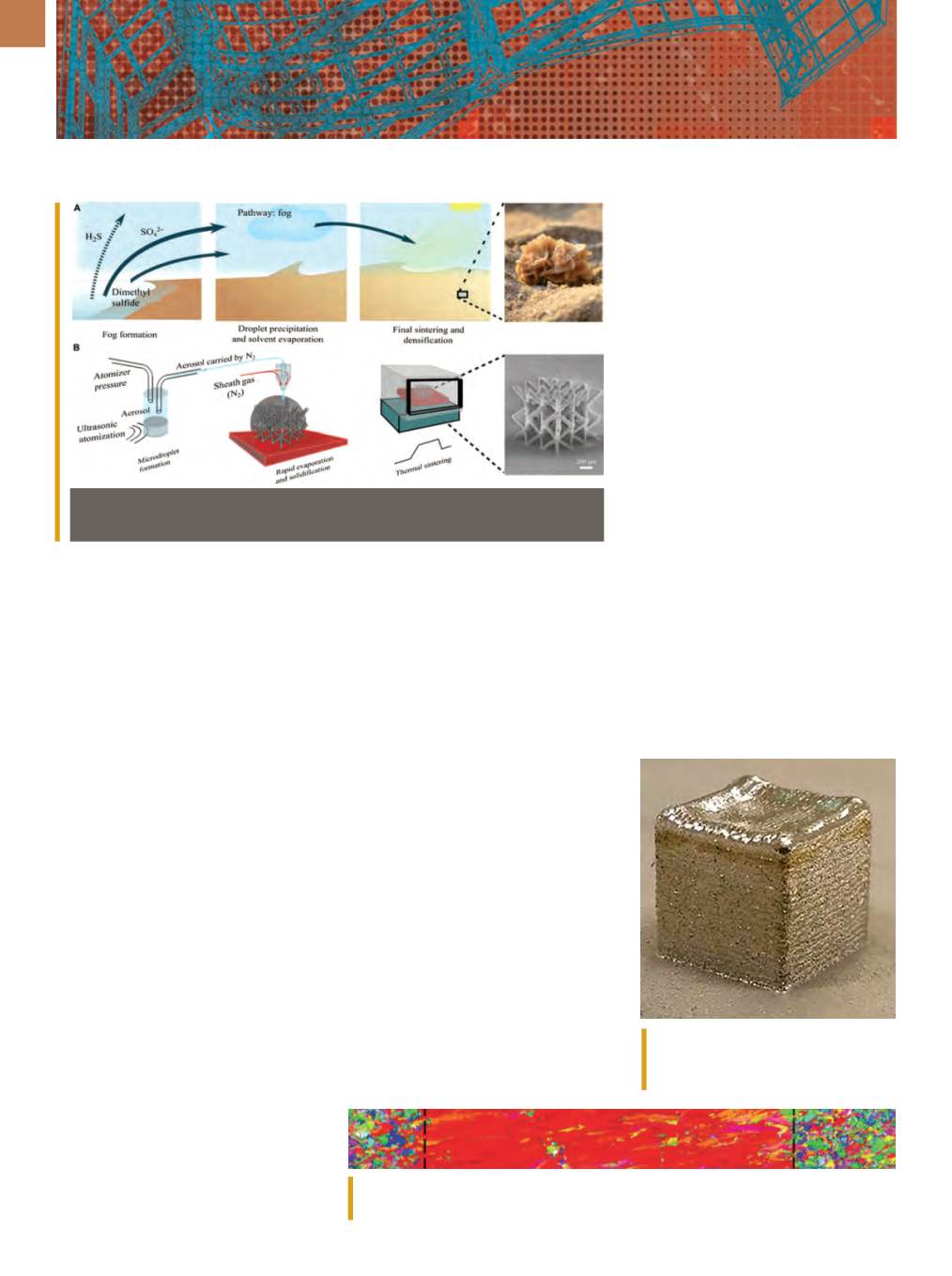
Instead of sulfides driven by des-
ert winds, however, WSU research-
ers use nitrogen gas to propel silver
nanoparticles to a hot substrate, where
they form 3D lattices that extend over
multiple length scales. The resulting
materials have a high strength-to-den-
sity ratio over a wide range of densi-
ties, occupying a previously unrealized
area on the Ashby chart. To see how the
process works, visit
https://youtu.be/ a0Oa_JjNCTI.A cube made of boron nitride and titani-
um is the first 3D structure successfully
printed from a BNNT composite.
ONE METAL, MULTIPLE
PROPERTIES
Inconel 718, a nickel-chromi-
um-base superalloy, is a preferred
material for high temperature, high
pressure applications and use in corro-
sive environments. It is also the focus
of a joint project between St. Peters-
burg Polytechnic University, Russia,
and Delft University of Technology, the
Netherlands, in which researchers are
using selective laser melting (SLM) to
create 3D structures with the properties
of two metals—in this case, two grades
of Inconel. The dual nature of themono-
lithic samples is the result of a gradient
microstructure achieved during the
build. Researchers have shown that by
varying laser energy, they can control
microstructure formation—and thus
the grade of Inconel—throughout the
sample. With this technology, specific
properties can essentially be assigned
to specific areas of a part, optimizing
performance with fewer constraints.
www.english.spbstu.ru.
FIRST SUCCESSFUL BNNT
COMPOSITE PRINT
Researchers at the Deakin Univer-
sity Institute for Frontier Materials
(IFM), Australia, achieved a milestone
by successfully printing a cube-shaped
sample from a boron nitride nanotube/
titanium (BNNT) composite. BNNTs
have a structure similar to carbon nano-
tubes that makes them ultralight and
super strong, but they are much more
heat resistant. They also have better
electrical and piezoelectric properties,
are more chemically stable, and unlike
carbon nanotubes, they can be made
transparent or dyed various colors. The
problem with BNNTs is that they are
difficult to produce in volume, render-
ing them impractical for commercial
use. IFM researchers believe they can
overcome this limitation with a scal-
able additive process compatible with
standard equipment. They now plan to
build a pilot plant where they expect to
produce BNNTs in kilogram quantities.
www.deakin.edu.au.
Variations in the microstructure of a test sample made using SLM correspond to different
grades of Inconel 718 achieved by controlling laser energy and scan rate during the build.
3D printing method inspired by a weather phenomenon produces strain resistant
materials similar in structure to bone and wood.