



 37 / 50

HIGHL IGHTS
A D V A N C E D
M A T E R I A L S
&
P R O C E S S E S |
A P R I L
2 0 1 7
3 7
WOMEN IN ENGINEERING
happy with!’” Steigauf encourages others to choose one
chapter activity and volunteer with ASM. “Stick your toe in.
You’ll find it’s fun, and you’ll develop skills you didn’t know
you had.”
EMERGING
PROFESSIONALS
Rotational Engineering Programs
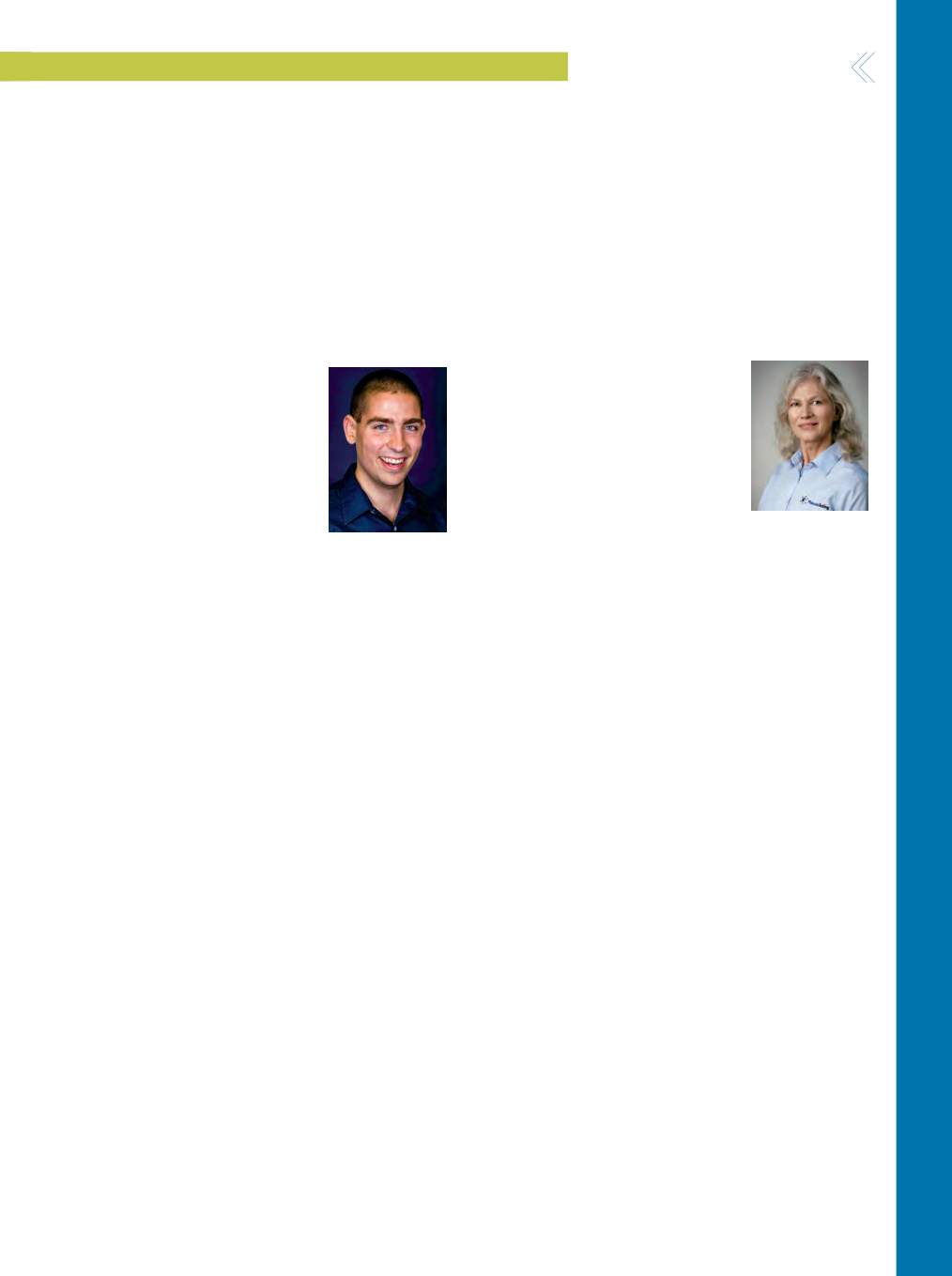
Joe DeGenova, Loop Program Metallurgist,
Ellwood Group Inc.
Today, the process of fabricat-
ing engineered products relies on
materials engineers with knowledge
of multiple processes and materials.
Traditionally, this knowledge is accu-
mulated through multiple years on the
job, and often after serving multiple
roles within a company.
While a college education pro-
vides students with access to funda-
mentals, the detailed work of a full-time job comes through
years of practice and execution. Rotational programs are
ideal for exposing young professionals to a company’s entire
product line in a short time. Although the approaches to
rotation time and structure vary from company to company,
the final product is fairly consistent—a young professional
who is well-versed in the technical aspects of a company’s
products, processes, and people.
Those who enter into rotational programs will gradu-
ate with exposure to diverse technical knowledge that takes
many engineers years to experience. In a short time, young
professionals learn the technical aspects of a company or
division, become competent enough to complete projects,
hand those over, and begin anew. Having a more intimate
knowledge of a company’s products from inception to final
application allows a materials engineer to be more for-
ward-thinking in their approach to problem-solving upon
graduation.
Additionally, the contacts and relationships one
obtains during a rotational program are invaluable. When
technical questions arise, a rotational program graduate
has a vast network of intercompany contacts with whom to
consult. While creating this network, individuals also have
ample opportunity to develop critical soft skills not widely
taught in college. Learning details of a different techni-
cal background with a new group of people every several
months necessitates development of advanced communi-
cations skills and increased workplace agility. As a result,
rotational program graduates gain excellent communica-
tions skills crucial to the success of future achievements.
Rotational programs are not for everyone. Individuals
must be willing to move frequently and learn an entire busi-
ness. Regardless, those who graduate will be well prepared
to take on the challenges of a permanent role. The exposure
to multiple technical experiences and soft skills provides an
excellent opportunity to succeed as an engineer in today’s
increasingly demanding manufacturing environment.
WOMEN IN ENGINEERING
This profile series introduces lead-
ing materials scientists from around the
world who happen to be females. Here
we speak with
Beth Matlock,
senior
materials engineer at Technology for
Energy Corp. (TEC).
What does your typical workday
look like?
My day starts early. I spend
the quieter moments tying up loose ends, planning my day,
and performing tasks that require extra concentration. I
have technical responsibility for TEC’s materials testing lab.
We are in the process of introducing MAX, a new, portable
x-ray diffraction system. I spend part of my time making
sure that MAX meets or exceeds the technical specifications,
but the majority of the day is spent working with our accred-
ited services lab. There’s never a dull moment reviewing
jobs, instructing lab personnel, and discussing results with
customers. Happily, I’m part of a great team, which makes
my job much easier. Since we use and manufacture x-ray
producing equipment, we have a state-regulated radiation
safety program. As radiation safety officer, I have the oppor-
tunity to teach andmaintain radiation safety at TEC. Luckily,
the safety systems in place minimize any radiation exposure
to our employees and customers.
What part of your job do you like most?
I have the best job in the world. I continue to learn and
grow. I have the chance to solve problems, provide base-
lines, and compare different processes for our customers.
There’s often an interesting story behind the parts that
come into our lab. Working with my customers and cowork-
ers feeds my extroverted nature. There’s enough challenges
with finding a unique approach to solving a problem that
the job is never dull. There’s also the reward of persevering
until a project is successfully completed. We see enough
variety in our lab that we don’t get bored with routines.
What is your engineering background?
My degrees are in materials engineering and materials
science. I started my career working for a metallurgical and
DeGenova
Matlock