


 54 / 58

STRESS RELIEF
5 4
3D PRINTING DINOSAUR FOSSILS
MakerBot, Brooklyn, N.Y., introduced T-Rex Skeleton, an anatomically
correct, scaled model of a full Tyrannosaurus rex skeleton. The T-Rex
lived in North America more than 65 million years ago. The giant has
long been a favorite of 3D modelers, but is difficult to sculpt and 3D print.
In addition to the T-Rex skeleton, the company also introduced a T-Rex
skull. Both fairly complex models showcase advanced sculpting and are
geared toward education, functional use, and scientific content. The
T-Rex skeleton model contains 19 files for a total of 79 pieces, which are
numbered, labeled, and come with assembly instructions.
makerbot.com.
Two new 3D printable models, a T-Rex skeleton and
a T-Rex skull, were released by MakerBot. Courtesy of Business Wire.
FIGHTING AIR POLLUTION WITH POETRY
Simon Armitage, poetry professor at the University of Sheffield, UK, collaborated with
science professor Tony Ryan to create a catalytic poem called
In Praise of Air
—printed
on material containing a formula invented at the university that is capable of purifying
its surroundings. This inexpensive technology could also be applied to billboards and
advertisements alongside congested roads to cut pollution. The 10 × 20 m (38 × 66 ft)
piece of material that the poem is printed on is coated with microscopic pollution-
eating particles of titanium dioxide, which use sunlight and oxygen to react with
nitrogen oxide pollutants and purify the air. “This poem alone will eradicate the nitrogen
oxide pollution created by about 20 cars every day,” says Ryan.
For more information:
Tony Ryan,
t.ryan@sheffield.ac.uk,
www.sheffield.ac.uk.
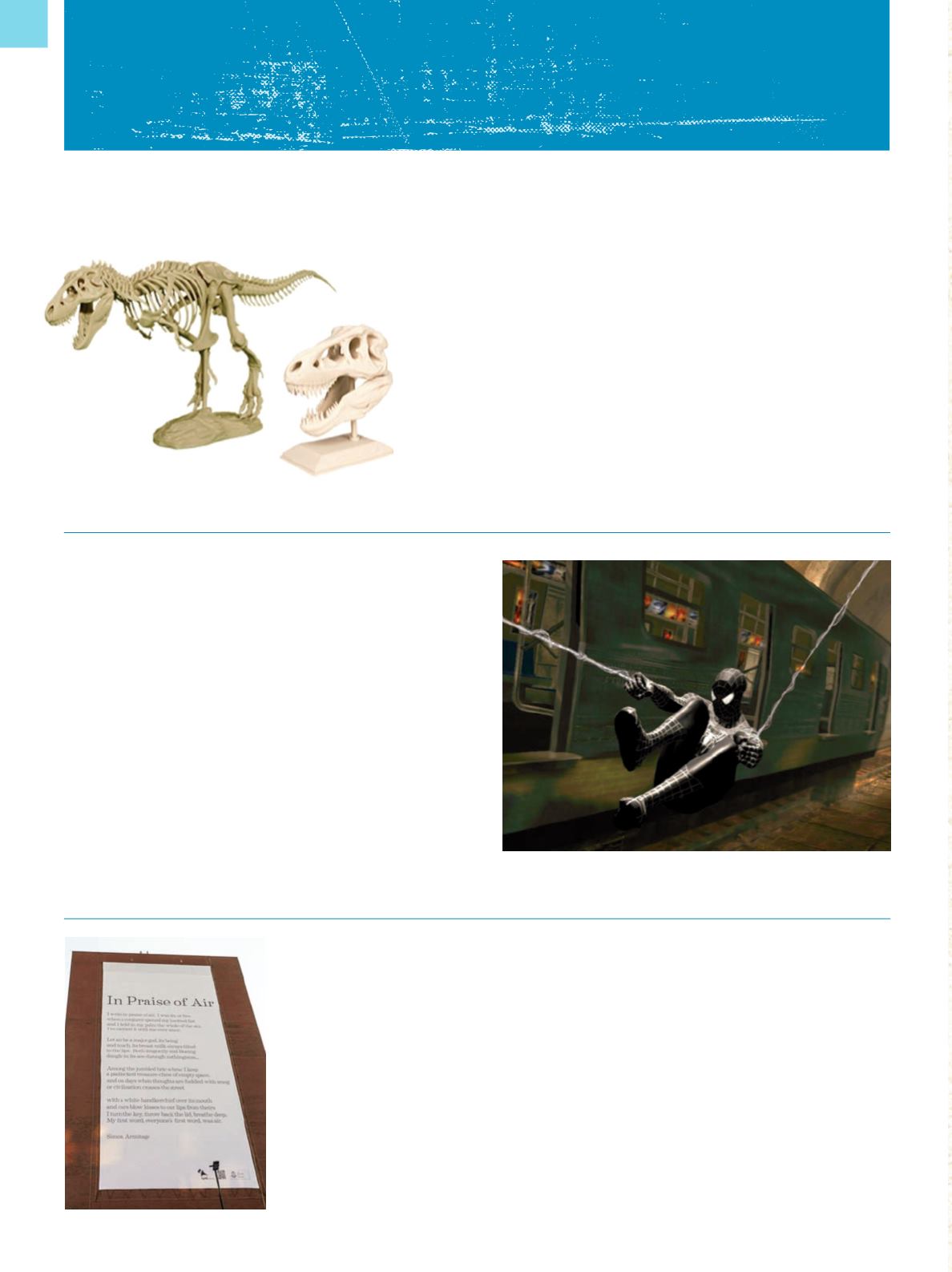
CALCULATING THE STRENGTH OF SPIDER-MAN’S WEB
Spider webs are notoriously strong, with spider silk reported as
having a tensile strength of up to 1.75 GPa. Carbon nanotubes
(CNTs) are even stronger, handling 63 GPa or more. Though
according to the 1986
Official Handbook of the Marvel Universe,
Spidey’s webs are made of a nylon-like material that can
support a measly 0.5 GPa. But can the strength of a specific
material alone account for the properties of Spidey’s web?
The structure of the web is also clearly important. But what is
the web actually made of? One hypothesis is that the web may
be made of carbon nanotubes. If so, we may see something
Spidey-esque sooner rather than later.
For more information:
Suveen Mathaudhu,
snmathau@ncsu.edu, ncsu.edu.
Cover image of Amazing Spider-Man #520 by Mike Deodato.
Courtesy of
marvel.com.
A D V A N C E D M A T E R I A L S & P R O C E S S E S | J A N U A R Y 2 0 1 5