



 60 / 62

60
Vital Statistics:
2014 is the International Year of Crystallography. According to the Inter-
national Union of Crystallography database, roughly 10,000 crystallogra-
phers worldwide are organized into national societies that support their
specialized discipline. More than 75% of these scientists use x-ray diffraction
techniques to reveal and determine the structures of solids, liquids, and
molecules at the atomic level. This data enables a systematic understanding of
the chemical and physical properties of inorganic materials
and the biological functions of macromolecules.
Approximately 900,000 atomic structures are known for
inorganic materials, while only about 100,000 protein molecules are
currently defined. Major crystallographic databases are growing by
50,000 entries per year and determining the structure of macro-
molecules is today’s critical research frontier: Current esti-
mates state that the human body contains more than
two million types encoded by just 20,000 to
25,000 genes, and understanding these
structures is vital to future medical progress.
Success Factors:
The federal Science, Technology, Engineering,
and Mathematics (STEM) education five-year strate-
gic plan states that generating more STEM
professionals is a national priority. Yet not
enough students are graduatingwith the right
skills to fill available positions. Part of the problem is a lack of teaching tools to
keep scientific concepts interesting and relevant for students. As one approach,
hands-on physical models are proven to enhance learning compared to 2D pic-
tures of complex 3D information. As a disruptivemethod, 3Dprinting holds prom-
ise for communicating spatial information in a memorable and meaningful way.
Crystallographic data is created in the
crystallographic information file
(.cif) format.
However, this file format is not widely accessible. As part of a new collaboration to improve
the situation, Werner Kaminsky, a staff crystallographer at the University of Washington, cre-
ated programs that can read .cif file information and convert it to the .stl format for 3D printing.
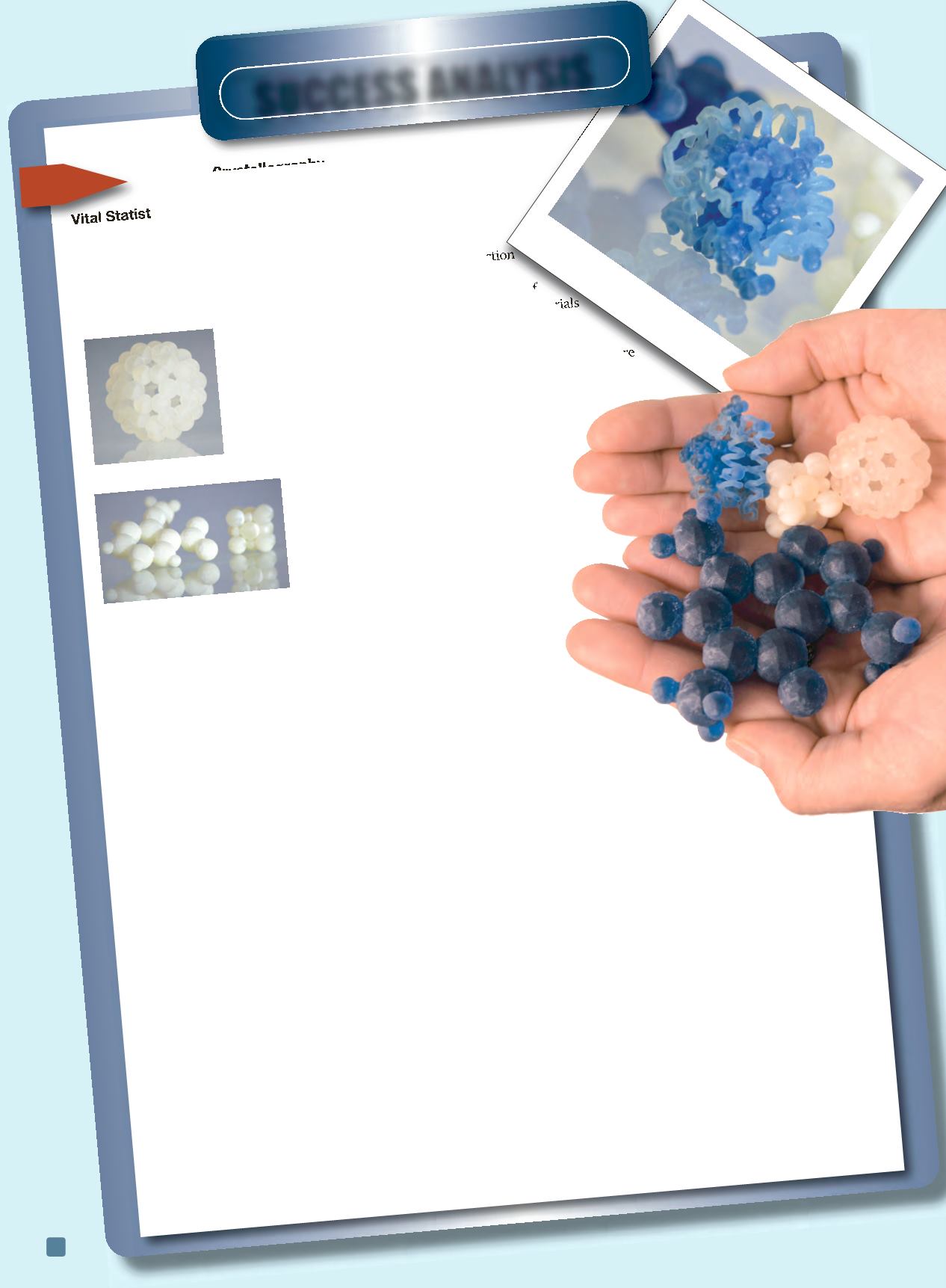
Numerous molecular models of crystal structures have been created using these tools. Models of caf-
feine, salt, sugar, aspirin, nicotine, and beer hops have all been successfully printed and used as teaching
aids, as well as more complex structures such as myogoblin.
These models are being displayed at numerous conferences including the grand opening of the Inter-
national Year of Crystallography in Place de Fontenoy, Paris, and the recent STEM Expo inWashington.
About the Innovators:
Peter Moeck, an applied crystallographer, studied in Leipzig and Berlin and is now at Portland State
University’s physics department. Werner Kaminsky studied at the Institut für Kristallographie and is
now a research professor and staff crystallographer at the University of Washington. Trevor Snyder,
who studied at Washington State University, worked on 2D printer development for Tektronix and
Xerox and is now principal scientist for 3D Systems Inc. Jennifer Stone-Sundberg studied at Oregon
State University and is now working with Portland State University on projects related to crystal
growth and science education.
What’s Next:
The collaborators are now focusing on three main objectives: Organizing files into a worldwide database; developing
educational modules to supplement 3D printed molecules for K-16 learning; and making these models and modules avail-
able for all fields of study—including art, science, math, and physics—for all education levels.
Contact Details:
T
revor Synder, Principal Scientist
3D Systems Inc.503.685.2576,
trevor.snyder@3dsystems.com, 3dsystems.com
Hemoglobin molecule in backbone
representation.
ADVANCED MATERIALS & PROCESSES •
AUGUST 2014
3D Printed Crystallography
Specimen
Name:
SucceSS AnAlySiS
C
60
molecule.
Models of caffeine and
salt molecules.
Handful of 3D
printed
crystallography
pieces. All
models shown
here were made
using the ProJet
3500 3D printer
from 3D Systems.