


 60 / 62

A D V A N C E D M A T E R I A L S & P R O C E S S E S | F E B R U A R Y 2 0 1 6
6 0
NEW RESIN ENABLES CERAMIC PARTS PRINTING
3D PRINTSHOP
S
cientists at HRL Laboratories LLC,
Malibu, Calif., report a new mile-
stone in 3D printing technology
by demonstrating an approach to ad-
ditively manufacture ceramics. They
say the method overcomes the limits of
traditional ceramic processing and en-
ables high temperature, high strength
components. Zak Eckel and Chaoyin
Zhou invented a resin formulation that
can be printed into parts of virtually
any shape and size. The printed resin
can then be fired, converting it into a
high strength, fully dense ceramic. The
resulting material withstands ultrahigh
temperatures in excess of 1700°C and
exhibits strength 10 times higher than
similar materials. Ceramics are more
difficult to process than polymers or
metals because they cannot be cast or
machined easily. Ceramic parts are tra-
ditionally consolidated from powders
by sintering, which introduces porosity
and limits both achievable shapes and
final strength.
“With our new 3D printing process,
we can take full advantage of the many
desirable properties of this silicon oxy-
carbide ceramic, including high hard-
ness, strength, and temperature capa-
bility as well as resistance to abrasion
and corrosion,” says program manager
Tobias Schaedler. The process could
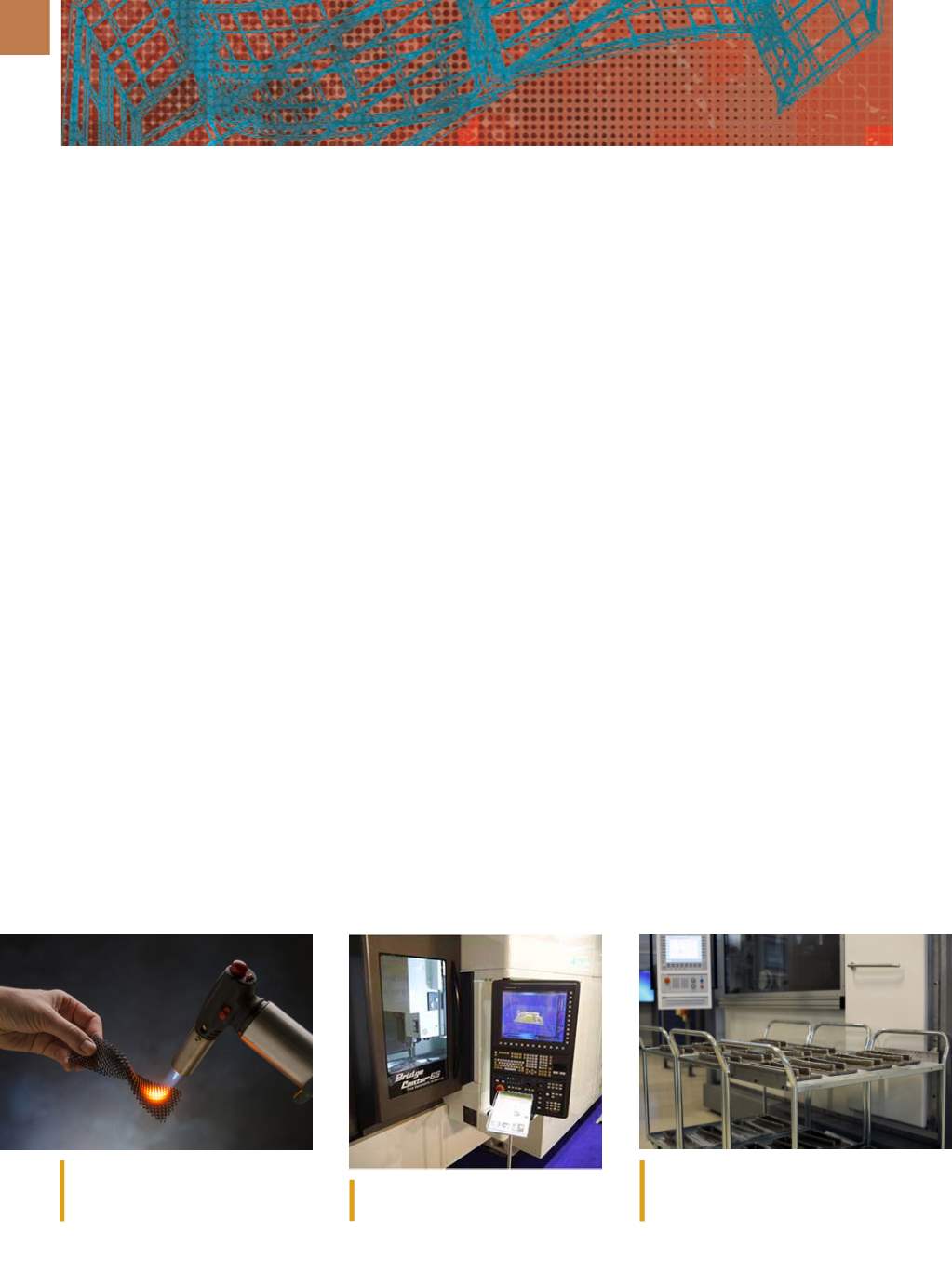
A new ceramic resin can be 3D printed
into parts of any size. Courtesy of HRL
Labs/Dan Little Photography.
be used in applications ranging from
large components in jet engines to in-
tricate parts in electronic device pack-
aging. HRL, a corporate R&D laboratory
owned by The Boeing Co. and General
Motors, is seeking a commercialization
partner for this technology.
For more
information: 310.317.5000,
innovation@ hrl.com,
www.hrl.com.INTELLIGENT MACHINE TOOL
MAKES DECISIONS
A research group at Kobe Univer-
sity Graduate School of Engineering,
Japan, developed a prototype ma-
chine tool that works like a 3D printer
to manufacture metal components.
Traditional metal cutting machine
tools follow preprogrammed instruc-
tions, which require extensive labor
to develop. In addition, the machines
cannot make adjustments on the fly
or respond to unforeseen issues. Com-
ponents can also be made with metal
3D printers, but drawbacks include
the need for expensive metal powders
as base materials and poor quality of
finished surfaces, which require addi-
tional work.
The Kobe prototype moves away
from rigid instructions and instead en-
trusts the machine tool to figure out
operational details. Based on both a
3D model and a material model of the
component, the tool determines the
optimum machining process using a
database of machining information
and cutting conditions. The team says
this development could pave the way
for intelligent manufacturing systems,
reduced costs, and faster production
cycles.
www.eng.kobe-u.ac.jp/en.
NORSK TITANIUM ACHIEVES
TRL 8 STATUS
Norsk Titanium AS, Norway, re-
cently achieved Technology Readiness
Level Eight (TRL 8) by concluding a test
plan coordinated through the Feder-
al Aviation Administration, which be-
gan in September 2012. Results of the
multiyear testing campaign conducted
by Westmoreland Mechanical Testing &
Research Inc., Youngstown, Pa., demon-
strate that Norsk’s rapid plasma depo-
sition titanium parts meet demanding
aerospace requirements. Parts can now
be supplied to aerospace and defense
manufacturers for final certification
and airframe integration. Delivery of
commercial aviation qualification parts
is underway, with the first approvals
expected in early 2016. Full commercial
production of titanium aerospace com-
ponents is expected by the second half
of 2016.
norsktitanium.com.
Intelligent machine tool prototype.
Courtesy of Kobe University.
Norsk Titanium’s additively manufac-
tured structural parts await final qualifica-
tion testing. Courtesy of Business Wire.