


 64 / 70

HIGHL IGHTS
A D V A N C E D M A T E R I A L S & P R O C E S S E S | J U L Y / A U G U S T 2 0 1 5
6 4
MEMBERS IN THE NEWS
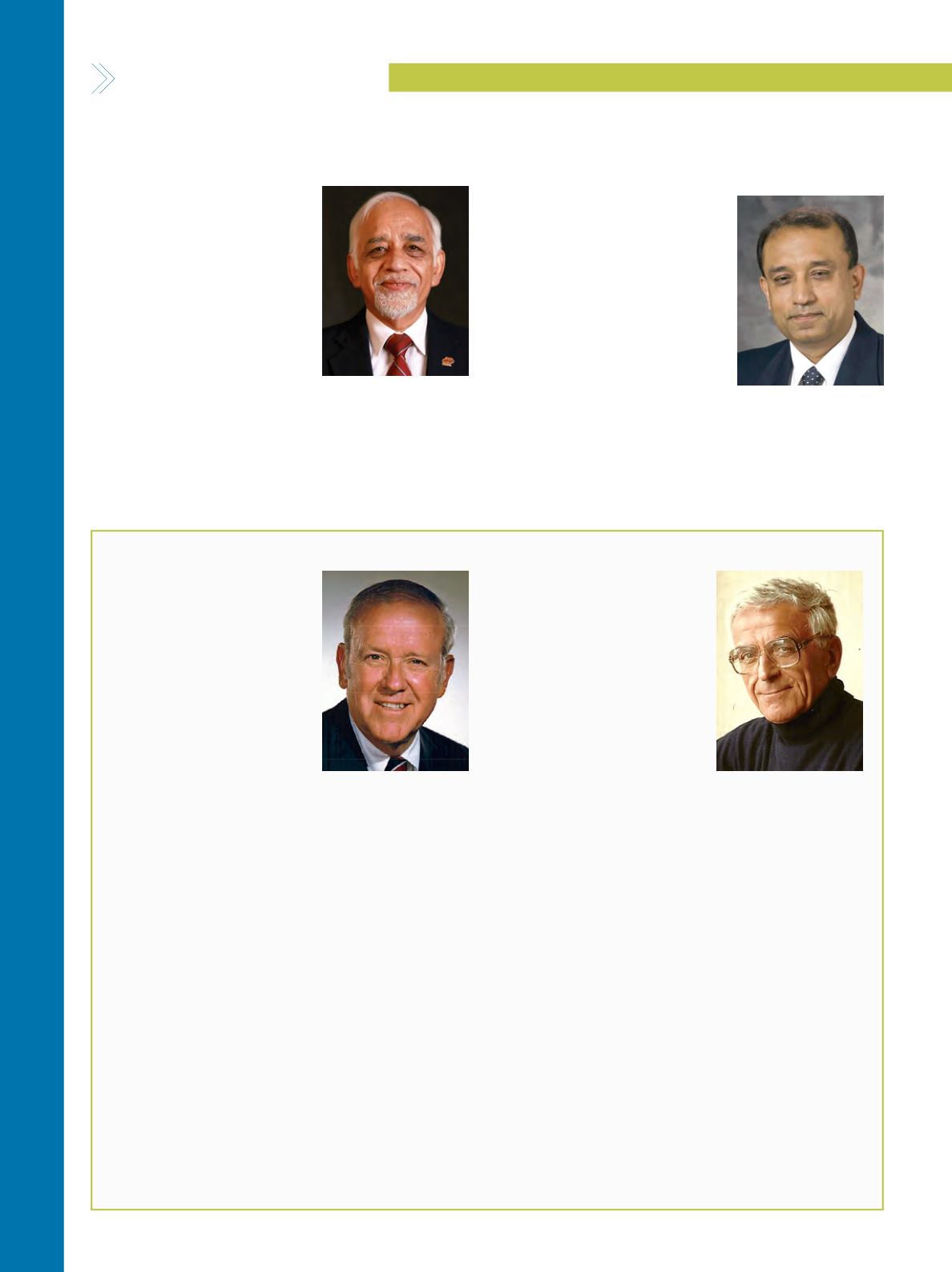
Singh Recognized by National
Academy of Inventors
On March 20,
Raj Singh,
FASM,
Williams Distinguished
Chair Professor and Head of the
School of Materials Science and
Engineering at Oklahoma State
University, was inducted as a Fel-
low of the National Academy of
Inventors by the Deputy U.S. Com-
missioner for Patent Operations
from the U.S. Patent and Trade-
mark Office. Singh’s inventions have been used in the de-
velopment of many products such as ceramic matrix com-
posites for more efficient aircraft engines, more powerful
sodium-sulfur batteries utilized for energy storage systems,
and novel electrolyte retainers and self-repairing glasses for
molten carbonate and solid oxide fuel cells.
Sridharan Inducted into Institute of
Materials, Minerals, and Mining
Kumar Sridharan, FASM,
distinguished research professor
in the departments of engineer-
ing physics and materials science
and engineering, University of
Wisconsin-Madison, was inducted
as a Fellow of the Institute of Ma-
terials, Minerals, and Mining, UK,
in recognition of his contributions
to materials science and applica-
tions, and education.
Vander Voort Teaches in Spain and Russia
George Vander Voort, FASM,
presented a two-day
seminar on the metallographic characterization of steels
at the Arcelor-Mittal steel plant in Aviles, Spain. He also
IN MEMORIAM
GeorgeHarwoodBodeen,
FASM,
ASM past president,
passed away on May 21 at age
91. Born in Chicago on March
31, 1924, Bodeen graduated
from Amundsen High School
in June 1941 and was accepted
to Northwestern University’s
engineering school. After his
father’s sudden passing, he be-
came the primary provider for
his family at age 17. He withdrew from school and took
a position with Teletype Corp., enlisting in the U.S. Army
Air Corps in 1943. He served as a navigator/bombardier
as well as a radar operator on B-17s and B-24s. Follow-
ing the war, he was again accepted to Northwestern on
the G.I. Bill, graduating with a B.S. in 1949. He began his
career with Neenah Foundry and then went to Lindberg
Steel Treating Co. Bodeen attended night school at North-
western to earn his master’s degree in materials science
(1970). He later became president, chairman, and CEO of
Lindberg, shepherding the company’s growth from a re-
gional heat treating company to the largest commercial
heat treater in North America. One of Bodeen’s major
achievements was the successful processing of solid rock-
et fuel motor cases for the Minuteman and other missile
programs. Bodeen was the founding president of the ASM
Heat Treating Society, and the George H. Bodeen Heat
Treating Achievement Award was established in his honor
in 1997. He was a humble, compassionate, and energetic
man who made everyone smile when they saw him.
Edward Epremian, FASM,
died on November 11, 2014, at
age 93. Graduating from MIT in
1943 with a degree in metallurgy,
he soon went to work for Gen-
eral Electric in his home town of
Schenectady, N.Y. While at GE he
was awarded patents for alloys
he developed for the turbosu-
perchargers that enabled U.S.
bombers to fly at higher alti-
tudes, and for the first military jet engines. After receiv-
ing his doctorate from Carnegie Institute of Technology
in 1951, he joined the Office of Naval Research as a sci-
entific liaison in England and Western Europe. Returning
to the U.S. in 1954, he served for four years as chief of the
metals and materials branch of the Atomic Energy Com-
mission. Moving to private industry, he worked for Union
Carbide Corp. in a variety of research and management
positions. In the 1960s, Epremian headed the division that
developed and introduced the first carbon fibers for use in
composite materials. In the 1970s, he returned to public
service, joining the National Research Council of the Na-
tional Academy of Sciences, followed by two years with
the United Nations Industrial Development Organization
as special assistant to the Director General.